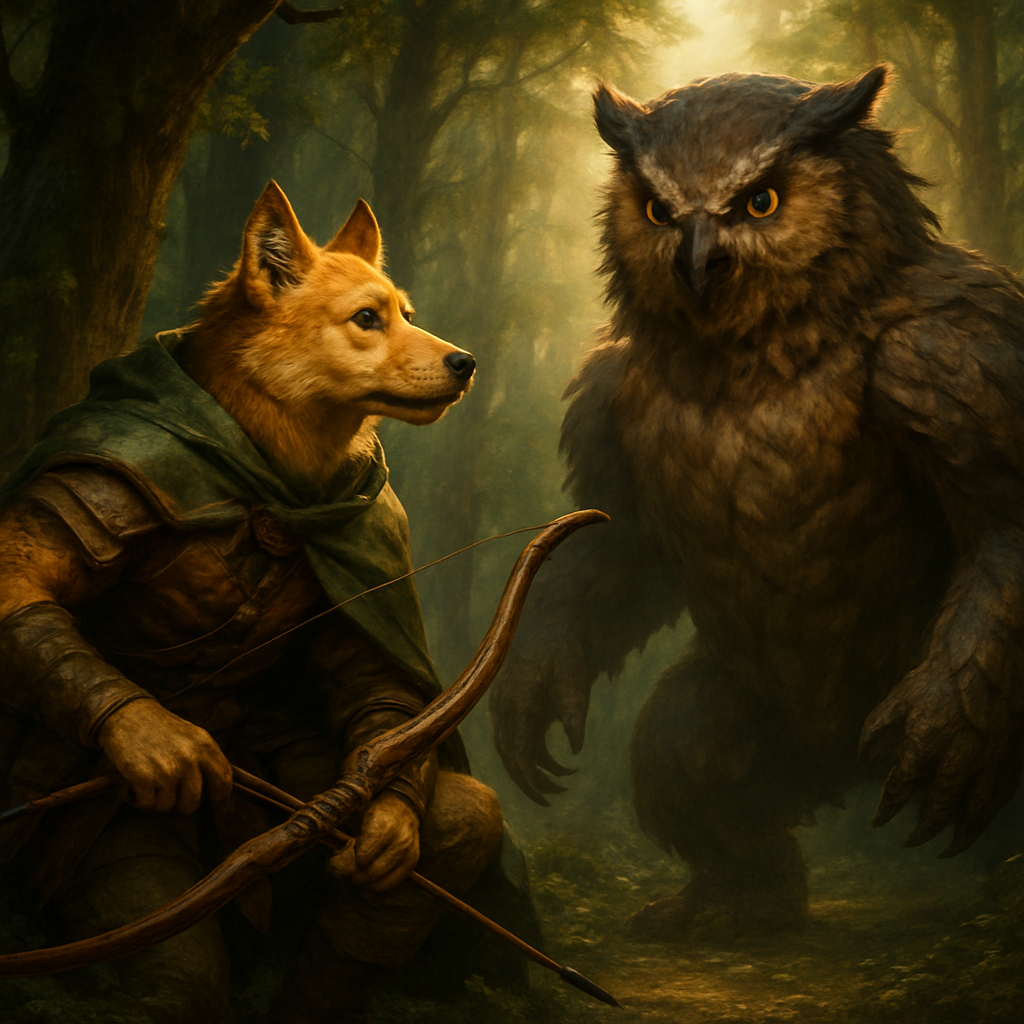
I spent three months running a solo campaign where my character's only companion was a stray dog she picked up in session two. That dog—a scrappy terrier mix I named Scraps—ended up saving her life twice, detected more traps than she ever could, and had better survival instincts than any NPC I'd written. By session twelve, I realized Scraps had more personality than my actual character.
The thing is, our pets are already adventurers. They're brave, loyal, weirdly intuitive, and occasionally stupid in exactly the ways that make great D&D moments. So why not turn your pet into a D&D character—a real one, with stats and abilities and a character sheet you can actually play?
Here's how to do it, whether you're homebrewing from scratch or using tools that do the heavy lifting for you.
Why Your Pet Makes a Perfect D&D Character
Let's be honest: your golden retriever has more charisma than most bards. Your cat has higher dexterity than any rogue. And if you have a livestock guardian dog, that's a paladin. They're already playing a class.
Pets have personalities we know inside and out. We know their quirks, their fears, what makes them bolt or stand their ground. That's characterization most players spend sessions trying to figure out. You already have it. You just need to translate "steals socks" into "kleptomaniac tendencies" and "barks at the mail carrier" into "sworn enemy of the Postal Guild."
The best part? Pets are heroic without trying. They're loyal to a fault. They charge into danger for the people they love. They're curious, food-motivated, and occasionally make terrible decisions that somehow work out. That's D&D energy.
Step One: Pick a Class That Fits Their Personality
This is where you translate real-world behavior into game mechanics. Think about what your pet actually does, not what they look like.
- Rangers: Dogs who love the outdoors, natural trackers, loyal companions. Border collies, hounds, any working breed.
- Rogues: Cats. Just... cats. Sneaky, selfish, absurdly good at getting where they shouldn't be.
- Barbarians: Big dogs with zoomies. Bulldogs, mastiffs, any dog that plays like they're trying to tackle a linebacker.
- Druids: Animals who seem weirdly in tune with nature. That chicken who knows when it's about to rain. The cat who always finds the one sunny spot.
- Paladins: Protective, noble, self-important. Livestock guardians, German shepherds, any pet who thinks their job is to defend the household.
- Bards: Loud, charismatic, desperate for attention. Huskies. Parrots. That one cat who yells at 3 AM for no reason.
- Monks: Cats again, but the calm ones. Precise, patient, disturbingly good at knocking things off tables with perfect accuracy.
My border collie, Maggie, is 100% a ranger. She's got the focus, the work ethic, and the "I'm scanning the horizon for threats at all times" energy. If she were in a campaign, she'd multiclass into something anxiety-driven, like a divination wizard who sees danger everywhere.
Step Two: Write Their Backstory (It's Already There)
Your pet's real history is their backstory. You just need to fantasy it up.
Rescue dog? They're a survivor. Lone wanderer who learned to trust again after a dark past. Maybe they were a soldier separated from their unit. Maybe they escaped captivity. The scars (literal or behavioral) are part of the character.
Purebred from a breeder? Noble lineage. They were raised in a manor, trained for a specific role, and left to seek adventure (or got kicked out for being too much of a handful).
Adopted as a kitten? Street urchin. Scrappy, resourceful, learned to survive on charm and cunning.
Farm animal? They're a laborer turned hero. Goats are barbarians who've seen some things. Horses are mounts who got tired of carrying other people's glory and decided to earn their own. Chickens are... honestly, chickens are chaos warlocks. There's no other explanation.
Take the real story—how you met them, what they've been through—and give it a fantasy coat of paint. That's a character hook.
Step Three: Assign Stats Based on What They're Actually Good At
This is where you get mechanical. Think about your pet's real strengths and weaknesses.
- Strength: Can they drag something heavy? Do they win tug-of-war? High STR.
- Dexterity: Are they fast, agile, good at squeezing into tight spaces? High DEX.
- Constitution: Are they tough? Do they bounce back from injuries? Eat things they shouldn't and survive? High CON.
- Intelligence: Do they problem-solve? Open doors, figure out puzzles, outsmart you? High INT.
- Wisdom: Are they perceptive? Do they notice things before you do? Sense when you're upset? High WIS.
- Charisma: Are they charming? Do strangers love them? Can they manipulate you into extra treats? High CHA.
Most pets are going to have high WIS (they notice everything) and high CON (they're surprisingly resilient). Cats tend toward high DEX and CHA. Dogs skew STR and CON. But every pet is different. My old barn cat, Biscuit, had 8 CHA and 18 WIS. He was ugly, antisocial, and could predict weather better than any farmer.
Step Four: Pick Abilities That Match Their Quirks
This is the fun part. Your pet's weird habits become class features.
Does your dog alert you to every sound? That's the ranger's Keen Hearing. Do they steal food off counters? Sleight of Hand proficiency. Does your cat parkour off furniture? Feline Agility. Does your parrot repeat everything? They're a bard with Cutting Words.
Think about the stuff your pet does that's funny, annoying, or genuinely impressive. That's their kit.
- Loyal to a fault: Give them Pack Tactics or an ability that buffs allies.
- Food-motivated: Advantage on checks if food is involved.
- Easily distracted: Disadvantage on Perception checks when squirrels are present.
- Protective: Reaction to impose disadvantage on attacks against allies.
- Escape artist: Expertise in Acrobatics or proficiency with thieves' tools.
Make them playable but specific. The quirks are what make them memorable.
Step Five: Get Art That Actually Looks Like Them
Here's where most homebrew pet characters fall apart. You've got the stats, the backstory, the personality—but the art is just a generic dog or a stock photo of a cat in a wizard hat.
If you want your pet to feel like a real character, you need art that captures them. Not a random animal. Your animal.
This used to mean commissioning an artist (expensive, slow) or awkwardly photoshopping armor onto a photo of your dog (it never looks good). But there's a faster way now: Creature Forge AI's character generator lets you upload an actual photo of your pet and it builds a fantasy character that looks like them. I uploaded a photo of Maggie—my border collie—and got back a ranger in leather armor with her exact coloring, her alert posture, her "I'm working even when I'm resting" expression. It wasn't generic dog art. It was her.
That's the difference between "I made a character based on my pet" and "I turned my pet into a D&D character." The art sells it.
Step Six: Playtest Them (Solo or With a Group)
Once you've got your pet statted up, run them through a session. Solo play is great for this—you can test their abilities, see what feels right, adjust on the fly.
I ran Maggie through a quick encounter with some goblins. Her high Perception caught their ambush. Her Survival proficiency tracked them back to their camp. Her terrible CHA meant she couldn't intimidate anyone, which felt accurate. She's a good dog, but she's not exactly threatening.
If something feels off, tweak it. Maybe your cat's DEX is too high and they're untouchable. Maybe your dog's STR isn't pulling its weight. Adjust until they feel like the pet you know.
When to Actually Play Them
Some campaigns, your pet character is the main PC. Other times, they're a sidekick, a companion, or an NPC the party adopts. All of those work.
If you're playing solo, they're perfect as a main character. You already know their voice, their motivations, their boundaries. You're not trying to figure out who they are—you're exploring how they'd handle a dungeon.
In a group, they work best as a sidekick or a beloved NPC. The ranger's animal companion who's secretly the brains of the operation. The tavern cat who's been there longer than the barkeep and knows everyone's secrets. The retired war horse who agrees to one last adventure.
Don't force them into a party if it doesn't fit. But if there's space for a loyal, quirky, deeply personal character? Your pet's already auditioning.
Why This Matters More Than You Think
Turning your pet into a D&D character isn't just a gimmick. It's a way to honor the relationship you have with them. It's storytelling that pulls from something real.
Every time I play a character based on one of my animals, I'm reminded why I love them. I'm playing out the version of them that's brave and capable and gets to be the hero. And when you're sitting alone at a table at midnight, rolling dice for a character who's based on the dog asleep at your feet? That's connection. That's why we play.
Start Building Your Pet's Character
You don't need to be a game designer to turn your pet into a D&D character. You just need to know them, translate their quirks into mechanics, and give them a world where those quirks matter.
If you want to skip the manual work—or if you just want to see your pet rendered as a fantasy hero—try Creature Forge AI. Upload a photo, pick a class, and let it build the character for you. You'll get stats, abilities, and art that actually looks like your companion. It's faster than homebrewing from scratch, and honestly? It's more fun to see your dog staring back at you in full adventurer gear.
Your pet's already a hero. Give them the character sheet to prove it.