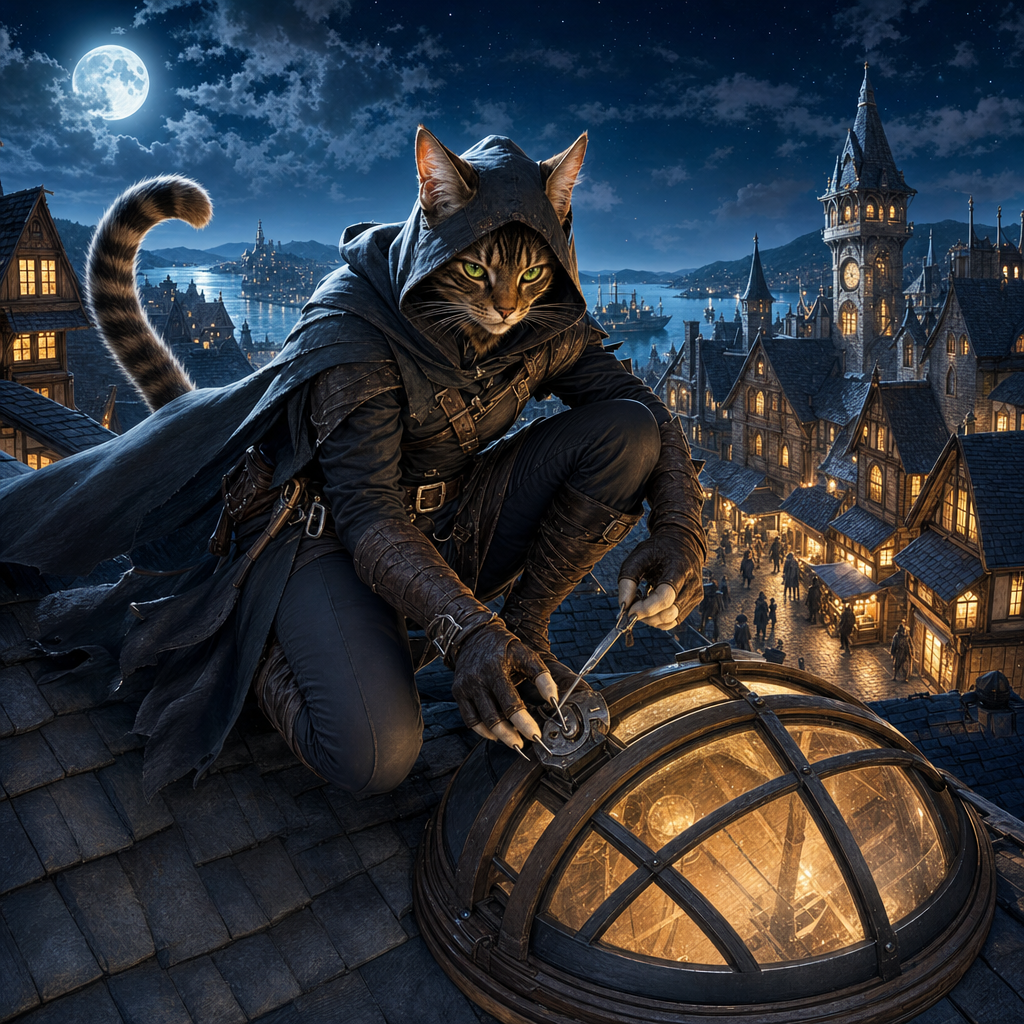
I grew up with barn cats. Not the kind you cuddle — the kind that tolerate your existence while they patrol the property like tiny, judgmental sheriffs. My favorite was a gray tabby named Smokey who sat on the fence post every morning at dawn, surveying his kingdom with the calm authority of a king who knows his subjects fear him.
Years later, during one of my late-night solo campaigns, I realized something: Smokey would have made an incredible D&D character. The independence. The calculated risk-taking. That look he'd give you before knocking your coffee mug off the table — pure chaotic neutral energy.
So I started wondering: what if you could actually turn your cat into a D&D character? Not just mechanically, but capture their actual personality, their look, their essence in a character sheet? Turns out, you absolutely can — and it's one of the most fun exercises in character creation I've stumbled into.
Why Your Cat Makes the Perfect D&D Character
Cats are already living their best fantasy lives. They've got:
- Natural stealth: You've seen them disappear into thin air when the vet carrier comes out
- Unpredictable alignment: Lawful one moment, chaos incarnate the next
- Main character syndrome: Every cat believes the world revolves around them (and honestly, they're not wrong)
- Distinct personalities: No two cats are alike, which makes for compelling roleplay
- Built-in quirks: That weird thing your cat does at 3am? Perfect character trait
The challenge isn't whether your cat deserves to be a character — it's translating their real-world presence into game mechanics that feel right.
Step 1: Choose the Right Race
The obvious choice is Tabaxi — the cat-folk race that's literally built for this. Tabaxi get Feline Agility (perfect for that burst of speed when your cat suddenly zooms across the house), Darkvision, and proficiency in Perception and Stealth. They're charismatic, curious, and obsessed with collecting things. Sound familiar?
But don't limit yourself. Consider:
- Aarakocra: For cats who climb everything and think they can fly
- Halfling: Small, lucky, and perpetually underfoot
- Changeling: For cats with multiple personalities depending on who's holding the treat bag
- Warforged: For that one cat who's emotionally unavailable and seems genuinely confused by affection
My barn cat Smokey? Definitely Tabaxi. But my sister's chonky orange tabby who falls off furniture and still lands in the food bowl? Halfling all the way.
Step 2: Match Class to Personality
This is where you really turn your cat into a D&D character instead of just making a generic feline. Watch your cat for a day and take notes:
The Rogue
Does your cat:
- Knock things off tables for the pure chaos of it?
- Steal food when you're not looking?
- Have hiding spots you've never found?
- Move in complete silence until they want something?
Congrats, you've got an Arcane Trickster or Thief on your hands.
The Ranger
Outdoor cat? Hunter? Brings you "gifts" of questionable origin? The Ranger's bond with nature and favored enemy feature (probably Birds or Vermin) fits perfectly. Beast Master if they've somehow befriended the neighborhood raccoon.
The Monk
Cats are already unarmed strikers. If your cat does that thing where they tap you with increasing force until you wake up, that's Flurry of Blows. The whole "landing on their feet" thing? Slow Fall. The sudden bursts of energy? Step of the Wind.
The Warlock
Every cat has a patron — you, the treat-giver. They've formed a pact in exchange for food and shelter, and in return they grant you the occasional headbutt. Pact of the Chain seems redundant when the warlock IS the familiar.
The Barbarian
For cats who go from zero to full zoomies in 0.5 seconds. Rage represents that moment when they puff up to twice their size over absolutely nothing. Unarmored Defense is just their natural floof.
Step 3: Build the Stats (Honestly)
Here's where it gets fun. Don't just make your cat perfect — make them accurate:
- Strength: Can they open doors? Jump to high places? Or do they struggle with a paper bag? (Smokey: 8. He was tactical, not muscular.)
- Dexterity: Most cats are rocking 16+ here. Unless they're the clumsy one. You know the one.
- Constitution: How many lives has this cat used already? Outdoor cats tend higher.
- Intelligence: Does your cat solve problems or just yell at them? Big range here.
- Wisdom: Perception should be high (they notice everything), but Insight? Does your cat understand cause and effect, or do they keep trying to fit in the same too-small box?
- Charisma: Does your cat charm everyone they meet, or hide from strangers? Barn cats typically dump stat this.
Step 4: The Game-Changer — Upload Their Photo
This is where I fell down a rabbit hole I didn't see coming. I'd built Smokey as a Tabaxi Ranger on paper, but he didn't feel real until I used Creature Forge AI's character generator. The tool lets you upload an actual photo of your cat, and it builds a character design that genuinely looks like them.
I uploaded an old photo of Smokey from the farm — this grainy shot of him mid-prowl in the barn — and what came back was a Tabaxi ranger with his exact markings, that same lean build, those calculating eyes. It wasn't just "a gray cat person." It was him, but with armor and a bow.
Suddenly the character clicked. I could see him in my campaign, taking watch on night shifts, speaking rarely but with precision, judging the party's choices from the shadows.
The photo upload feature works because cats already have such distinct looks. That one white paw. The notch in their ear. The particular pattern on their face. Those details carry over, and they matter.
Step 5: Nail the Personality and Background
Your cat has given you years of character development material. Use it:
Personality Traits
- "I trust no one until they prove themselves — repeatedly."
- "If I fits, I sits, regardless of whether it's tactically sound."
- "I always land on my feet. Literally. It's unnerving."
- "Three hours ago I wanted nothing to do with you. Now I require immediate lap access."
Ideals
- Independence: "I work with the group because it serves my interests, not because I need them."
- Curiosity: "Every closed door is an insult. Every box must be investigated."
- Comfort: "The best treasure is a warm sunbeam and regular meals."
Bonds
- "There's one person I've claimed as mine. I'll tolerate others for their sake."
- "This one specific spot in the tavern is MY spot. Fight me."
- "I once survived [real thing your cat survived]. I'm never that vulnerable again."
Flaws
- "I knock things over when I'm bored. I'm bored a lot."
- "I'm easily distracted by small moving objects."
- "I require exactly four pets — no more, no less — before I bite."
Step 6: Add the Quirks That Make Them Real
This is what separates "a cat character" from your cat character:
- Does your cat chirp at birds? They make strange clicking sounds when tracking prey.
- Do they have a favorite toy? They carry a specific threadbare mouse everywhere "for luck."
- Do they knead biscuits? They perform a small ritual before resting, pressing their paws methodically against their bedroll.
- Do they headbutt for affection? Their primary expression of trust is a forehead bump, which confuses other party members.
- Are they food-motivated? They will absolutely prioritize looting rations over healing potions.
Smokey used to bring me dead mice and drop them at the door like an offering. His D&D version leaves "gifts" of defeated enemy weapons at his patron's tent. Same energy, different context.
Playing Your Cat Character
Here's the thing about actually turning your cat into a D&D character — they're bizarrely fun to roleplay because you already know them inside and out.
You know how they react to stress (hide, puff up, or attack). You know their priorities (food, safety, comfort, chaos). You know their relationship with authority (lol). You don't have to invent their voice — you've been interpreting their meows for years.
In my solo campaigns, Smokey-the-Tabaxi became this reliable, unsentimental ranger who kept the party alive through sheer competence and zero emotional investment. He was tactical. Patient. Occasionally brought them useful intelligence and always acted like it was no big deal.
Which is exactly how barn cat Smokey operated. The character worked because he was true.
Make It Happen
Your cat is already the main character of their own story. They've got the attitude, the moves, and the unshakeable confidence that they're the most important being in any room.
Now they can have the character sheet to prove it.
If you want to see what your cat looks like as an actual D&D character — markings, personality, and all — try Creature Forge AI. Upload their photo, choose their class, and watch them transform into the adventurer they were always meant to be.
Smokey would absolutely approve. Though he'd never admit it.