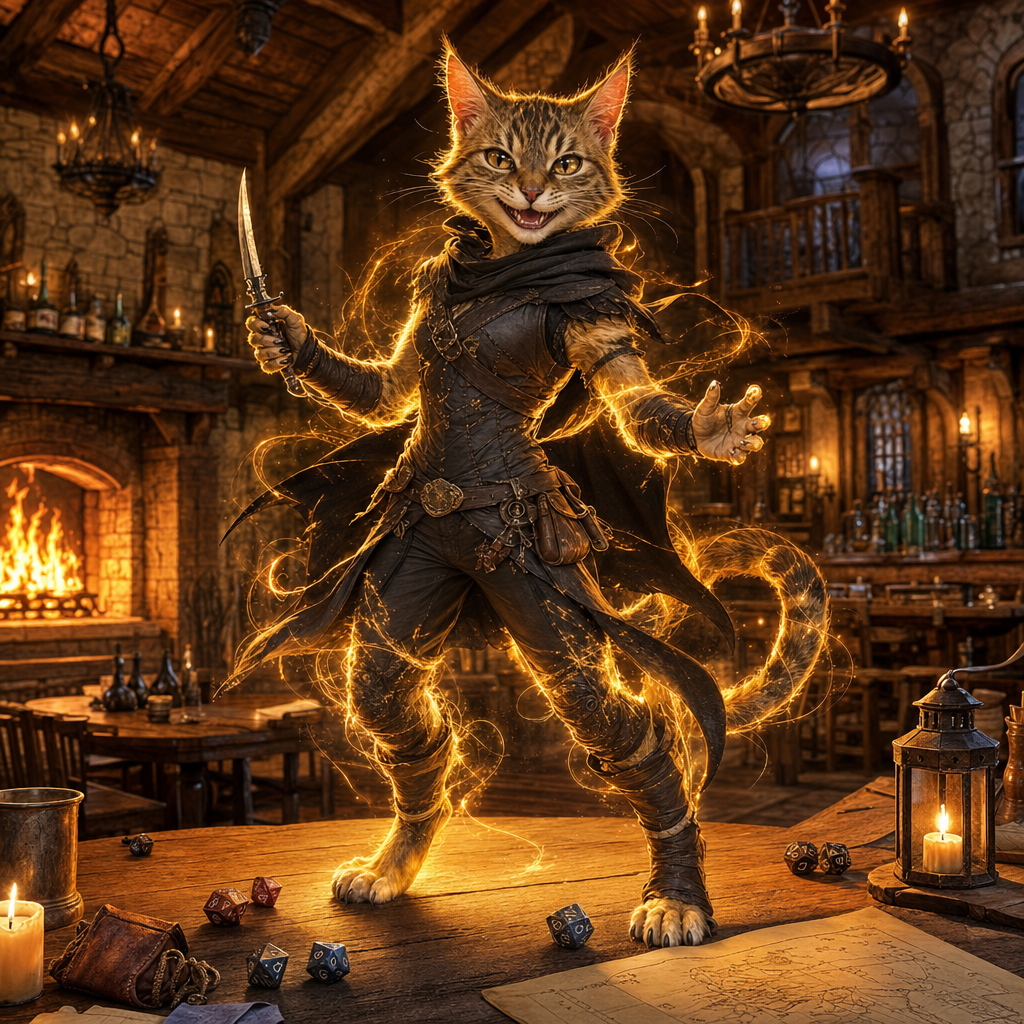
What Is a Tibbit in D&D?
If you've been searching for "tibbit dnd," you've stumbled onto one of the game's weirdest, most delightful oddities. Tibbits are small felines—think ordinary housecats—that can shapeshift into a humanoid form at will. They appeared in Dragon Compendium and a handful of 3.5 supplements, but they never quite made it into the 5e spotlight. That doesn't mean they're forgotten. Tibbit characters show up in homebrew campaigns all the time, and for good reason: they're mechanically interesting, narratively flexible, and absurdly fun to roleplay.
In their natural form, tibbits are Small creatures—literally cat-sized. They have darkvision, a climb speed, and all the charm of a pet that knocks mugs off tables. But with a standard action (or a bonus action in most homebrew conversions), they can transform into a Medium humanoid. Think of it as permanent alter self, but you're always a cat underneath. The result is a character who can scout as a stray, charm NPCs as a "lost kitten," then stand up on two legs and pull a rapier when things get serious.
Why Tibbits Work (Even If They're Obscure)
I'll be honest: I didn't know tibbits existed until a player in one of my solo campaigns rolled one up from an old PDF they'd found. I was skeptical. A shapeshifting cat? It sounded like the kind of thing that would either break the game or turn into a joke character. But after a few sessions, I got it. Tibbits aren't about power—they're about versatility and personality.
Here's what makes them tick:
- Two bodies, one character. You get the mechanical benefits of being Small (harder to hit, easier to hide) and Medium (better reach, can use all weapons) depending on the situation.
- Built-in disguise. No spell slots required. You're a cat. People trust cats. You can infiltrate, eavesdrop, and escape suspicion in ways a dragonborn simply cannot.
- Narrative gold. A tibbit's dual nature invites roleplaying hooks: Do they prefer one form over the other? Are they hiding their true nature? Do they have cat-like quirks even in humanoid shape—grooming their hands, napping in sunbeams, hissing at dogs?
My solo character—a tibbit rogue named Whisker—spent half a dungeon as a cat, riding in the ranger's backpack and scouting ahead through arrow slits. When the party got ambushed, Whisker leapt out, shifted mid-air, and landed with daggers drawn. It was ridiculous. It was perfect.
Tibbit Lore: Cats with Secrets
Canonically, tibbits are mysterious even to themselves. They don't have a unified culture or homeland—they're scattered across the world, living as wanderers, spies, or solitary tricksters. Most tibbits grow up believing they're just clever cats until their shapeshifting ability manifests in adolescence. Some are mentored by other tibbits; others figure it out alone, which leads to a lot of awkward first transformations in front of very confused farmers.
Tibbits tend toward Chaotic alignments—not because they're evil, but because they value independence and adaptability. They're survivors. A tibbit might work as a familiar for a wizard (while secretly being far more than a pet), a spy for a thieves' guild, or a wandering bard who performs as a "trained cat" in one town and a lutist in the next.
One thing I love: tibbits don't usually tell people what they are. Shapeshifting is their ace in the hole. If you're playing a tibbit, you get to decide who knows and who doesn't—and when the reveal happens, it's always a moment.
Building a Tibbit in 5e (Homebrew Conversion)
Since tibbits aren't official 5e content, you'll need a homebrew framework. Here's a balanced approach that keeps the spirit of the original while fitting 5e's design:
Tibbit Traits (Homebrew)
- Ability Score Increase: +2 Dexterity, +1 Charisma
- Size: Small (cat form) or Medium (humanoid form)
- Speed: 30 ft. (both forms); 20 ft. climb speed (cat form only)
- Darkvision: 60 ft.
- Feline Agility: Proficiency in Acrobatics or Stealth (your choice)
- Shapechanger: You can use a bonus action to shift between cat and humanoid forms. Your equipment merges into your cat form and reappears when you return to humanoid shape. You retain your mental stats in both forms.
- Cat's Claws: In cat form, your unarmed strikes deal 1d4 + Dex slashing damage.
- Languages: Common and one other language of your choice
This keeps tibbits nimble, sneaky, and fun without overshadowing other races. The bonus action shift is key—it means you can adapt mid-combat without burning your whole turn.
Best Classes for Tibbits
Rogue: The obvious choice. Stealth, Acrobatics, and a built-in escape plan make tibbits natural rogues. Go Arcane Trickster for extra magic or Swashbuckler for a cat with panache.
Bard: Charm, deception, and performance—tibbits are born entertainers. A cat "familiar" that suddenly stands up and starts singing? Iconic.
Ranger: Beast Master rangers with a tibbit twist are fascinating. You're the ranger and the beast companion rolled into one.
Monk: Dex-based, mobile, and thematic. A tibbit monk is a martial arts master who trains in both forms—think Kung Fu Panda but smaller and furrier.
Roleplaying Your Tibbit
Here's where tibbits go from "neat mechanic" to "unforgettable character." Lean into the duality. Ask yourself:
- Does your tibbit prefer being a cat? Or do they see their feline form as a disguise?
- Do they groom themselves, stretch, or purr even in humanoid shape?
- Are they secretive about their nature, or do they announce it proudly?
- What's their relationship with actual cats? Do they see them as kin or as... less intelligent cousins?
One of my favorite tibbit moments: Whisker spent an entire negotiation as a cat on the table, "ignoring" the conversation while actually listening to every word. When the NPC made a threat, Whisker transformed, tail still swishing, and said, "I wouldn't." The DM loved it. The NPC did not.
Using Tibbits as NPCs
Tibbits make excellent NPCs. They're the spy who's been hiding in plain sight. The tavern cat who's actually the thieves' guild's information broker. The "stray" the party adopts, only to discover it's been reporting back to someone.
If you're a DM looking to surprise your players, a tibbit NPC is a slow-burn reveal with huge payoff. Describe the cat. Let the party interact with it. Then, three sessions later, have it stand up and start talking. Chef's kiss.
And if you want to quickly generate tibbit NPCs—complete with stats, personality traits, and a character portrait—you can use tools like Creature Forge AI's NPC generator. You can even upload a photo of your own cat (I did this with my barn cat, Marmalade) and get a feline character that actually looks like them. It's absurdly fun and saves hours of prep time.
Bringing Tibbits Back to the Table
Tibbits never got the official 5e treatment, but that doesn't mean they're gone. Homebrew keeps them alive, and honestly, they're better as a niche pick—something your table discovers together rather than pulling from a Player's Handbook everyone's memorized.
If you're building a tibbit, commit to the bit. Make them weird. Make them catlike. Make them the character people remember three campaigns later because "oh yeah, you played the cat."
And if you're stuck on how to bring your tibbit to life—whether you need stats, a backstory, or just a character portrait that captures their scrappy energy—try Creature Forge AI's character generator. Build the cat of your dreams, or upload a photo and let the generator do the heavy lifting. Either way, your tibbit's ready to steal the spotlight.
Now go roll up a cat. Your table won't know what hit them.