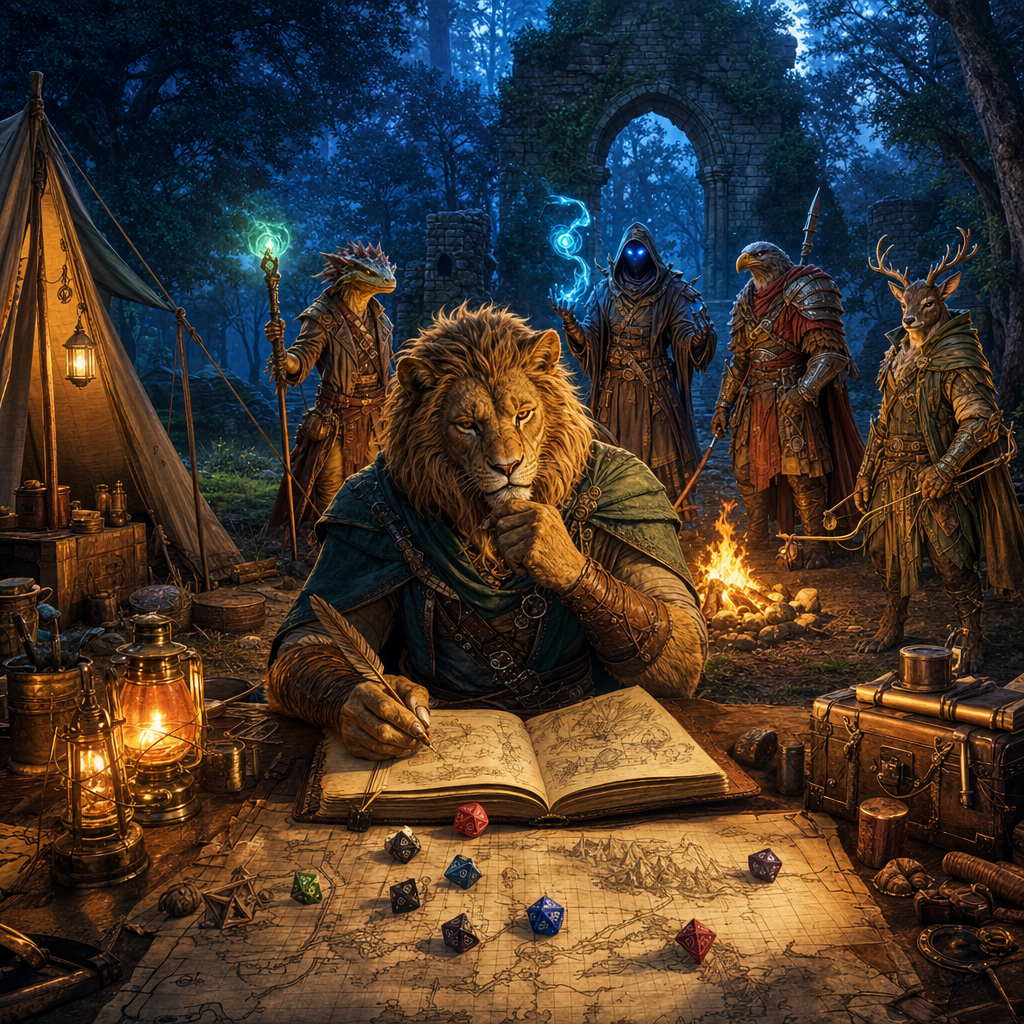
Why I Started Playing Solo (And Why You Might Too)
I came to solo ttrpg tools out of necessity, not preference. Growing up on a farm meant late nights, early mornings, and very few people around who wanted to spend three hours debating whether a gnome could realistically ride a chicken into battle. So I learned to play alone — one notebook, a set of dice, and a lot of coffee that should've been decaf.
What I discovered surprised me. Solo play isn't some compromise version of "real" tabletop gaming. It's its own thing entirely. You move at your own pace. You explore the parts of the story that interest you. You're not waiting for Chad to finally decide what his rogue does this turn. And with the right solo ttrpg tools, you're not just playing pretend in your head — you're building actual, structured adventures that feel as rich as any group campaign.
The trick is finding tools that do the heavy lifting without doing all the thinking for you. You still want surprises. You still want creative friction. You just need help with the parts that normally require other people: populating your world, generating unexpected encounters, and creating NPCs who feel like more than cardboard cutouts.
What Makes a Solo TTRPG Tool Actually Useful
Not every generator or random table earns a spot in my rotation. Here's what I look for:
- Speed without sacrificing detail — I don't want to spend twenty minutes building a random shopkeeper, but I also don't want "Grug the Blacksmith" with zero personality
- Surprise factor — good tools introduce elements I wouldn't have thought of myself, which keeps solo play from feeling too controlled
- Flexibility — I need to tweak things on the fly without breaking the whole system
- Actual usability at the table — if I need three browser tabs and a spreadsheet to use it, it's not making my life easier
The best solo ttrpg tools feel like having a co-DM who throws you curveballs but doesn't take over the story.
Random Generators: Your First Line of Defense Against Blank Pages
Let's be honest — the hardest part of solo play is staring at a blank page at 11 PM and trying to invent an entire tavern full of NPCs from scratch. Random generators solve this.
Name Generators
I use these constantly. Fantasy Name Generators has been my go-to for years — it covers everything from elven surnames to tavern names to bandit gang monikers. When I need a name fast and don't want to accidentally call three different characters "Thorin," this is where I go.
Plot Hook and Quest Generators
Donjon's random generators are old-school but reliable. The quest generator in particular has saved me multiple times when my carefully planned storyline collapsed because my character did something completely unexpected (which, let's be real, happens in solo play just as much as group play — I surprise myself constantly).
Encounter Builders
Kobold Fight Club remains the gold standard for building balanced encounters. Even playing solo, I want combat that challenges me without being a guaranteed TPK. The filters let you narrow by environment, difficulty, and creature type, which means I can populate a swamp with appropriately swampy threats in about ninety seconds.
Character and Creature Generators: When You Need More Than Stats
Here's where things get interesting. Stats are easy — any generator can spit out numbers. What's harder is creating characters and creatures that feel real, with personality and presence and the kind of details that make you remember them three sessions later.
This is where Creature Forge AI changed my solo campaigns completely. I'd been using generic generators for years, getting serviceable but forgettable results. Then I tried uploading a photo of my border collie, Scout — mostly as a joke, honestly — and got back a lupine ranger character with Scout's exact coloring, his alert posture, even something in the eyes that felt familiar.
I named him Scout Swiftpaw. He became my character's companion NPC. And because he looked like my actual dog, I found myself caring about him in a way I hadn't with randomly generated characters. When he got injured in a goblin ambush, I felt it. That's the kind of emotional investment that makes solo play work.
Why Photo-Based Generation Matters
The difference between a generic "wolf ranger" and a character that looks like a specific creature you know is the difference between reading about a place and actually visiting it. It grounds your imagination. It gives you visual anchors.
I've used this for NPCs too — uploaded photos of my neighbor's absurdly dignified cat and got a perfectly haughty felian wizard who became a recurring quest-giver. The tool gave me stats, abilities, and a character portrait that looked exactly like Mr. Whiskers in a pointy hat. My solo campaign is now full of these characters, and they feel like actual inhabitants of the world rather than dispositions on a random table.
Oracle Systems: For When You Need the Dice to Decide
Solo play requires answering a lot of yes/no questions that would normally be handled by a DM. Does the guard believe my lie? Is there a trap in this room? Does this NPC know anything useful?
Oracle systems handle this elegantly. The Mythic GM Emulator is probably the most well-known — you ask a question, roll against a chaos factor, and get an answer that includes unexpected twists. It's not perfect, and sometimes you get results that make zero sense, but that's part of the fun. Some of my best story moments came from oracle results I had to figure out how to justify.
For something simpler, the MUNE system (Madey Upy Namey Emulator — yes, really) gives you straightforward yes/no/and/but results without too much overhead. I use this when I'm tired and don't want to think too hard about probability matrices.
Mapping Tools: Because Theater of the Mind Has Limits
I'm not a visual person naturally, but even I need maps sometimes. Donjon's random dungeon generator creates quick, usable dungeon layouts with room descriptions. For overworld maps, Inkarnate's free tier gives you enough tools to sketch out regions, mark important locations, and generally keep track of where everything is.
The key with mapping tools in solo play is not to get obsessed. You're not publishing this. You're not running a game for ten players who need tactical precision. A rough sketch that helps you remember whether the wizard's tower is north or south of the corrupted forest is enough.
Journaling and Note-Taking: The Unsexy Essential
This isn't technically a specialized solo ttrpg tool, but it might be the most important thing on this list. Your solo campaign lives in your notes. Without them, you'll forget NPCs, lose plot threads, and contradict yourself constantly.
I use a physical notebook — something about writing by hand helps me process the story. But plenty of solo players swear by Obsidian, Notion, or WorldAnvil. The specific tool matters less than having a system to track:
- NPC names and basic details (I cannot tell you how many times I've forgotten a shopkeeper's name mid-session)
- Open plot threads and quest hooks
- Session summaries — just a paragraph or two about what happened
- Character development moments worth remembering
Some solo players go wild with this, creating elaborate wikis for their campaigns. I keep it simple. But even simple notes make a huge difference when you're picking up a campaign three weeks later and trying to remember why your character was tracking a mysterious cult through a mining town.
Monster Generators: Populating Your World with Threats
Combat in solo play can feel stale if you're always fighting the same creatures from the Monster Manual. You know their stats. You know their tactics. There's no surprise.
Custom monster generators fix this. The Creature Forge AI monster generator lets you specify environment, challenge rating, and creature type, then builds something unique with full stat blocks. I've populated entire regions this way — coastal areas with bioluminescent sea horrors, mountain passes with crystalline predators, forests with things that definitely aren't in any official sourcebook.
The best part about custom monsters in solo play is that you genuinely don't know what they'll do. You're discovering their abilities at the same time your character is, which creates actual tension even though you're technically both sides of the encounter.
Putting It All Together: A Sample Solo Session
Here's how these tools work in practice. Last week's session, my half-elf bard arrived at a new town. I used:
- Fantasy Name Generators to name the town (Millhaven) and three random NPCs
- An oracle roll to determine if the town was friendly (yes, but with complications)
- Creature Forge AI to generate the town's suspicious guard captain — I uploaded a photo of Biscuit, my goat, because I wanted someone stubborn and hard to read, and got a caprine fighter with Biscuit's skeptical expression
- A random encounter table for what was causing trouble nearby (bandits)
- My notebook to tie this into an existing plot thread about a thieves' guild
Total prep time: maybe fifteen minutes. The session ran two hours and felt completely natural, with surprises I didn't plan and character moments that emerged organically. That's what good solo ttrpg tools enable — structure without rigidity, surprise without chaos.
The Tools Don't Play For You
One last thing worth saying: these tools are frameworks, not replacements for imagination. The worst solo sessions I've ever had were when I let generators make all the decisions and just passively accepted whatever they gave me. The best sessions happened when I used tools to create friction and possibility, then made choices about what my character would do in response.
You're still the storyteller. You're still making the meaningful decisions. The tools just mean you're not also playing the role of random number generator, census bureau, and monster manual all at once.
Start Simple, Build From There
If you're new to solo play, don't try to use every tool at once. Start with a basic oracle system for yes/no questions and a name generator for NPCs. Get comfortable with that. Then add an encounter builder when you're ready for combat. Work in character and creature generators when you want more depth.
The solo ttrpg tools that work for you will depend on your play style, your system, and what parts of DMing you actually enjoy doing yourself. I like creating plot but hate inventing NPC personalities on the spot, so I lean heavily on character generators. You might be the opposite.
The point is that playing solo doesn't mean playing with less. It means playing differently — and with the right tools, it means telling stories that are just as rich, surprising, and memorable as any group campaign. Maybe more so, because every character, every choice, every unexpected dice roll is entirely yours.
If you're looking to add more personality to your solo campaigns, try creating a character from a photo — seriously, upload your pet, a friend, anyone with an interesting face — and see what kind of adventurer emerges. Sometimes the best NPCs are the ones who started as someone real.