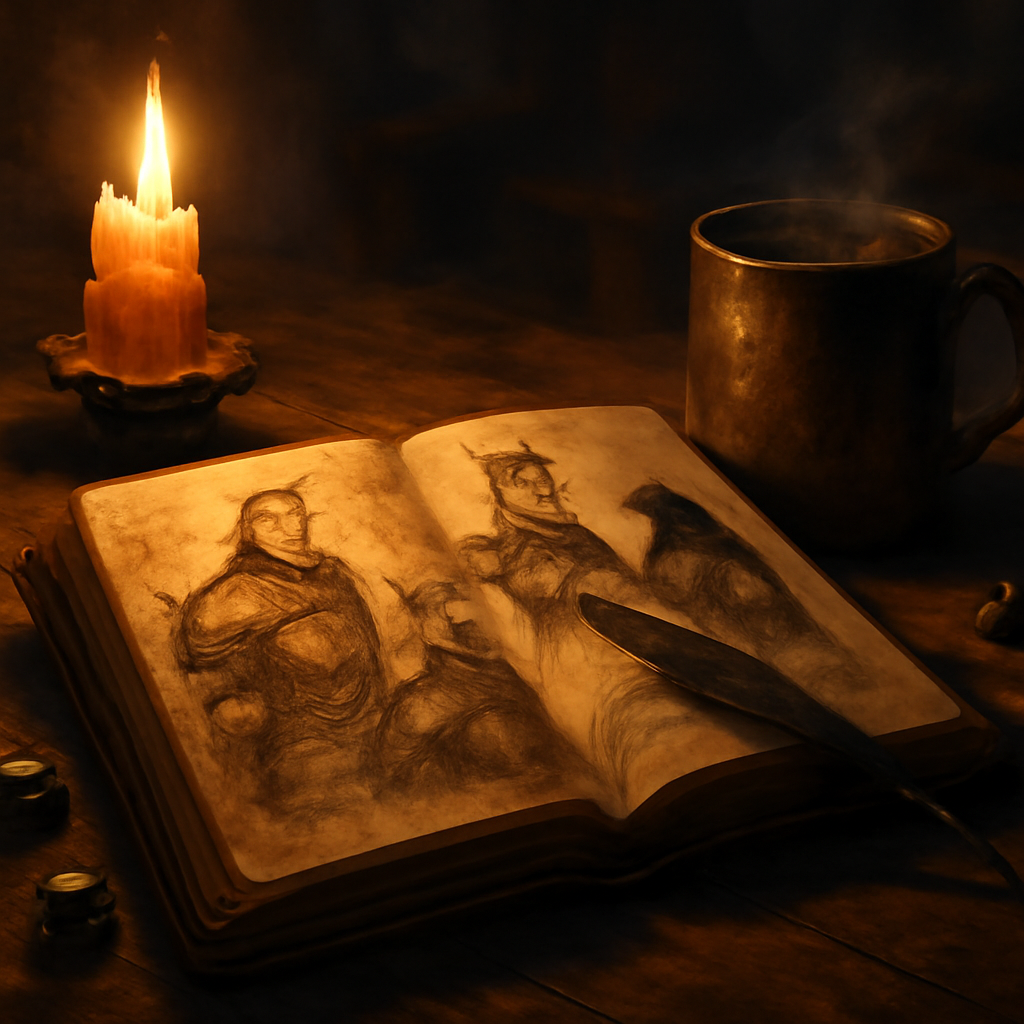
I've filled fourteen notebooks with solo RPG sessions. Some entries are three lines long. Others sprawl across pages, detailing conversations my rogue had with a talking goat (long story, involves a cursed amulet). The difference between those short, forgettable sessions and the ones I still think about? The right solo RPG journaling prompts.
When you're playing alone — no DM to react to, no party to bounce off — prompts become your creative engine. They're the difference between "I search the room" and a full paragraph about why your character hesitates at the threshold, remembering the last time they entered a stranger's home uninvited.
Why Most Prompts Fall Flat
Generic prompts don't work for solo play. "Describe your character's appearance" gives you a height and hair color. "What does your character want?" gets you "to defeat the villain." These aren't prompts — they're checkboxes.
Good solo RPG journaling prompts dig deeper. They create friction, reveal contradictions, force specific details. They make you discover things about your character you didn't plan.
Character Foundation Prompts
Start here when you're building someone new. These prompts establish the details that'll pay off fifty sessions later.
The Sensory Memory Prompt
What smell immediately transports your character back to childhood?
Not "what was their childhood like" — too broad. A specific smell. My half-orc barbarian, Grenna? Wet dog and hay. She grew up in stables. When she entered a nobleman's perfumed parlor three sessions later, I had her physically recoil. That sensory anchor made her real.
The Skill Origin Prompt
Who taught your character their most valuable skill, and what did that person get wrong about them?
This prompt does double duty. You establish competence and relationship in one stroke. My rogue learned lockpicking from her aunt, who assumed she'd use it for the family business. She didn't. That tension — between expectation and reality — writes itself.
The Comfort Object Prompt
What item does your character carry that has no practical value?
I once uploaded a photo of my border collie, Maggie, to Creature Forge AI's character generator and built her as a Lupine ranger. The tool gave me this brilliant illustration — Maggie standing upright with her characteristic head-tilt, holding a bow — but I needed to make her feel like Maggie. In my journal, I wrote that she carries a smooth river stone. No magic, no value. She just likes how it feels. That one detail made every subsequent entry easier to write.
Relationship-Building Prompts
Solo RPG can get lonely. These prompts populate your world with people who matter.
The Debt Prompt
Who does your character owe, and why haven't they paid yet?
Debts create built-in plot hooks. Could be money, could be a favor, could be an apology they can't bring themselves to deliver. My cleric owes a blacksmith three gold pieces from two years ago. She avoids that entire district now. Suddenly I have geography in my city that means something.
The Unexpected Friendship Prompt
Who likes your character that logically shouldn't?
This is where NPCs get interesting. The guard captain who should arrest your thief but shares her taste in terrible poetry. The rival guild member who keeps warning your character about ambushes. Illogical friendships feel human because people are illogical.
Session-Starting Prompts
You sit down to play. You know where your character is, what quest they're on. But the page is still blank. These prompts get the words flowing.
The Morning Ritual Prompt
What's the first thing your character does when they wake up?
Describe it in detail. Every. Single. Session. This sounds repetitive — it's supposed to be. Rituals ground you. My paladin sharpens his sword for exactly ten minutes. When he skipped it once (ambushed in the night), I felt his unease the entire session. That wouldn't have landed without the established routine.
The Weather Mood Prompt
How does today's weather match (or contradict) your character's emotional state?
Pathetic fallacy is a tool, not a crutch. Rain during grief? Sure. But rain during triumph? That's texture. My bard finally won the respect of the college that rejected her — on the coldest, clearest winter day imaginable. The contrast made the moment sharper.
Conflict and Growth Prompts
Characters need friction to develop. Use these when the story feels stagnant.
The Moral Compromise Prompt
What would your character do for money that they'd refuse to do for free?
This reveals principles and desperation. My ranger will track anything if you pay her. Anything. She won't track deer during fawning season for free, but for fifty gold? She'll justify it. That uncomfortable truth — that her ethics have a price — drives entire sessions.
The Fear Reaction Prompt
What does your character do when they're terrified but can't show it?
Not "what scares them" — how they mask it. Physical tells. My sorcerer picks at his cuticles until they bleed. Now, whenever I write "he examined his fingernails," you know he's scared. Simple tell, big impact.
Using Prompts with Oracle Systems
If you're using dice oracles or Mythic GME, combine prompts with random results. Roll for a scene — "appears threatening but is harmless" — then journal: What assumption does your character make based on their past that's completely wrong here?
The collision between random events and character-specific prompts creates emergent storytelling. You're not just narrating what happens — you're discovering how your character's baggage colors everything they see.
The Pet Prompt (My Favorite)
Here's one I invented out of necessity. I have a goat named Biscuit who has more charisma than any NPC I've ever rolled. She's convinced she's a dog. She's wrong, but she's confident.
If your character had a pet, what animal would annoy them least?
Not "what would they choose" — what could they tolerate. My stoic fighter, who trusts no one? He'd tolerate a cat. Cats don't perform loyalty — they coexist. That insight led to a whole arc where he rescued a feral kitten and spent six sessions pretending he didn't care about it.
You can actually build these companion NPCs now. I uploaded a photo of Biscuit to Creature Forge AI and got back a Caprine merchant — standing upright, merchant's robes, Biscuit's exact stubborn expression. The image made me laugh, then made me write three pages about a traveling goat-folk who sells "insurance" against curses she definitely cast herself.
Making Prompts Work Long-Term
Prompts aren't one-and-done. Revisit them. Ask the comfort object question at session one and session fifty. The answer should change. If it doesn't, you're not letting your character grow.
- Keep a "prompt jar" — index cards with your favorites, drawn randomly when stuck
- Pair prompts with specific scenes (the morning ritual prompt always before travel scenes, the fear reaction during combat)
- Challenge yourself to answer a prompt from a different character's perspective (how does the villain answer "what smell means childhood"?)
- Write "bad" answers first — get the obvious stuff out, then dig deeper
When Prompts Aren't Enough
Sometimes you need more than words. Visual references break creative blocks in ways prompts can't. I keep a folder of character art, but the generic stuff never quite fits. Finding an image that looks like the character in your head — especially when that character is based on your actual German Shepherd or your nephew or that one rooster who attacked your mailman — is nearly impossible.
That's where actually seeing your character helps. Creature Forge AI lets you upload a photo and generates a fully-realized fantasy character that genuinely resembles them. The journaling gets easier when you can look at your Maggie-the-ranger and remember, "Oh right, she'd tilt her head exactly like that when she's confused."
Start Tonight
You don't need all these prompts. You need one that breaks your current block. Pick whichever question made you immediately think of an answer — that's the prompt your character wants to answer.
Pour coffee. Grab your dice. Open your notebook. Ask your character about a smell, a debt, a fear they hide. Write until you surprise yourself.
And if you need a face to go with that voice you're discovering — something that looks like the inspiration behind your character, whether that's a beloved pet or a person who shaped your idea — try building them with Creature Forge AI. Sometimes seeing them standing there, real and rendered and ready for adventure, is the prompt that matters most.
The blank page is only scary until you fill it. These prompts are how you start.