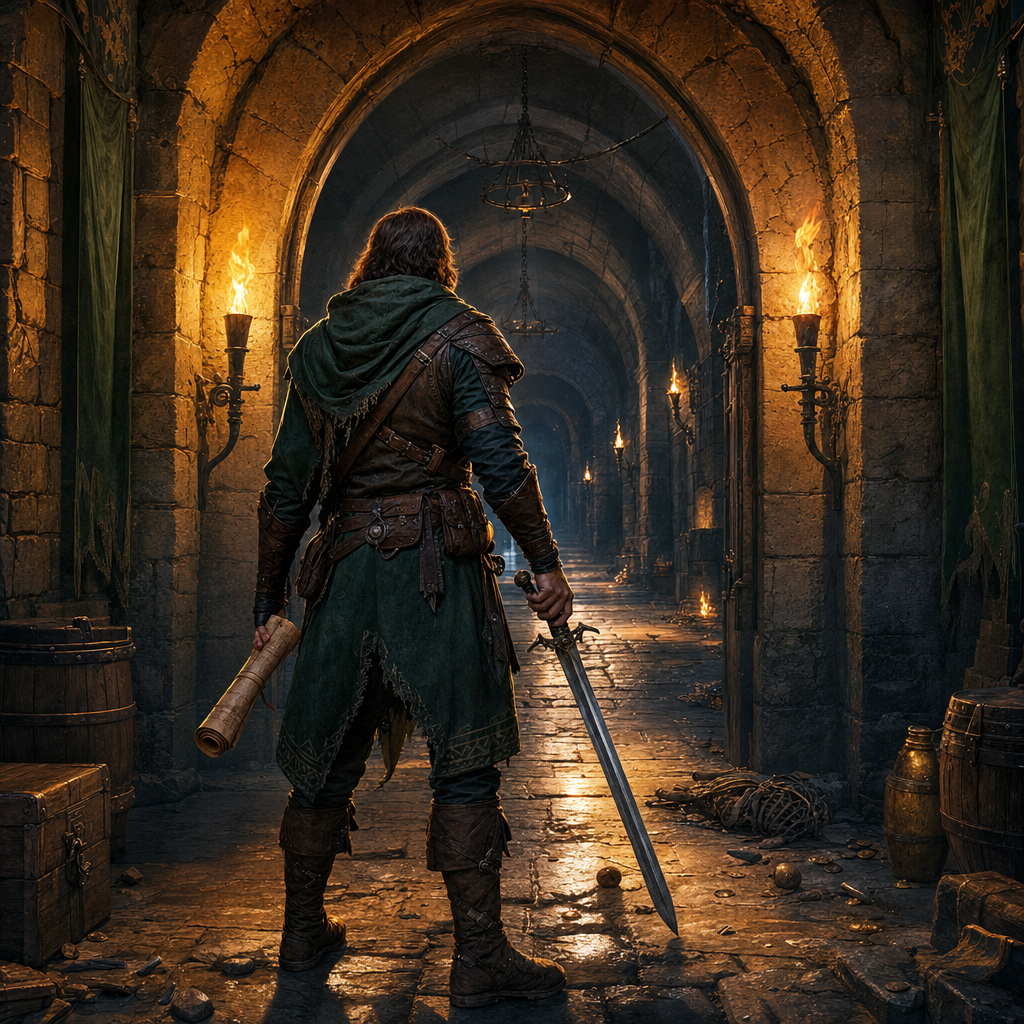
I discovered solo dungeon crawling on a Tuesday night after the chickens were fed and the barn was locked up. The house was quiet, I had fresh coffee, and my regular group had canceled for the third week in a row. I wasn't about to let that stop me. I grabbed my dice, a notebook, and decided to see if I could run a dungeon by myself. Turns out, with the right solo dungeon crawl rules, you absolutely can—and it's become one of my favorite ways to play.
Solo dungeon crawling isn't about replacing your group. It's about having a system that lets you explore, fight, and problem-solve when you're the only one at the table. No scheduling conflicts. No waiting. Just you, the dungeon, and whatever horrors wait in the dark.
The Core Challenge: Making Decisions Without a DM
The biggest hurdle in solo play is replacing the DM's role as arbiter and narrator. You need solo dungeon crawl rules that answer questions like: Which direction does the corridor go? Is there a trap? What happens next? The solution is a combination of random tables, oracle systems, and procedural generation.
Oracle Systems: Your Solo DM
An oracle is your decision-making tool when you need an answer. The simplest version uses a d6:
- 1-2: No, and... (something worse happens)
- 3-4: No
- 5: Yes
- 6: Yes, and... (something good happens)
You ask yes/no questions: "Is there a guard in this room?" Roll. The dice decide. Adjust the probabilities based on likelihood—if something is very likely, maybe 3-6 means yes. This keeps you honest and creates genuine surprise.
Dungeon Generation Tables
I use simple d6 or d10 tables for procedural generation as I explore:
- Room contents: Empty, monster, trap, treasure, special (roll on a detail table)
- Exits: Number of doors/passages (1d4)
- Room size: Small, medium, large, vast
- Features: Pillars, water, rubble, furniture, etc.
You can find dozens of these tables online, or make your own based on your dungeon's theme. I keep mine in a notebook that's coffee-stained and dog-eared from use.
Combat Without a DM
Combat is where solo dungeon crawl rules really matter. You need a system that's challenging but not arbitrary.
Enemy Behavior
Instead of playing enemies optimally (which feels like cheating yourself), use simple AI rules:
- Aggressive monsters: Always attack the nearest target
- Tactical monsters: Roll d6: 1-3 attack, 4-5 use terrain/ability, 6 flee if bloodied
- Mindless undead: Attack whoever damaged them last
This keeps enemy actions consistent and prevents you from metagaming. The moment you start playing monsters "smart" based on what you know as the player, the challenge evaporates.
Initiative and Surprise
Run initiative normally, but use your oracle for surprise rounds. When you enter a room: "Do they notice me?" Roll. On a "No, and..." result, maybe you get a full surprise round. On a "Yes, and..." they were expecting you—ambush from behind.
Encounter Scaling
This is crucial: don't build encounters for your level. Build them for the dungeon. If you're level 3 and you stumble into the dragon's lair on level 5, that's a dragon fight. Your job as a solo player is to recognize danger and run, negotiate, or get creative. I've had some of my best sessions sneaking past encounters I had no business fighting.
Managing Your Character
One character or multiple? Both work, but they play differently.
Single Character Solo
Playing one character is intimate and tense. Every hit point matters. Every spell slot is precious. I recommend:
- Choose a versatile class (Ranger, Cleric, Bard) that can handle multiple situations
- Use hirelings or companions for backup (run them with simple AI rules)
- Accept that you'll be more vulnerable—that's the point
- Have an escape plan for every room
When I run solo with my ranger—who started life as a stats-for-fun version of my border collie, Max, after I uploaded his photo to Creature Forge AI—I know I can't tank damage. I scout, I use terrain, I run when things go south. That tension is what makes it thrilling.
Party-Style Solo
Running 3-4 characters gives you tactical options but slows combat. Keep it manageable:
- Use simpler builds—avoid complicated spell lists
- Run monsters in groups with average HP to speed rolls
- Track party resources on a single sheet
- Let characters have distinct personalities but don't overdo roleplay (you're talking to yourself)
Exploration and Pacing
Dungeon crawling is about tension—light sources burning down, rations dwindling, HP not recovering. Track these strictly:
The Countdown
Use a "dungeon turn" system (common in OSR games): every 10 minutes of in-game exploration is one turn. Roll a d6 each turn:
- 1: Wandering monster (roll on encounter table)
- 2-4: Nothing happens
- 5-6: Clue, sound, or omen (foreshadow nearby danger)
This keeps pressure on. You can't long rest after every fight—monsters patrol these halls.
Light and Vision
Track torches and lamp oil religiously. A torch lasts one hour (six dungeon turns). When light runs out, everything gets harder: disadvantage on attacks and Perception, monsters get surprise more easily. I've had sessions where managing light became the main challenge.
Handling Traps and Puzzles
Traps work fine solo—roll Perception to notice, roll Investigation or Thieves' Tools to disarm, roll DEX save if you trigger one. The oracle handles edge cases.
Puzzles are trickier because you're both the puzzle-maker and solver. My approach:
- Use published adventures and genuinely try to solve puzzles yourself
- Set a timer—if you can't solve it in 10 real minutes, let your character make an Intelligence check
- On a success, give yourself one hint
- Avoid complex riddles—favor physical/spatial puzzles you can sketch out
Tools and Resources
You don't need much, but a few tools make life easier:
- Random tables: Donjon, Chaotic Shiny, or OSR supplements like "Maze Rats"
- Generators: When you need a quick NPC or encounter, Creature Forge AI's monster generator can build stat blocks on the fly, letting you populate rooms without breaking flow
- Notebook: Paper, not digital—sketching maps as you go is half the fun
- Published adventures: Don't reinvent the wheel; run modules solo (they work great with these rules)
My Current Solo Campaign
I'm three levels into a solo crawl through a converted megadungeon. My character is a human fighter with a pet goat companion (yes, based on my actual goat, Biscuit—she has more charisma than most NPCs I've written). I've died once, got resurrected by a weird cult on level 2, and now I owe them a favor I'm definitely going to regret.
The point is: it works. Solo dungeon crawl rules aren't about perfect simulation. They're about creating enough structure that the game can surprise you, challenge you, and pull you into the world even when you're alone at the kitchen table at midnight.
Getting Started Tonight
If you want to try this yourself, here's what you do:
- Grab a character—existing or new, doesn't matter
- Pick a simple dungeon (even a one-page dungeon works)
- Make a d6 oracle table and a room contents table
- Light a candle or brew some coffee—set the mood
- Start at the entrance and ask: "What do I see?"
- Roll dice, write down what happens, and keep going
You'll stumble at first. You'll have questions the oracle can't answer cleanly. That's fine. Improvise, make a ruling, keep moving. By the third room, you'll find your rhythm.
And if you need help building monsters, NPCs, or even turning your own pets into unlikely adventurers? Creature Forge AI has your back. The character generator even lets you upload photos—which means Biscuit the goat now has official 5e stats, a class, and a personality trait that reads "stubborn as hell." It's perfect.
Solo dungeon crawling isn't a substitute for group play. It's its own thing—quieter, more personal, and completely at your own pace. No scheduling, no compromises, just you and the dungeon. Give it a shot. You might surprise yourself.