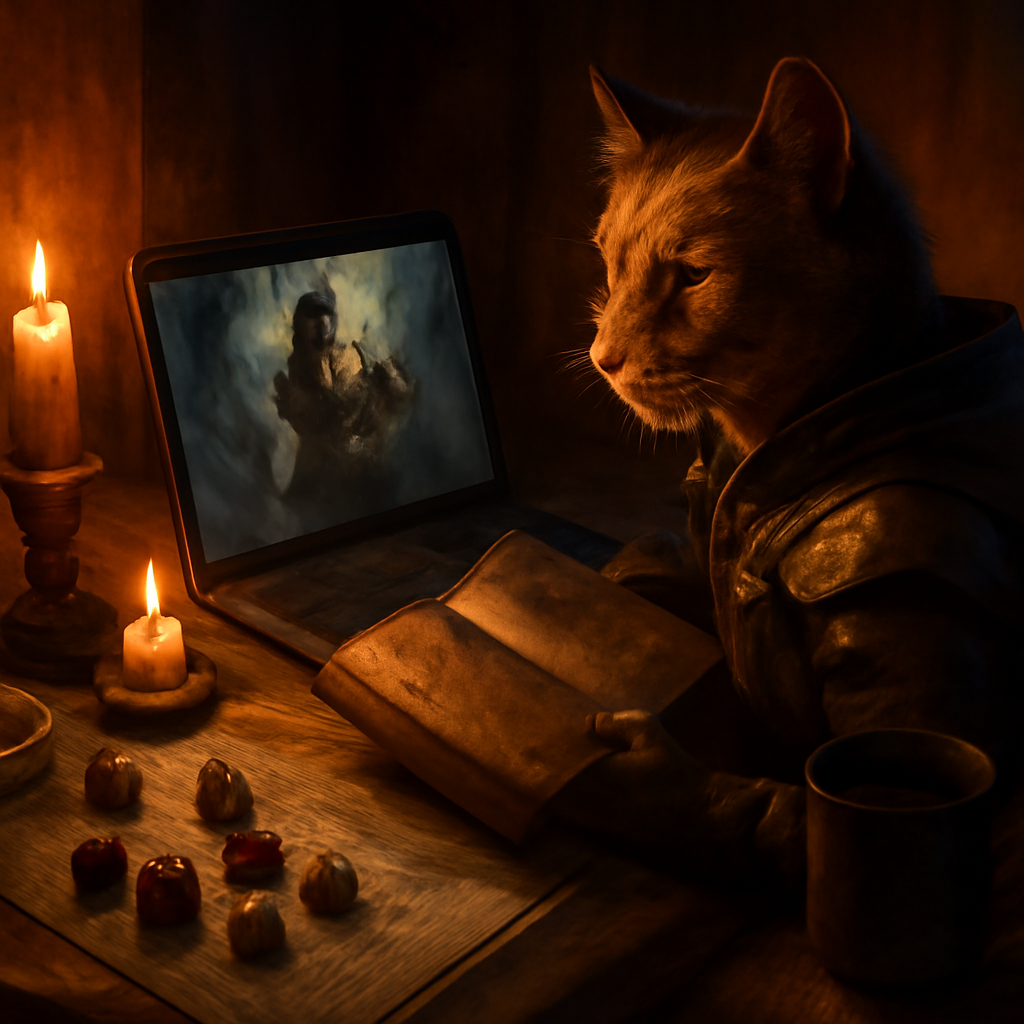
I started playing solo D&D with an AI dungeon master out of pure necessity. When you live on a farm forty minutes from the nearest game store, and your social calendar revolves around feeding schedules and whether the goats have escaped again, finding a consistent gaming group isn't exactly realistic. So I adapted. Coffee at 10 PM, laptop open, dice bag within reach, and an AI ready to throw plot twists at me until I couldn't keep my eyes open.
What I discovered surprised me: some of my most memorable campaigns happened entirely solo, guided by artificial intelligence that never complained when I wanted to spend three hours developing my character's backstory or exploring a random cave system that had nothing to do with the main quest.
Why Solo D&D Actually Works
The thing nobody tells you about solo D&D with an AI dungeon master is how freeing it feels. No scheduling conflicts. No waiting for that one player who's always twenty minutes late. No awkward moments when someone wants to seduce the dragon and everyone else just wants to get on with the dungeon crawl.
You play at your own pace. If you want to spend an entire session just building relationships with NPCs in a tavern, nobody's sighing and checking their phone. If you want to rush through combat to get to the roleplaying, you can. The AI adapts to whatever energy you bring to the table.
I'll be honest—I was skeptical at first. How could an algorithm create the spontaneity and creativity of a human DM? But modern AI dungeon masters have gotten remarkably good at improvisation, narrative consistency, and even emotional stakes. They remember your choices. They build on your ideas. They surprise you.
Choosing Your AI Dungeon Master
Not all AI dungeon masters are created equal. I've tried most of the major platforms, and each has its own personality and strengths. Some excel at combat mechanics. Others shine in narrative depth. A few are better at handling complex character interactions.
Here's what I look for:
- Memory consistency: Does it remember that your character's sister died in the goblin raid three sessions ago? Does it bring up consequences from your earlier choices?
- Narrative flexibility: Can it roll with your weird ideas, or does it railroad you back to its predetermined plot?
- Mechanical accuracy: Does it actually understand 5e rules, or do you spend half your time correcting it?
- Character generation support: This one matters more than you'd think. Can it help you build interesting NPCs and encounters quickly?
That last point is where I found Creature Forge AI's NPC generator invaluable. Instead of spending an hour statting out the suspicious merchant or the helpful blacksmith, I could generate fully-realized characters in minutes—complete with personality traits, motivations, and secrets. It kept my solo sessions moving instead of bogging down in prep work.
Setting Up Your Solo Session
My setup is probably simpler than you'd expect. Here's the ritual that's worked for me across probably fifty sessions now:
I make coffee. Real coffee, not the instant stuff. This matters—it's part of the atmosphere.
I pull up my AI dungeon master in one browser window, my character sheet in another. Physical dice, always. Rolling digital dice in a solo game feels like admitting defeat somehow. I want to hear the clatter on my desk.
I light a candle. Yes, really. It helps my brain shift into "adventure mode." Plus it keeps the glare off my screen.
Then I spend five minutes reviewing my campaign journal—not the official notes, but the personal one where I write what my character is actually thinking and feeling. This is the secret weapon of solo play. Without other players to bounce off, you need to develop your character's internal world more deliberately.
The First Session Problem
Starting a solo campaign is genuinely harder than continuing one. You're building everything from scratch—the world, the stakes, your character's place in it. I recommend starting small. Not "save the kingdom" small. "Investigate the weird noises in the barn" small.
My most successful solo campaign started with my character—a ranger I'd loosely based on myself, minus the fantasy elements and plus actual competence with a bow—investigating livestock disappearances. Just that. No ancient evils, no chosen one prophecy. Chickens were vanishing and the farmers were worried.
It spiraled from there, naturally. The chickens led to goblins. The goblins led to a smuggling operation. The smugglers led to a corrupt magistrate. Before I knew it, I had twenty sessions of material, all organically developed from investigating missing chickens.
Managing Combat Solo
This is where solo D&D gets tricky. In a regular game, combat is dynamic because you've got multiple players contributing ideas, taking different actions, creating chaos. Solo, you're running one character against whatever the AI throws at you.
Here's what works:
- Keep encounters small: Three enemies max for most fights. You're managing everything yourself.
- Use environmental elements: Chandeliers to swing from, oil lamps to throw, rickety bridges to collapse. Give yourself tactical options beyond "I attack again."
- Don't be afraid to retreat: Solo characters should run away sometimes. It's not cowardice; it's tactics.
- Consider a companion: An animal companion, a hireling, or even just a temporary ally makes combat more interesting and gives you someone to protect.
Actually, that last point deserves more attention. I spent three sessions with a mule named Cornelius, and I got more emotionally invested in keeping that stubborn animal alive than I did in most human NPCs. When Cornelius got caught in a trap and I had to spend my healing potion on him instead of saving it for myself, that felt like real stakes.
The Photo Upload Revolution
Here's something I never expected to care about: being able to upload actual photos to generate characters. I stumbled onto this feature in Creature Forge AI almost by accident, uploaded a picture of Biscuit—my extremely photogenic goat—mostly as a joke, and got back a complete stat block for a Tabaxi druid that genuinely captured something essential about her personality.
Stubborn, curious, absolutely convinced she should be allowed to eat anything she can reach, and surprisingly wise when it matters. The AI caught all of it. I ended up running that character for an entire campaign arc, and every time she made a decision, I'd think, "Yeah, that's exactly what Biscuit would do."
It sounds silly until you try it. Then it becomes this weird bridge between your real life and your fantasy adventures. My solo campaigns stopped feeling quite so isolated when I could populate them with character-versions of creatures I actually knew.
Story Over Systems
The beautiful thing about solo D&D with an AI dungeon master is that nobody's watching. Nobody's judging you for ignoring the optimal combat tactics because your character would never do that. Nobody's rolling their eyes when you spend forty minutes having a philosophical conversation with a talking raven.
I've had sessions where I didn't roll a single attack. Just investigation, persuasion, insight checks. Entire evenings of pure roleplaying and problem-solving. I've had other sessions that were basically dungeon crawls with minimal story—just me, some procedurally generated monsters, and a bag of dice.
Both are valid. Both are fun. The AI doesn't care which way you want to play tonight.
When the AI Surprises You
The first time my AI dungeon master introduced an NPC who turned out to be working against me—an NPC I'd grown to trust over several sessions—I sat back from my laptop genuinely shocked. I hadn't seen it coming. The clues were there in retrospect, but I'd missed them, and the betrayal felt earned, not cheap.
That's when solo D&D with an AI clicked for me. It wasn't replacing human DMs. It was creating a different experience entirely—one where the story emerged from the collaboration between my choices and the AI's responses, without any of the social dynamics or expectations of a traditional table.
Building Your Campaign Journal
If you take nothing else from this article, take this: keep a campaign journal from your character's perspective.
Not session notes. A journal. What your character thinks about what happened. What they're afraid of. What they're hoping for. The small details they noticed that might not matter—or might be crucial later.
This single habit transformed my solo sessions from "fun" to "genuinely compelling." When I'd sit down for a new session, I'd read the last journal entry, and I'd immediately be back in my character's headspace. The AI would throw new challenges at me, and I'd respond not as a player optimizing outcomes, but as a character with history, fears, and goals.
My ranger's journal entry after losing Cornelius the mule to a gelatinous cube ran three pages. I cried while writing it. Over a fictional mule in a solo campaign. That's the kind of emotional investment that only happens when you're this deep in a character's head.
The Technical Side
Let's talk practicalities. You'll need:
- A reliable AI platform for dungeon mastering (I rotate between a few depending on the campaign tone)
- A character sheet—I use digital ones that auto-calculate modifiers
- Dice (physical or digital, your preference)
- A note-taking system (I use a combination of organized campaign notes and the personal journal)
- Tools for quick NPC and creature generation when the AI throws unexpected encounters at you
That last one matters more than you'd think. The AI will frequently introduce characters or creatures you haven't planned for. Having quick-generation tools means you can stat them out in real-time without breaking the session's flow.
When Solo Gaming Actually Works Better
There are situations where solo D&D with an AI dungeon master isn't just a substitute for group play—it's genuinely superior:
- Character exploration: You can spend as much time as you want developing your character's personality, backstory, and growth
- Pacing control: Some nights you want three hours of play. Some nights you want twenty minutes. Solo gaming accommodates both
- Experimentation: Want to try a weird build or unusual character concept? No need to worry about letting down your party
- Continuity: No cancelled sessions, no players dropping out, no campaign falling apart because life gets busy
- Personal stakes: Every decision is yours. Every consequence lands on you. The emotional investment runs deeper
I'm not saying abandon your gaming group if you have one. But if you don't, or if your group can only meet monthly and you need your fantasy adventure fix more often than that, solo play with an AI stops being a compromise and starts being its own valid form of the hobby.
Getting Started Tonight
If you're reading this at 11 PM, unable to sleep, wishing you could play D&D right now—you can. Make some coffee. Pull up an AI dungeon master. Roll a character, or use one you've been thinking about for months.
Start small. Start simple. Don't worry about having the perfect setup or the optimal build. Just start playing.
The AI will guide you. Your dice will tell the story. Your imagination will fill in the details that matter most.
And if you want to populate your adventure with creatures and NPCs that actually mean something to you—maybe ones based on the real animals and people in your life—tools like Creature Forge AI can help you bridge that gap between reality and fantasy in ways that feel genuinely magical.
My solo campaigns have given me some of my favorite gaming memories. The night my ranger finally confronted the magistrate who'd been behind everything. The session where I spent two hours just exploring an abandoned library, reading AI-generated book titles and imagining their contents. The moment when I realized the friendly innkeeper had been dropping hints about a major plot development for six sessions and I'd missed every single one.
These are my stories. Nobody else was there. The AI and I built them together, late at night, with nothing but imagination and dice.
You can build yours too. Tonight, if you want. The adventure is waiting, and it doesn't care whether you're playing solo or with a table full of friends. It just cares whether you're ready to begin.