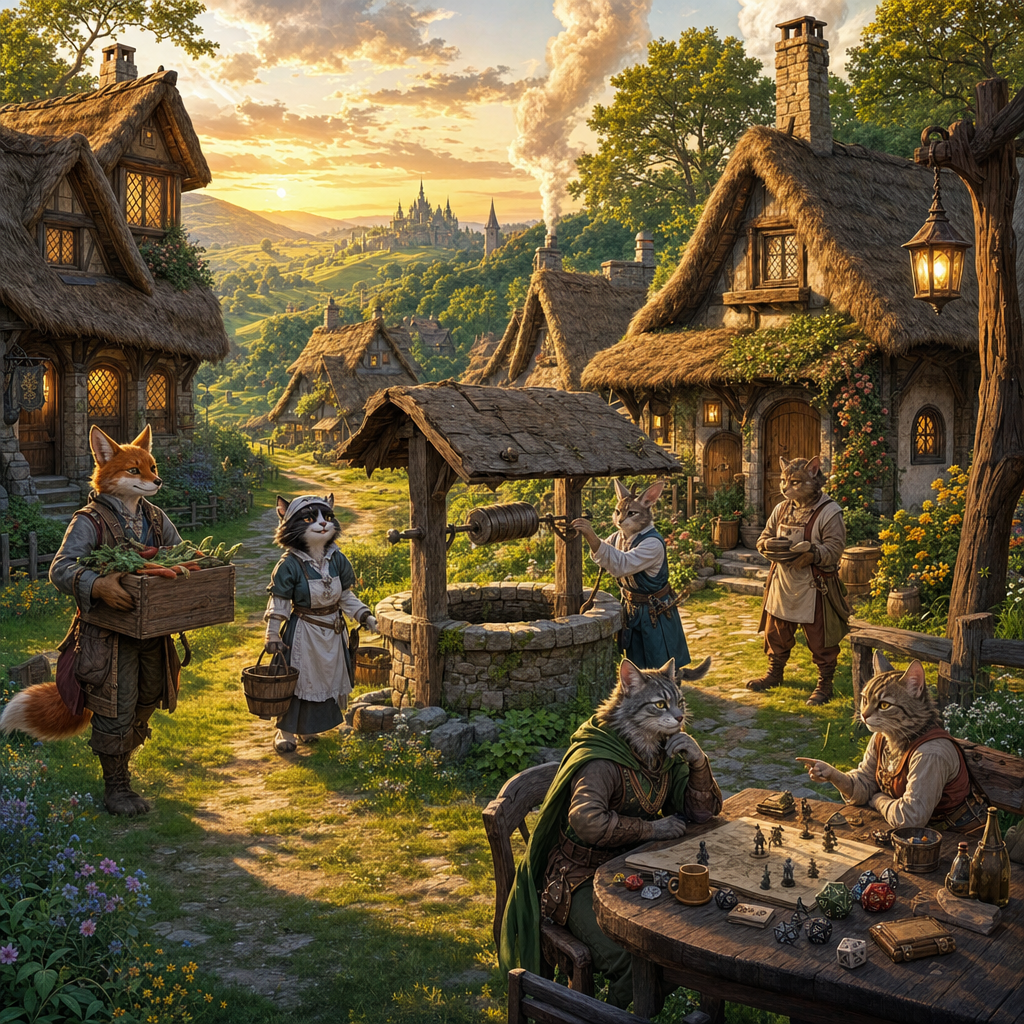
Why Small Villages Matter More Than You Think
I'll be honest: for the first year of my solo campaigns, I treated villages like rest stops. Players roll in, buy supplies, sleep at the inn, leave. Generic innkeeper, generic blacksmith, move along. Then one night—probably three cups of coffee deep—I realized my goat Biscuit had more personality than every village NPC I'd ever created combined.
Small village ideas for D&D shouldn't be afterthoughts. These rural communities are where your players catch their breath, form connections, and discover the hooks that drive your campaign forward. A well-crafted village feels lived-in. It has history, tension, and people worth remembering. Here's how I build them now.
Start with a Defining Feature
Every memorable village needs one thing that makes it distinct. Not a gimmick—a genuine characteristic that shapes how people live.
- The Crossroads Village: Built where two trade routes meet, always bustling with travelers, merchants, and rumor
- The Mining Settlement: Carved into a hillside, economically dependent on whatever they're pulling from the earth
- The Farming Community: Surrounded by fields, orchards, or pastures—vulnerable to weather, beasts, and crop failure
- The Fishing Village: Hugging a coastline or lake shore, with its own maritime culture and superstitions
- The Frontier Outpost: The last civilization before the wilderness, populated by people tough enough to make it work
- The Religious Sanctuary: Built around a shrine, temple, or sacred grove—pilgrims pass through regularly
Once you know what your village does, everything else follows. The defining feature determines who lives there, what they need, and what threatens them.
Build NPCs Who Actually Matter
Generic NPCs are campaign poison. You need villagers with personality, motivation, and at least one memorable detail.
The Village Elder
Not always the oldest person—sometimes it's whoever holds the community together. Maybe it's the miller who extends credit when harvests fail. Maybe it's the herbalist everyone trusts with their secrets. Give them a quirk: they always speak in farming metaphors, or they're half-deaf and mishear everything, or they're surprisingly well-traveled for someone who never left home.
The Outsider
Every small community has someone who doesn't quite fit. The merchant from the capital. The veteran who came home different. The widow everyone whispers about. This NPC can be your party's entry point—someone who understands what it's like to not belong.
The Troublemaker
Small communities breed resentment. Someone's son gambles away the family farm. Someone's daughter ran off with a bard. Someone holds a grudge from thirty years ago. This NPC creates tension without being a villain—they're just human.
The Hidden Talent
The baker who used to be an adventurer. The shepherd who reads ancient languages. The drunk at the tavern who's actually the village's best tracker. Subvert expectations. Let your players discover that the least impressive villager has the most impressive skills.
I recently used Creature Forge AI's NPC generator to create a village elder based on my old border collie, Murphy—loyal, intelligent, suspicious of strangers, and absolutely convinced he was in charge of everything. The generator captured that protective, no-nonsense energy perfectly. Gave him a shepherd's staff, some weather-beaten armor, and a habit of whistling commands. My players loved him.
Create Locations with Purpose
Small villages don't need fifty locations. They need five or six that actually matter.
The Heart of the Village
Usually the inn, tavern, or village square. This is where people gather, share news, and size up strangers. Give it a name that means something: The Shepherd's Rest, The Broken Wheel, The Crossroads. Describe the smell (woodsmoke, baking bread, spilled ale), the sound (conversation, crackling fire, a bard tuning a lute), and one piece of local flavor (a wall covered in carved initials, a trophy from a hunt, a portrait of the founder).
The Place of Need
Where villagers go when something's wrong. The healer's cottage. The shrine to the harvest goddess. The mill that grinds everyone's grain. This location shows what the community values and what they fear losing.
The Edge
Every village has a boundary where civilization stops. The forest line. The old bridge. The abandoned farmhouse. The graveyard. This is where your adventure hooks live—where something went wrong, where someone disappeared, where the strange sounds come from at night.
The Secret
One location the villagers don't talk about or actively avoid. The locked room in the elder's house. The sealed root cellar. The cave the children are forbidden to explore. Your players will find it. Make sure it's worth discovering.
Layer in Conflict (The Small-Scale Kind)
Not every village needs a dragon problem. Small conflicts feel more real and give your players meaningful choices.
- Resource Scarcity: The well is running dry. The harvest failed. The merchant caravan is two weeks late.
- Interpersonal Drama: Two families won't speak to each other. The blacksmith's daughter loves the miller's son. Someone's been stealing from the communal stores.
- External Pressure: Bandits demand tribute. The lord's tax collector is coming. A neighboring village claims disputed land.
- Supernatural Unease: Animals acting strange. Crops withering in one field only. Children having the same nightmare.
- Generational Divide: Young people want to leave. Old traditions are dying. Someone wants to modernize and someone else will fight to stop it.
I grew up watching these exact conflicts play out. When our farm's creek started running low one summer, neighbors who'd been friendly for decades started arguing about water rights. Small stakes can create massive tension.
Make It Feel Lived-In
Details matter. Sprinkle them in during descriptions and conversation.
- Villagers call the nearby forest by a specific name, and there's a reason why
- Local kids have a game they play, and it reflects village values or fears
- There's a festival or market day that happens regularly—your players might arrive during one
- The village has its own dialect quirks, sayings, or superstitions
- Certain families have lived here for generations, and everyone knows which houses belong to which names
- There's a local food or drink unique to this place—and your players can try it
When players ask "Is there a temple?" don't just say yes or no. Say "There's a shrine to Chauntea at the edge of the fields—everyone leaves an offering during planting season." Give texture.
Create Story Hooks That Pull Players Deeper
The best village quests don't feel like quests. They feel like helping people.
The Missing Person
Someone didn't come home. Could be innocent (they're lost), tragic (they're dead), or sinister (they were taken). Let the village's reaction tell your players how to feel—if everyone's terrified, it's serious. If only one person seems worried, there's more to the story.
The Broken Agreement
The village made a deal—with fey, with a local monster, with a neighboring lord—and someone broke it. Now there are consequences. Your players have to decide whether to honor a bad agreement or deal with the fallout of breaking it.
The Returning Threat
Something bad happened here before. Long enough ago that people thought it was over, but recent enough that some villagers remember. Now it's happening again. The well is poisoned again. The beast is back. The murders have started again.
The Hidden Truth
The village is built on a secret. Maybe literal—there's a dungeon under the square. Maybe historical—the founders did something terrible. Maybe current—everyone's protecting someone. Your players stumble onto clues and have to decide what to do with what they learn.
Practical DM Tips
Here's what actually works at the table:
- Prep five NPCs deeply. Names, voices, motivations, secrets. Everyone else can be improvised.
- Draw a simple map. Doesn't have to be pretty. Just mark the six important locations so you stay consistent.
- Give the village a problem your players can solve. Not "save the world" big. "Save this place" small.
- Let players leave and come back. Returning to a village that remembers you feels meaningful. Show how things changed in their absence.
- Use the environment. Weather, seasons, time of day. A village in spring planting feels different than the same village during harvest or winter.
Bring Your Own World to Life
The villages I care about most are the ones I can see. I know what the main street looks like in morning light. I know which house has the garden. I know where the old dog sleeps in the sun.
If you want NPCs and creatures that feel equally vivid, Creature Forge AI is worth exploring—especially if you've got real-world inspiration lying around. Upload a photo of your pet, a friend, or even yourself, and it builds a fully-realized D&D character that actually captures the essence of the original. I've turned half my barnyard into NPCs at this point, and honestly? They're better than anything I would've written from scratch.
Small village ideas for D&D aren't about reinventing the wheel. They're about knowing your people, understanding their struggles, and giving your players a reason to care what happens to them. Build a place that feels real, populate it with people who matter, and let your players discover why this particular village—out of all the villages in your world—is worth saving.
Now go make a village your players will actually remember. And maybe name a goat after one of them. Trust me on that one.