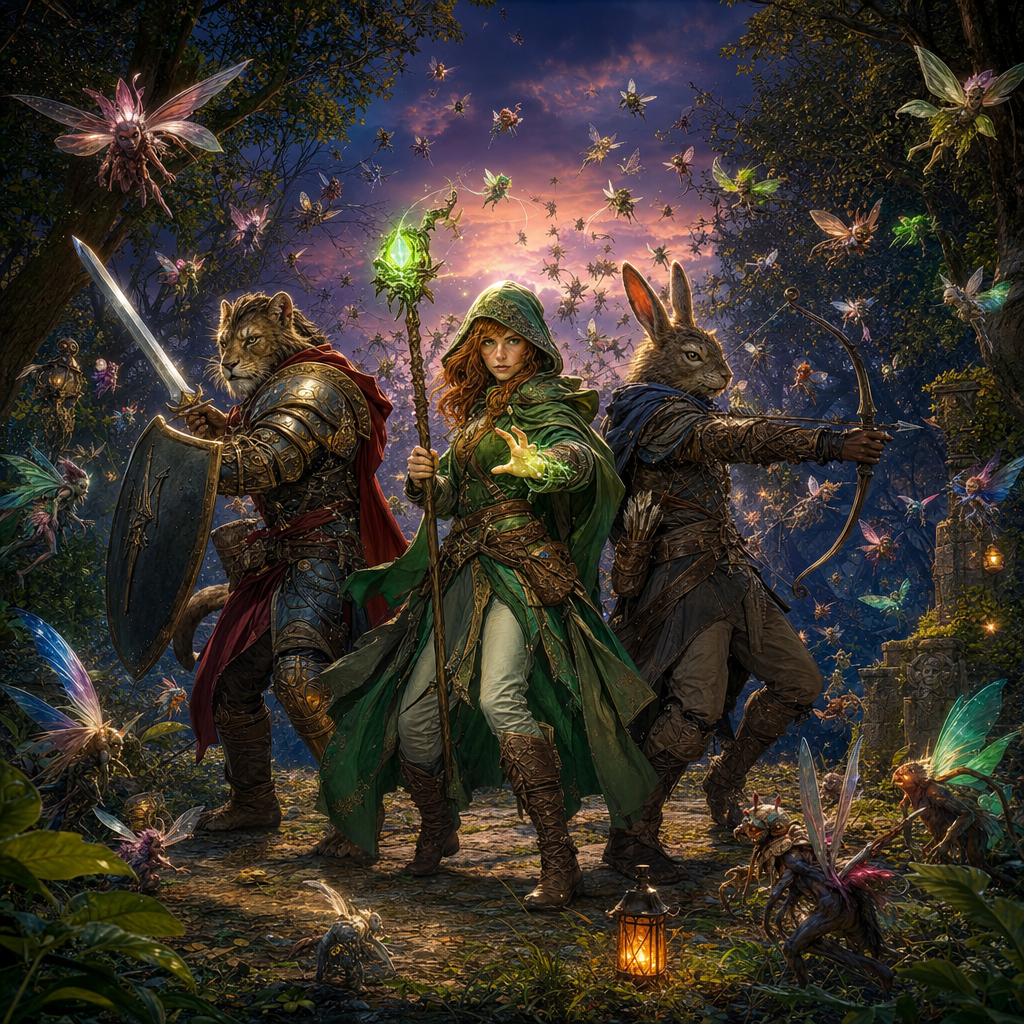
Why Small Monsters D&D Encounters Hit Different
I'll never forget the night my solo campaign's ranger—a character I'd lovingly built around my old barn cat, Turnip—got absolutely demolished by a handful of stirges. Not a dragon. Not a lich. Stirges. Those little mosquito bat things that most players dismiss as cannon fodder. But when you're crossing a swamp at dusk and six of them drop from the canopy, suddenly "small" doesn't mean "harmless." It means "you're about to learn a very specific lesson about action economy."
Small monsters in D&D are criminally underrated. They're not just scaled-down versions of bigger threats—they're fundamentally different tactical challenges that force players to adapt or die. Let's talk about why these tiny terrors deserve a permanent spot in your encounter rotation.
The Tactical Advantage of Thinking Small
Here's what most DMs miss: small monsters dnd encounters aren't about damage-per-round. They're about disruption. A single ogre hits hard, sure. But four pixies with Sleep, Polymorph, and an attitude problem? That's a party wipe waiting to happen, and your players won't see it coming.
Action Economy Is Everything
Small creatures excel because they multiply the enemy's actions. Consider:
- One giant spider: 1 attack per round
- Eight tiny spiders: 8 attacks per round, potentially 8 different targets
- Same CR budget, completely different encounter
Your fighter with 18 AC and a shield? Great. Now they're making eight saves against poison instead of one. Your wizard hoarding spell slots? Each hit breaks concentration. Suddenly that Haste spell they were counting on just evaporated because a creature the size of a dinner plate latched onto their neck.
Environmental Synergy
Small monsters shine when you give them terrain that matches their size. Pixies in a dense forest with thick canopy? They have full cover between attacks. Rats in a sewer with crawlspace-only passages? The barbarian's greataxe is now a liability. Sprites in a library? They can hide inside the books.
I once ran an encounter where a swarm of cranium rats (yes, they're Small, and yes, they're nightmare fuel) used the ventilation shafts of an old wizard tower. The party could hear chittering in the walls. They could see little glowing eyes in the grates. But they couldn't reach them until the rats decided to attack. When they finally did, it was from six different angles at once.
Best Small Monsters for Every Situation
For Early-Level Parties (CR 0-2)
Stirges: The classic. They attach, they drain blood, they make every player paranoid about marching order. CR 1/8 individually, but run them in groups of 6-8 and watch the chaos unfold.
Rats and Cranium Rats: Regular rats are CR 0, but their swarm tactics make them dangerous. Cranium rats add the psychic nightmare factor—they get smarter in groups and can cast spells when enough gather together.
Sprites and Pixies: Fey creatures that turn combat into a puzzle. Sprites can turn invisible and poison arrows. Pixies can cast spells. Both can fly. Your melee characters will hate you (affectionately).
For Mid-Level Challenges (CR 3-6)
Quicklings: CR 1, but with 120 ft. speed and three attacks per turn. They're like caffeinated murder children. Use them to kite, harass, and generally make your party question their life choices.
Imps and Quasits: Shapeshifting, flying, magical resistance, and devil/demon flavor. They work as minions, spies, or just ambient threats in a corrupted area.
Needle Blights: Plant creatures that throw needles and hide in forests. Boring on paper. Terrifying when the entire forest is made of them and nobody can tell which trees are real.
For High-Level Nightmares (CR 7+)
Meenlocks: CR 2 psychic horrors that cause paranoia. Use them in groups to create actual dread. They teleport, they're hard to pin down, and they make your players turn on each other.
Will-o'-Wisps: CR 2 ghostly lights that are immune to most damage types. They consume the life force of dying creatures. They're intelligent. They're patient. They'll follow a wounded party for miles.
Swarms of Any Description: Once you hit mid-to-high levels, swarms of CR 1/4 creatures become environmental hazards. Swarm of Insects, Swarm of Poisonous Snakes—these force AOE usage and create resource drain.
Building Memorable Encounters with Small Monsters
Here's my process, refined through way too many late-night solo sessions and a dog-eared Monster Manual:
Start with the Environment
Small monsters need space that advantages them. Don't put pixies in an open field—put them in brambles where Medium creatures have difficult terrain but Small creatures don't. Don't put stirges in a well-lit throne room—put them in a dark cave where the party's torchlight gives away their position.
Layer the Threat
Combine small monsters with other challenges:
- Stirges + a rickety rope bridge = concentration checks while balancing
- Rats + disease mechanics = long-term consequences beyond HP damage
- Pixies + a riddle-locked door = "we could fight them OR solve this puzzle, but not both"
Give Them Personality
This is where it gets fun. Small monsters aren't just stat blocks—they're creatures with motivations. Maybe those sprites are protecting a sacred grove. Maybe the stirges are starving because something bigger drove them from their hunting grounds. Maybe that swarm of rats is being psychically controlled by something worse in the basement.
When I created my barn cat ranger (RIP Turnip, you would've been a great Tabaxi), I learned something important: size doesn't determine significance. Turnip was eight pounds of spite and whiskers, but he ran that barn like a crime boss. Your small monsters should have the same energy.
Using Creature Forge AI to Build Your Small Monster Arsenal
Here's my favorite trick: I take photos of real animals—the chickens in my coop, the neighbor's aggressively territorial chihuahua, that one weird toad that lives under the porch—and I run them through Creature Forge AI's monster generator. You can upload an actual photo and it'll create a D&D creature with stats, lore, and art that actually looks like your subject.
Last month I uploaded a picture of a hummingbird. The generator gave me a Tiny fey creature with flyby attacks and a nectar-based charm ability. Perfect for a forest encounter. Complete with tactics, CR rating, and a personality quirk about being obsessed with shiny objects.
The best part? You can customize size categories. Want to turn your friend's pet ferret into a Small fiendish scout? Done. Need a swarm variant of those wasps that built a nest in your shed? The tool handles it.
Common Mistakes (That I've Definitely Never Made)
Mistake #1: Too Many at Once
Yes, action economy matters. No, you don't need forty stirges. Combat bogs down when you're tracking too many initiatives. Sweet spot: 6-10 small creatures max, or use swarm rules to consolidate.
Mistake #2: Making Them Too Weak
Don't nerf small monsters just because they're small. A pixie's Polymorph spell should feel like a real threat, not a minor inconvenience. Commit to the danger or don't use them.
Mistake #3: Forgetting They're Smart
A lot of small monsters have decent Intelligence. Pixies have Int 10. Imps have Int 11. They should fight smart—hit and run, target the weak, retreat when outmatched. They're not zombies.
The Story Potential of Small Monsters
Small monsters dnd encounters aren't just combat—they're story hooks. Consider:
- A village plagued by stirges leads to discovering a vampire's hidden lair
- Helpful sprites offer guidance through the Feywild (for a price)
- A swarm of cranium rats reveals a mind flayer plot
- Quicklings stealing supplies hint at a desperate fey court
My solo ranger campaign took an entire detour because of those stirges I mentioned earlier. I got curious: what drove them to the swamp? Turns out, a green hag had cursed their breeding grounds. That became a three-session arc, complete with moral ambiguity about whether exterminating the stirges was even the right call. All because I took six CR 1/8 creatures seriously.
Final Thoughts: Size Doesn't Matter (Except When It Does)
Small monsters teach players a critical lesson: in D&D, the biggest threat isn't always the biggest creature. Sometimes it's the thing you didn't see coming. The ambush predator. The swarm in the shadows. The tiny fey with a grudge and a spell list.
They force creativity. They reward tactics. They turn straightforward combat into dynamic problem-solving. And honestly? They're fun. There's something deeply satisfying about watching a party of hardened adventurers panic because eight tiny flying things just showed up.
If you're looking to expand your small monster roster, try Creature Forge AI. Upload a photo of literally any small creature—your pet, a wild animal, that weird bug you found—and turn it into a fully-statted D&D monster. It's like having a Monster Manual that never runs out of ideas.
Now if you'll excuse me, I need to finish statting out my rooster, Harold. He's going to be a fiend, obviously. That bird has negative Wisdom and an aggro radius of sixty feet.