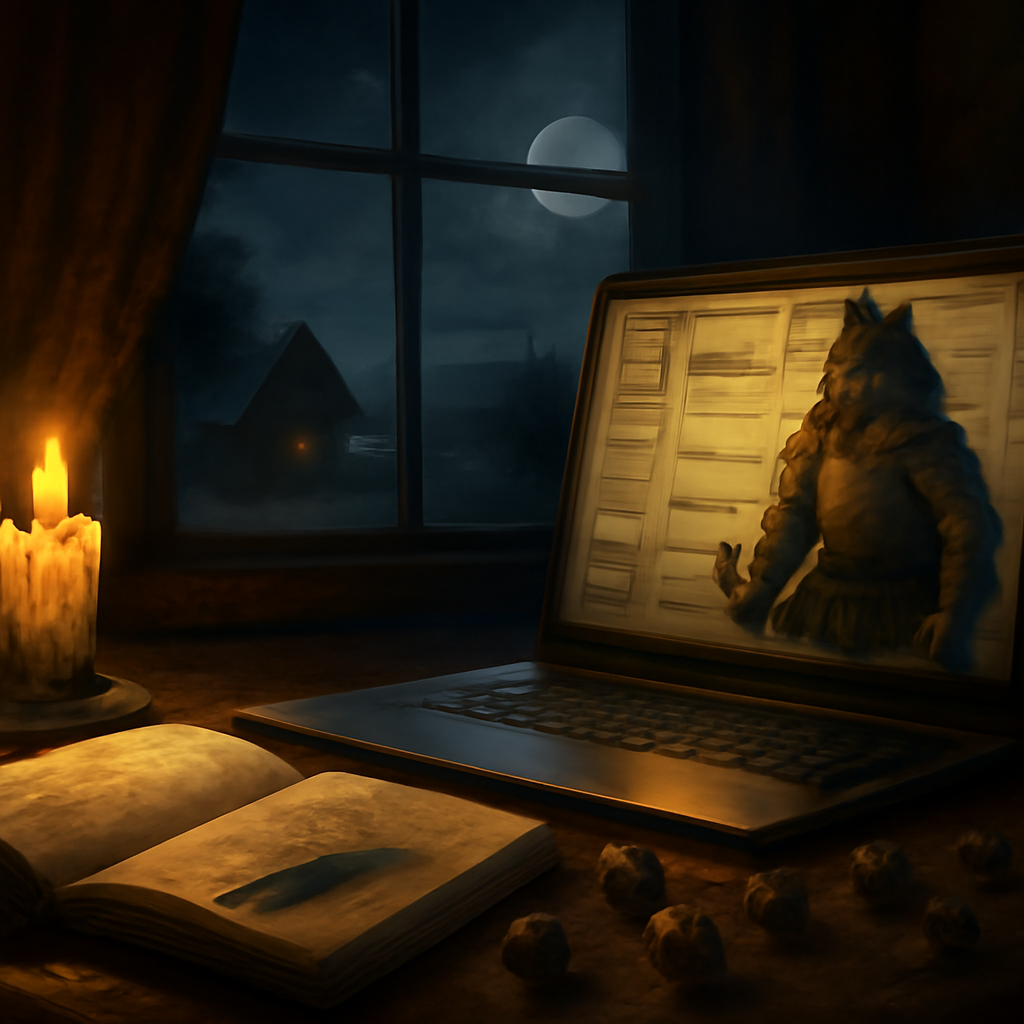
Why I Started Playing D&D Alone with AI
Let me tell you about Tuesday nights on a farm. The animals are settled, the work's done, and the house is so quiet you can hear the old floorboards breathe. That's when I pull out my dice, pour something warm, and disappear into another world entirely. I've been playing D&D alone with AI for the better part of two years now, and it's become as essential to my routine as morning feed.
I didn't start here by choice, exactly. Finding a consistent group when you live thirty minutes from the nearest town and work unpredictable hours? That's a fantasy more far-fetched than anything in the Monster Manual. But solo play—especially with the right AI tools—turned what could've been isolation into something I genuinely look forward to. No scheduling conflicts. No player drama. Just pure, unfiltered storytelling on my terms.
What Playing D&D Alone with AI Actually Looks Like
Here's what people get wrong: they imagine you're just talking to a chatbot that responds with generic fantasy descriptions. That's not it. The real magic happens when you treat AI as a collaborative tool rather than a replacement DM. Think of it as your creative partner—something that fills the gaps you can't reach alone.
On a practical level, here's my typical session:
- I prep a rough scene or situation—maybe my character's entering a suspicious tavern or tracking something through the woods
- I use AI to generate NPCs, unexpected encounters, or environmental details I hadn't considered
- I make decisions, roll dice for outcomes, and let the AI help narrate consequences
- I keep notes in a physical journal because there's something about writing by hand that makes it feel real
The AI doesn't replace my imagination. It amplifies it. When I'm stuck or need a twist, it offers possibilities I hadn't seen. When I need an NPC to react authentically, it helps me think through motivations and responses.
The Tools That Actually Work
Not all AI tools are created equal for solo tabletop play. Some are too rigid, locked into specific game systems. Others are so open-ended they give you nothing to work with. You need something that understands D&D mechanics but doesn't handcuff your creativity.
Character and Creature Generation
This is where things get genuinely exciting. I uploaded a photo of my border collie, Scout, to Creature Forge AI's character generator one night—mostly as an experiment. What came back was a fully-statted Lupine ranger with Scout's exact coloring, her alert posture, even that intense stare she gets when she's tracking something in the pasture. The build was mechanically sound, the backstory felt earned, and suddenly I had a companion character who actually meant something to me.
That's the feature that hooked me. You can turn your actual pets, your friends, even yourself into playable D&D characters. It's not just novelty—it creates instant emotional investment. When that character faces danger, it matters more because you've seen those eyes looking back at you from your couch.
NPC and Monster Tools
Solo play lives or dies on NPC quality. You need personalities that feel real enough to bounce off. Generic "innkeeper" or "guard captain" descriptions kill momentum fast. Good AI tools give you NPCs with quirks, motivations, and secrets—the kind of details that make improvisation easier.
Same with monsters. When you're generating encounters on the fly, you need stat blocks that work mechanically but also creatures with presence. A "wolf pack" is boring. A pack of scarred, winter-starved wolves led by a massive silver alpha with a notched ear? That's a scene.
The Stuff Nobody Tells You About Solo D&D
Here's the honest part: playing D&D alone with AI can feel weird at first. You might feel self-conscious narrating out loud to yourself. You might worry you're doing it "wrong" because there's no DM, no other players to validate your choices.
Let that go.
Solo play isn't inferior—it's different. You have complete narrative freedom. Your character can chase threads that interest you without worrying about spotlight balance. You can explore moral ambiguity without anyone getting uncomfortable at the table. You can make the story about whatever matters to you in that moment.
The Self-Consciousness Fades
After my third session, I stopped caring if I looked ridiculous rolling dice and talking through combat turns out loud. My dog's heard weirder things. The rooster outside has definitely judged me for lesser crimes. Once you accept that nobody's watching and nobody's grading you, the self-consciousness just evaporates.
You Still Need Structure
Total freedom can be paralyzing. I've learned to set light constraints: a quest goal, a deadline, a complication. The AI helps here—ask it to introduce a complication or create a ticking clock, and suddenly your wandering exploration has stakes.
Embrace the Unexpected
Some of my best sessions came from AI-generated elements that initially seemed wrong. A merchant NPC with an inexplicable fear of birds. A seemingly straightforward dungeon that turned out to be a massive turtle shell. Lean into the weird. The AI sometimes makes logical leaps you wouldn't—that's not a bug, it's a feature.
Building Better Prompts
If you're using AI for solo D&D, prompt quality matters enormously. Vague inputs get vague outputs. Here's what works:
- Be specific about tone: "Give me a sinister NPC" gets generic villain. "Give me a halfling merchant who seems friendly but collects debts with unsettling precision" gets gold.
- Include context: Tell the AI what's happened so far, what your character knows, what they're trying to achieve.
- Ask for options: Instead of "what happens next," try "give me three possible complications, ranging from minor to campaign-altering."
- Request stat blocks when needed: Don't just ask for monster descriptions—ask for full 5e stat blocks if you're planning combat.
When to Roll Dice vs. When to Narrate
This is pure personal preference, but here's what I've landed on: I roll for anything that would traditionally require a roll—attacks, saving throws, skill checks. I narrate or use AI for descriptions, NPC reactions, and environmental details. The dice keep things unpredictable. The narrative tools keep things flowing.
There's something almost meditative about the rhythm. Roll dice. Consider outcome. Prompt AI for the consequence or reaction. Write down what happened. Move forward. It's not faster than group play—it's actually slower—but it's deeper. More contemplative.
The Photo Upload Feature Changes Everything
I keep coming back to this because it's genuinely transformative: being able to upload actual photos and get D&D characters from them creates a bridge between your real world and your fantasy world that's hard to describe until you experience it.
I've made characters from my livestock guardian dog (a Leonin paladin, because of course), my barn cat (a Tabaxi rogue so obvious it hurt), even my ornery rooster (a Kenku warlock with a chaos streak). My nephew visited last summer and we turned his photo into a human fighter. He's eight. He talks about "his character" like it's the coolest thing that's ever happened to him.
That's the real power here—it makes the abstract concrete. Fantasy stops being something distant and becomes something woven into your actual life.
Solo Play Doesn't Mean Lonely Play
The biggest misconception about playing D&D alone with AI is that it's somehow sad or isolating. It's not. It's meditative. It's creative. It's the same satisfaction as writing in a journal or working on any solitary craft.
I still value group play when I can get it. But solo sessions with AI support have become their own thing—not a substitute, but a distinct experience I'd miss if it disappeared. There's freedom in solo play that you simply can't get with other people at the table, no matter how compatible your group.
Getting Started Tonight
If you're curious about trying this, here's my advice: don't overthink it. Pick a character concept, establish one clear goal, and start small. Generate one interesting NPC or monster. Ask yourself what your character would do. Roll when it matters. Use AI to fill gaps and add texture.
Tools like Creature Forge AI make the technical side—stat blocks, character sheets, balanced encounters—nearly effortless. That leaves you free to focus on the only part that really matters: the story you're telling yourself.
Is it strange to sit alone at a table, rolling dice and consulting AI-generated NPCs while your dog snores nearby? Maybe. But so is everything worthwhile when you first start. These Tuesday nights have given me some of my favorite stories, and not one of them required convincing four other people to show up at the same time.
Pour something warm. Pull out your dice. See where the story takes you. You might surprise yourself.