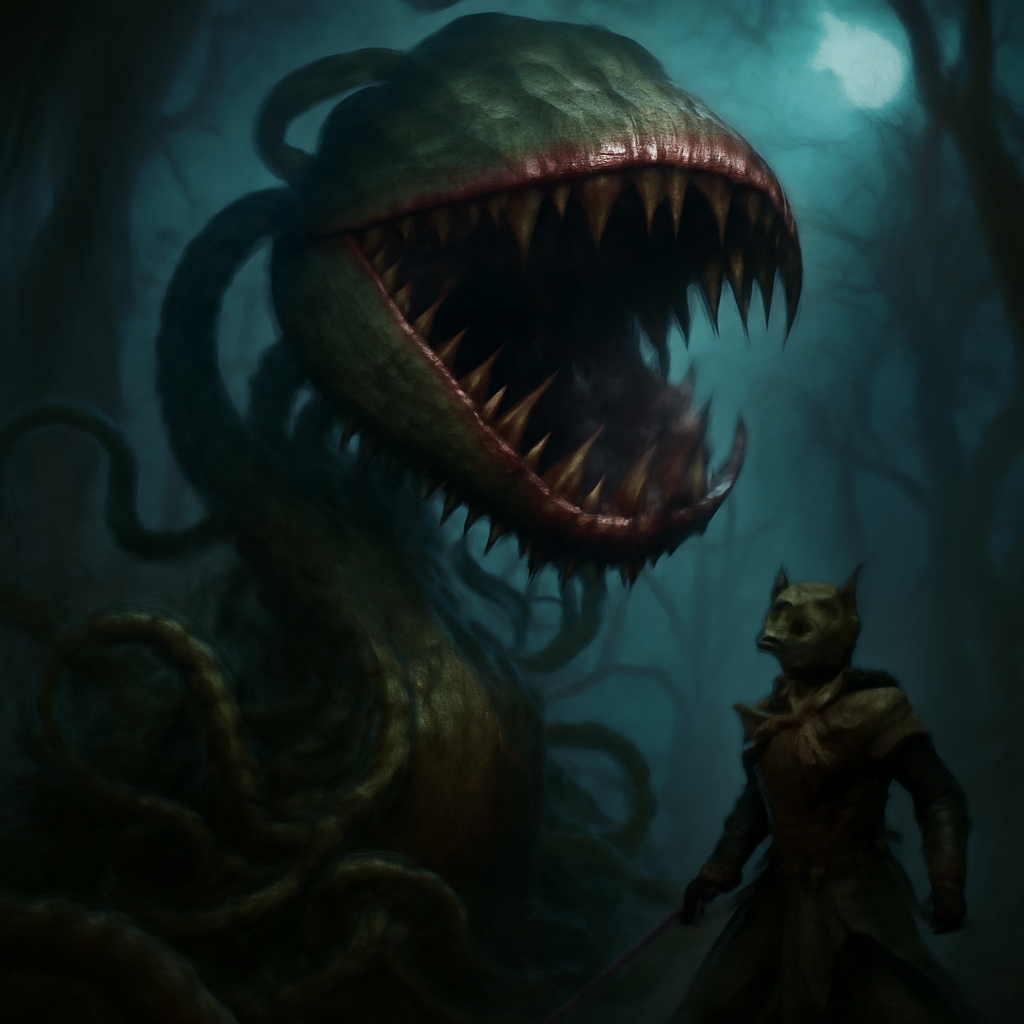
I grew up surrounded by plants that wanted me dead. Not literally—though tell that to the blackberry thicket that drew blood every summer, or the poison ivy that lurked by the chicken coop like it had a personal vendetta. When I started running solo D&D campaigns late at night with nothing but coffee and dice, those stubborn farm weeds became my inspiration for plant monster ideas for D&D that actually felt dangerous.
The Monster Manual gives us shambling mounds and treants, sure. But if you've ever fought actual nature—pulled thistle, hacked through kudzu, watched a pumpkin vine strangle everything in its path—you know plants can be so much worse. Here's how to build plant monsters that feel genuinely threatening, memorable, and rooted in the kind of botanical horror your players won't see coming.
Why Plant Monsters Hit Different
Plant creatures occupy this perfect horror sweet spot: they're familiar enough to be unsettling (everyone knows what a tree looks like) but alien enough to be unpredictable (but does it think?). They challenge players who've memorized every dragon's breath weapon but blank when the dungeon walls start bleeding sap.
The best plant monsters exploit what makes real plants genuinely weird: they're patient, they're invasive, they don't need to chase you because they were already there when you arrived. That's the energy we're channeling.
The Thorn Garden Stalker
Start with every player's instinct to walk through underbrush without a second thought. Now punish it.
Concept: A semi-mobile rose thicket that's developed rudimentary intelligence after feeding on wounded animals for decades. It looks like dense, thorny overgrowth until something bleeds nearby.
Mechanics I use:
- Passive camouflage: DC 17 Perception to notice it's alive before it attacks
- Grasping vines with reach that trigger on movement or the smell of blood
- Each hit causes bleeding (1d4 damage per turn until a Medicine check or healing)
- Weakness to fire, but burning it creates choking smoke (Constitution saves or poisoned condition)
The beauty here is tension. Once players know these exist in your world, every thorny patch becomes a negotiation. Do we risk the shortcut? Do we have fire ready? Who goes first?
The Fungal Choir
Mushrooms are nature's little weirdos, and D&D doesn't use them enough. Myconids are fine, but what about something that isn't a person—something that's genuinely other?
Concept: A colony organism that communicates through spores and sound. Individual mushrooms sprout and collapse, but the network beneath is ancient and patient. It doesn't want to kill you. It wants to know you. To become you.
Mechanics I use:
- Hallucinogenic spore clouds (Wisdom saves against confusion/charm)
- Each failed save against spores adds a "memory tag"—the Choir learns a fact about you and can mimic voices from your past
- Physical attacks destroy individual mushrooms but don't harm the colony—they just sprout elsewhere
- Vulnerable to salt, bright light, or anything that disrupts the underground network
I ran this in a solo campaign where my ranger kept hearing her dead sister's voice. Turns out the Choir had absorbed memories from a previous victim. It didn't understand what it was doing—it just knew the sounds made people stop and listen. Absolutely haunting.
Building Fungal Encounters
Fungal monsters work best when they're about atmosphere and wrongness, not combat stats. Use them in enclosed spaces. Have spores drift through torchlight. Let players notice the mushrooms have moved between long rests. The question "is this thing hostile or just incomprehensible?" does more work than any damage roll.
The Carnivorous Garden
We had pumpkins on the farm that would take over half an acre if you let them. Vines as thick as your wrist, tendrils that grabbed fence posts, leaves that blocked out the sun. Now imagine that pumpkin patch is hungry.
Concept: A cultivated space that's achieved collective sentience. Multiple plant types working in concert—pitcher plants as traps, vines as restraints, thorns as weapons, parasitic flowers as the "brain."
Mechanics I use:
- The entire encounter area is the monster—hitting individual plants only disables features temporarily
- Players must identify and destroy the "queen bloom" (the central coordination node)
- Environmental hazards: sticky sap patches (reduce movement), pollen clouds (saving throws), false paths that lead to pitcher plant ambushes
- The garden can reshape itself slowly—paths that were safe become trapped, exits disappear
This works as a set-piece encounter. Give players time to observe before they commit. Let them spot patterns. Reward creative problem-solving over hack-and-slash tactics. The wizard who uses Gust of Wind to clear pollen clouds should feel like a genius.
The Strangler Fig Horror
Real strangler figs are already nightmare fuel: they germinate in tree canopies, send roots down to the ground, then slowly encase and kill their host tree. That's metal. Let's make it worse.
Concept: A parasitic plant that doesn't just kill trees—it hollows them out and wears them like puppets. What looks like a normal treant is actually a shambling corpse controlled by the fig inside.
Mechanics I use:
- Appears as a standard treant or awakened tree until damaged
- When reduced to half HP, the host tree collapses and the actual monster emerges—a writhing mass of roots and vines
- Second phase is faster, more aggressive, and can grapple multiple targets
- Drops seeds that will sprout into new stranglers if not burned or destroyed
The fake-out is what makes this memorable. Players fight what they think is a known quantity, then suddenly the encounter changes. It's the botanical version of a mimic, and players will never trust trees the same way again.
Using Creature Forge AI for Plant Monsters
Here's where I'll share my secret weapon: when I need stats for these botanical horrors, I use Creature Forge AI's monster generator. You can describe exactly what you want—"a carnivorous plant that uses hallucinogenic spores and grasping vines"—and it builds the stat block, including CR, abilities, and lore hooks.
The best part? If you've got a photo of an actual plant that inspired you—that twisted vine from your backyard, the weirdly shaped mushroom from your last hike—you can upload it and the AI will build a creature that actually looks like your reference. I've turned farm photos into fungal nightmares and nobody at my table knew they were staring at the blackberry thicket from behind my barn.
Environmental Integration: Making Plants Feel Alive
The difference between a forgettable plant monster and one that haunts your players is context. These creatures should feel like they belong in their environment—because they are the environment.
Before the encounter:
- Describe unusual plant growth—trees with scorch marks, clearings where nothing grows, patches of wilted vegetation
- Have NPCs mention local superstitions: "Don't camp under the hanging moss" or "Stay on the path after dark"
- Show signs of previous victims: bones wrapped in vines, equipment tangled in roots, a sword embedded in a tree trunk
During the encounter:
- Use all the senses—the sweet rot smell of pitcher plants, the rustling of leaves when there's no wind, sap that burns like acid
- Plants don't roar or threaten—they just are. That silence is more unsettling than any monster monologue
- Remember that plants are patient. They don't chase. They wait. They were here before you arrived and they'll be here after you leave
Scaling Plant Encounters
Plant monsters work at any level if you adjust the right variables:
Low level (1-4): Individual plants with simple abilities. A single carnivorous vine. Animated shrubs. Threatening but manageable. Focus on teaching players that nature fights differently than bandits or beasts.
Mid level (5-10): Colonies and coordinated attacks. The Fungal Choir. The Carnivorous Garden. Encounters where the environment itself is hostile and players need strategy beyond "hit it with sword."
High level (11+): Ancient plant consciousness, mobile forests, plant-based plagues. The Strangler Fig Horror as a recurring villain that's been puppet-mastering an entire grove. At this tier, plant monsters should feel like forces of nature, not just big vegetables.
My Favorite Plant Monster Twist
The best plant encounter I ever ran was an abandoned garden where each flower bed had been cultivated by a different wizard, and over decades the plants had crossbred into something new. One patch had roses that whispered secrets (true information, but they attracted attention). Another had lilies that granted temporary flight (but made you hungry for sunlight and soil). The tomatoes in the corner had developed a taste for blood.
It wasn't a combat encounter. It was a resource negotiation with a garden that didn't understand concepts like "trespassing" or "consent." Some players harvested carefully. Others tried to burn everything and deal with the consequences. Both approaches were valid, and both had costs.
That's the energy I'm always chasing with plant monsters—not "nature as enemy" but "nature as utterly indifferent to your survival."
Start Growing Your Own Monsters
The plant monster ideas for D&D that will land hardest at your table are the ones connected to your own experiences. What plants scare you? What vegetation feels aggressive or invasive where you live? That kudzu that swallows abandoned houses, those mushrooms that spring up overnight, the ivy that pulls down fences—those are your monsters. You already know how they move and spread and persist.
Take that real-world observation, add teeth and intention, and you've got an encounter your players have never seen before. If you need help turning that vision into actual game mechanics, try Creature Forge AI—it's built exactly for this kind of creative translation from concept to stat block.
Now go forth and make your players afraid of houseplants. They'll thank you later. Probably. Eventually.
===