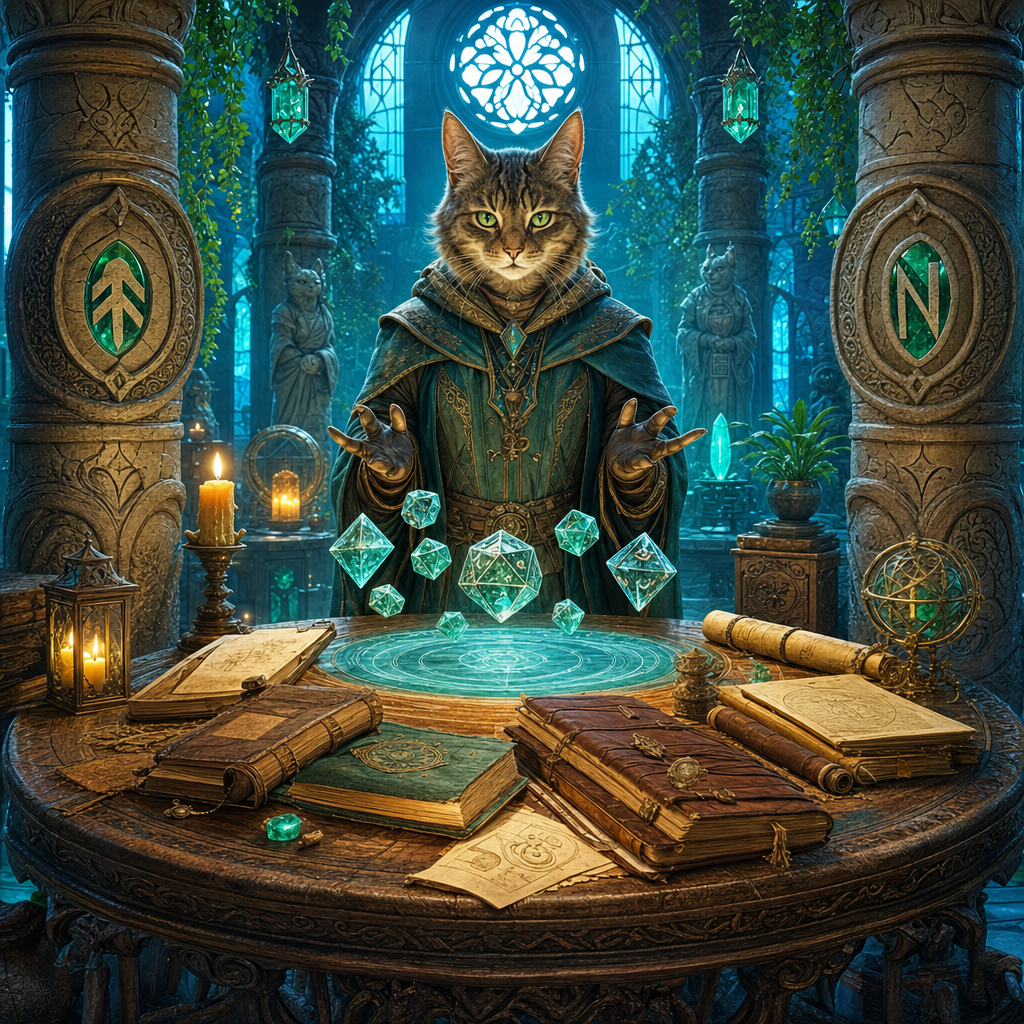
What the Mune Oracle Actually Is
The Mune oracle is a solo RPG tool designed to answer questions when you don't have a Game Master. Instead of asking another person "does the guard believe my lie?" or "is there a trap on this door?", you're asking the oracle — and it responds through an elegant combination of dice rolls and interpretive results.
I stumbled onto Mune about two years back, during one of those late-night solo sessions where I'd painted myself into a narrative corner. My character was trying to negotiate with a bandit leader, and I genuinely didn't know if this NPC should accept the deal or attack. I needed something more nuanced than a coin flip. The Mune oracle gave me exactly that: a "yes, but..." answer that sent the story somewhere I never would've planned. The bandits agreed to leave peacefully, but one of them recognized my character from a past job. Suddenly I had complications, consequences, and a hook for the next session.
How the Mune Oracle Works
At its core, Mune uses two six-sided dice to generate answers on a spectrum from "no, and..." to "yes, and..." Rather than binary results, you get nuanced responses that add texture to your game:
- No, and... — Not only does it fail, but something worse happens
- No — Simple failure
- No, but... — Failure with a silver lining
- Yes, but... — Success with complications
- Yes — Simple success
- Yes, and... — Success plus an additional benefit
The system also accounts for likelihood. Is this outcome highly likely? Unlikely? Somewhere in between? You adjust your odds accordingly, which keeps the oracle from feeling random. When my rogue tried to pick a simple lock, "yes" came up frequently. When she attempted to seduce the dragon? "No, and..." felt appropriately catastrophic.
The Intervention Mechanic
Here's where Mune gets really interesting. Occasionally the dice trigger an "intervention" — a random event or twist that changes everything. The system provides prompts to help you interpret what this means. During a dungeon crawl last month, an intervention turned a routine combat into a cave-in that separated my party (yes, I run multiple characters) and introduced a previously unknown underground river. None of that was planned. The oracle made it happen.
Why I Use Mune Instead of Other Oracles
I've tried Mythic GME, Story Engine, and a handful of others. They're all solid tools, but the Mune oracle clicked for me because of its speed. I don't have to reference complex charts or calculate weighted probabilities. Two dice, a quick interpretation, and I'm back in the story. When you're playing solo at eleven PM after a long day of farm chores, you want something that flows.
The nuanced answers also prevent that feeling of the dice "playing the game for you." A coin flip tells you yes or no. Mune tells you yes or no and what that means. It generates complications, opportunities, and unexpected story beats that make solo play feel less like talking to yourself and more like collaborating with an unpredictable co-author.
Practical Tips for Using Mune
Frame Your Questions Carefully
The oracle is only as good as what you ask it. "Does something happen?" is too vague. "Does the innkeeper know anything about the missing villagers?" gives you something concrete to interpret. I keep a running list of question types that work well:
- Does this NPC have [specific knowledge/skill/trait]?
- Is [location] currently [condition]?
- Do I encounter [type of obstacle/creature/person]?
- Does [action] succeed as intended?
Let "But" and "And" Breathe
When you get "yes, but..." don't immediately jump to the worst complication. Sit with it. Maybe your spell works but drains you more than expected. Maybe the guard lets you pass but now you owe him a favor. The "but" and "and" modifiers are invitations to think laterally about consequences and opportunities.
Last week I rolled "no, but..." when asking if a suspicious merchant would sell me information. He wouldn't talk — but his nervous glance toward the back room told me exactly where to search after he left. The "but" transformed failure into a different kind of success.
Combine Mune with Random Tables
The oracle tells you if something happens. Random tables tell you what happens. When an intervention triggers during travel and you need to know what kind of encounter occurs, that's when you break out your monster tables, weather charts, or NPC generators. I've found Creature Forge AI's monster generator pairs beautifully with Mune — the oracle tells me "yes, you encounter something dangerous," and the generator shows me exactly what I'm fighting. Sometimes I'll even upload a photo of one of my barn cats to create a feline-themed enemy that actually looks like the troublemaker who keeps knocking over my dice.
Trust Interventions Even When They're Inconvenient
Interventions derail plans. That's the point. My current character was supposed to be investigating a cult, but an intervention introduced a rival adventuring party with the same goal. Now half my campaign is political maneuvering and trying to stay one step ahead of competitors. It's better than what I'd outlined originally because it was genuinely surprising to me.
When Mune Works Best
The Mune oracle shines in narrative-focused games where player choice and consequences matter more than tactical combat optimization. It's perfect for:
- Investigation scenarios where you need to discover clues without pre-planning everything
- Social encounters with multiple possible outcomes
- Exploration when you want the world to feel reactive and alive
- Downtime activities that might succeed or fail in interesting ways
It's less useful for purely mechanical questions. "Do I hit with this attack?" is what your d20 is for. "Does the enemy have reinforcements nearby?" — now you're in Mune territory.
Integrating Mune with Your World-Building
One habit I've developed: whenever the oracle generates an unexpected answer, I write it into my campaign notes as established fact. If I ask "is there a thieves' guild in this city?" and get "yes, and..." then boom, there's a thieves' guild and it's more influential than typical. That detail might not matter immediately, but three sessions later when I'm asking "does anyone notice me breaking into the warehouse?", I remember that powerful guild and adjust the likelihood accordingly.
The oracle isn't just answering individual questions — it's helping you build a coherent, persistent world where past answers inform future probabilities. Your setting develops organically through play rather than through upfront planning.
Creating NPCs On the Fly
When Mune tells you an NPC exists or reacts a certain way, don't let them stay abstract. Give them a name, a personality quirk, maybe even a visual reference. I'll often sketch quick notes or use an NPC generator to flesh out whoever just emerged from the oracle's answer. That innkeeper who "yes, and..." knew about the missing villagers? She became Marella, a half-elf with trust issues and a surprisingly detailed backstory about why she's tracking the cult herself. All from a single oracle roll.
Common Mistakes and How to Avoid Them
After hundreds of oracle rolls, I've learned what not to do:
- Don't reroll because you don't like the answer. That's not emergent storytelling; that's just planning with extra steps. If the oracle says no, find the interesting failure.
- Don't ask questions you've already decided. If you know you want the duke to be corrupt, don't ask "is the duke corrupt?" Just make him corrupt. Save the oracle for genuine uncertainty.
- Don't ignore likelihood adjustments. Not everything is 50/50. A seasoned guard probably will notice your amateur disguise. A random peasant probably won't know ancient draconic languages. Adjust accordingly.
- Don't forget to interpret. "Yes, but..." means nothing until you decide what the "but" is. Take a moment. Think about complications that would be interesting rather than just punishing.
Why Solo Players Need Tools Like This
Playing solo without an oracle feels like writing a story where you know every twist before it happens. There's no surprise, no emergence, no sense of discovery. The Mune oracle gives you back that essential element of uncertainty that makes RPGs exciting in the first place.
My goat Biscuit has more charisma than any NPC I've ever planned. But the NPCs I've discovered through oracle play? They stick with me. The bandit who became a reluctant ally. The merchant whose nervousness revealed a secret. The rival party that turned a simple quest into a competition. None of them would exist if I'd tried to outline everything beforehand.
That's the magic. You're not asking a crystal ball to predict the future of your campaign. You're asking it to help you discover what was always possible — you just didn't know to look for it yet.
Getting Started
You don't need anything fancy. Two six-sided dice and the free Mune PDF (easily found online) will do. Start simple: use it for just one or two questions per session until the rhythm feels natural. Ask about NPC knowledge, environmental conditions, or whether your character's plans work out as hoped.
Pay attention to those "but" and "and" modifiers. They're where the real storytelling happens. And when you need to bring those oracle answers to life — whether it's a creature that emerged from an intervention, a character you want to visualize, or turning your actual border collie into a lupine ranger — that's when generators and creative tools make the whole process sing.
Solo play isn't about replacing other people. It's about finding systems that help you surprise yourself. The Mune oracle does exactly that, two dice at a time.
Ready to build the creatures, characters, and NPCs that your oracle-driven campaigns deserve? Try Creature Forge AI and turn those unexpected story beats into fully realized fantasy beings — including the option to upload photos and create characters that actually look like the inspiration behind them. Your next campaign is waiting. The oracle just needs to tell you where it begins.