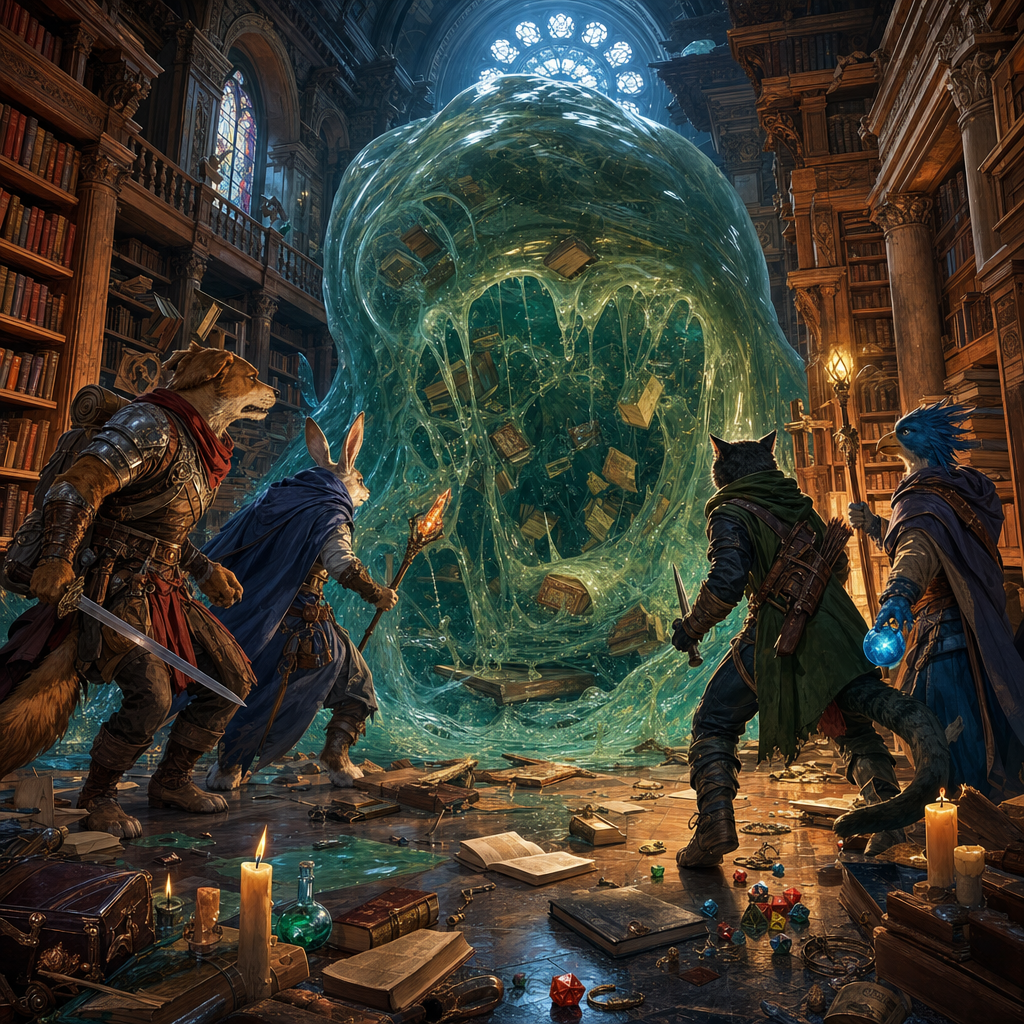
Why Your Low-Level Party Deserves Better Than Generic Wolves
I've been running solo campaigns long enough to know that the early levels are make-or-break for players. Throw something too deadly at a level 2 party, and you're writing epitaphs. Throw another pack of dire rats, and you're writing apologies for boring them to death instead.
The sweet spot for monster ideas for low level parties isn't about CR calculations alone—it's about creating encounters that feel dangerous, winnable, and memorable. Your players should walk away with stories, not just experience points.
Here's the thing: I grew up on a farm where every animal had personality. Our goat Biscuit had more tactical intelligence than most goblins I've ever run. She'd feint left, circle around the fence post, and headbutt you from an angle you didn't see coming. That taught me something crucial for D&D: even "simple" creatures become interesting when they behave like they're actually trying to survive, not just waiting to be killed.
Monsters That Scale Beautifully for Levels 1-3
Animate Objects (Household Edition)
Forget the shambling mound for now. A trio of animated brooms or a possessed suit of armor at CR 1 creates chaos without overwhelming action economy. The beauty here is environmental storytelling—why are these objects animated? Failed wizard apprentice experiment? Curse? Mischievous fey?
I ran an encounter once where animated kitchen knives chased the party through a haunted manor. One player still talks about using a cast-iron skillet as an improvised shield. That's the kind of creativity low-level encounters should inspire.
Swarms (But Make Them Weird)
A swarm of rats is boring. A swarm of clockwork beetles that emerged from a broken automaton? Now we're talking. Swarms at CR 1/4 to 1/2 are perfect for low-level parties because they:
- Create tactical challenges (area damage becomes valuable)
- Die to creative solutions (fire, water, barriers)
- Feel threatening without huge damage spikes
- Can be flavored into anything: spectral moths, crystalline spiders, carnivorous butterflies
The stat block stays the same. The description does all the heavy lifting.
Twig Blights and Myconids
Plant creatures are criminally underused at low levels. Twig blights (CR 1/8) come in numbers and can be controlled by a more intelligent creature, creating a mini-boss dynamic. Myconid sprouts (CR 0) are technically non-hostile, which opens roleplaying doors your players won't expect in a "monster encounter."
Bonus: if you're looking for fresh creature ideas with unique twists, the Creature Forge AI monster generator can spin up plant-based horrors with actual personality quirks and tactical behaviors. I've used it to create a fungal shambler that could only move when no one was looking—stolen straight from horror games, but it worked beautifully at the table.
Monsters with Built-In Story Hooks
Scarecrows
At CR 1, a scarecrow is a legitimately creepy challenge. It's immune to being frightened (unnerving for players used to causing fear), resistant to bludgeoning, and has a terrifying gaze that can paralyze.
But here's the real gold: scarecrows are created objects. Someone made this thing. Who? Why? That nearby farm with the missing family? The isolated wizard's tower? Instant plot hook.
Shadows
Yes, shadows are dangerous at CR 1/2—that Strength drain can drop a character fast. But used sparingly (one shadow, not four) in the right context, they create tension like nothing else. The flickering torchlight. The corner of the room that seems too dark. The creeping realization that darkness itself is hostile.
Key rule: telegraph danger. Describe the unnatural cold, the way shadows don't fall correctly, the NPC who warns them about "the dark corners." Give them a chance to prepare, and the encounter becomes thrilling instead of cheap.
Reskinned Classics That Feel Fresh
Sometimes the best monster ideas for low level parties come from taking an existing stat block and completely changing its coat of paint.
Giant Rats Become:
- Escaped magical experiments with glowing eyes and crystalline growths
- Miniature bulettes that burrow through wood instead of earth
- Fey-touched rabbits with unnaturally sharp teeth (keep the speed, add the creep factor)
Skeletons Become:
- Animated scarecrow frames (same stats, completely different vibe)
- Crystalline constructs that shatter dramatically when destroyed
- Coral-encrusted remains from a shipwreck, dripping seawater
The numbers don't change. The experience absolutely does.
The Pet-to-Monster Pipeline (Yes, Really)
Here's where things get personal and unexpectedly useful. I uploaded a photo of my old border collie, Ranger, into Creature Forge AI's character generator as an experiment. What came back was a canine-featured scout with his exact coloring pattern—white blaze, one ear up, one ear slightly crooked—translated into a fantasy character design.
That got me thinking: what if you built low-level monsters the same way? Take a pet, a local animal, something with actual personality, and transform it into an encounter. Your childhood cat becomes a fey-touched familiar gone rogue. That stubborn rooster from the farm becomes a cockatrice variant (use cockatrice stats, adjust flavor).
The encounters feel grounded because they're based on real behavioral quirks. Biscuit the goat's headbutt-from-nowhere tactic? That's a charge attack with advantage on surprised targets. Ranger's obsessive ball-chasing? A creature that becomes fixated on glowing objects, creating tactical opportunities.
Balancing Challenge Without Crushing Spirits
Low-level parties are fragile. A critical hit can drop a wizard from full HP to making death saves. Here's how to keep monster ideas challenging but fair:
The Action Economy Rule
More weaker creatures beats one strong creature almost every time. A single CR 2 monster might have big numbers, but four CR 1/4 creatures create more interesting combat through positioning, focus-fire decisions, and resource management.
Telegraph Tactics
Your monsters should behave intelligently, but players deserve fair warning. The giant spider retreating to its web-filled ceiling? Describe the webbing before initiative. The ooze that splits when damaged? Have them find a journal entry or scorch marks on the wall suggesting fire works best.
Build in Escape Routes
Not every encounter needs to be fight-to-the-death. Creatures that flee at half HP, environmental hazards that let clever players end combat early, objectives beyond "kill everything"—these turn potential TPKs into legendary close calls.
Monster Combinations That Punch Above Their Weight
Sometimes the best low-level encounters come from mixing creature types:
- Kobolds + environmental hazards: Separately easy, together deadly. Kobolds (CR 1/8) are cowards with Pack Tactics—put them in a trapped room with collapsing floor sections and watch your players sweat.
- Stirges + difficult terrain: Stirges (CR 1/8) are annoying alone, terrifying in swampy water where movement is halved and attacks have disadvantage.
- Bandits + mastiff war dogs: Two CR 1/8 creatures working together create tactical depth. The dogs grapple, the bandits get advantage. Simple, thematic, effective.
- Zombie + environmental storytelling: One zombie (CR 1/4) shambling through a plague-village creates atmosphere. Players expect more. The tension builds even if reinforcements never arrive.
When to Break Your Own Rules
Here's the controversial take: sometimes you should throw something slightly too powerful at a low-level party—if you've built in outs.
That CR 3 werewolf? Terrifying for level 2 characters. But if they've already learned it's trapped in a silver-lined cage, and the encounter is about keeping it contained while they solve a puzzle, you've just created a pressure-cooker skill challenge instead of a death sentence.
The dragon wyrmling circling overhead? Way too strong for direct combat. But as a ticking clock ("solve this before it notices you") or a negotiation opportunity ("what if we help it with its injured wing?"), it becomes the session everyone remembers.
Tools for Infinite Monster Variety
The honest truth about running games regularly—solo or with groups—is that prep time is limited. I spend more time mucking out stalls than stat-blocking custom creatures most weeks. That's where having reliable generators matters.
Modern tools like Creature Forge AI don't just spit out stat blocks—they create creatures with personality, tactics, and lore hooks that feel hand-crafted. The fact that you can upload a photo of literally anything and get a fantasy version back is wild. I've turned fence posts, weird clouds, and yes, multiple farm animals into encounters.
But whether you use generators, reskin existing monsters, or build from scratch, the core principle stays the same: low-level parties need encounters that respect their fragility while challenging their creativity.
Start Building Better Low-Level Encounters
Your level 1-3 party is navigating the most dangerous stretch of their adventuring careers, statistically speaking. They deserve monsters that feel like living parts of your world, not random encounter table filler.
Take that tavern rat problem and make the rats diseased victims of a failed alchemical experiment. Turn the forest bandits into desperate refugees driven to violence by something worse in the woods behind them. Give your shambling zombies a reason to be shambling—and give your players a way to solve the why instead of just the what.
If you're stuck for ideas or just want to see what happens when you feed your actual pet's photo into a fantasy creature generator, give Creature Forge AI a try. Sometimes the best encounters come from the most unexpected sources.
After all, Biscuit the goat taught me more about tactical positioning than any Monster Manual ever did. Your inspiration is probably closer than you think.