Why Low Level D&D Monsters Matter More Than You Think
I learned the hard way that low level D&D monsters aren't just cannon fodder for your starting party. Three sessions into my first solo campaign, I threw eight goblins at my level 2 ranger and her wolf companion. Should've been easy, right? Those goblins used pack tactics, hid behind cover, and one of them got a critical hit that dropped my character to 3 HP. I sat there at my kitchen table at midnight, genuinely stressed, with my dog Copper staring at me like I'd lost my mind.
That's when I realized: it's not about the challenge rating. It's about how you use them.
Low-level monsters—anything from CR 0 to CR 2—form the backbone of early campaign encounters. They introduce new players to combat mechanics without overwhelming them. They teach action economy, positioning, and resource management. And when used creatively, they create stories your players will remember longer than any ancient red dragon.
The Best Low Level D&D Monsters for Early Encounters
Goblins: Smarter Than They Look
Goblins are the gateway drug of D&D monsters, but most DMs use them wrong. A goblin has 7 hit points and a +4 to hit. Alone, it's a speed bump. But goblins have two features that make them dangerous: Nimble Escape and pack tactics when you run them smart.
Here's what works: goblins should never fight fair. They ambush from high ground. They throw nets. They set traps and then hide behind them. One goblin runs away screaming—and leads the party into three more goblins with readied actions. Suddenly your CR 1/4 creatures feel like a legitimate threat.
Giant Rats and Swarms
I used to think giant rats were boring until I uploaded a photo of my barn cat Biscuit to Creature Forge AI's character generator and built her as a ratcatcher ranger. That character needed rats worth catching. Giant rats (CR 1/8) have pack tactics and disease. A swarm of rats (CR 1/4) has resistance to physical damage and can occupy another creature's space.
Drop a swarm on your party in a sewer where they can't swing swords effectively. Add disease mechanics. Make them choose between fighting and running. Suddenly these 7 GP creatures create tension.
Skeletons: Action Economy Lessons
Skeletons are CR 1/4, which means you can throw a lot of them at a level 1 party. They're perfect for teaching new players about action economy—the idea that more turns often beats stronger individual units. Four skeletons against three level 1 characters creates a numbers disadvantage that feels threatening without being unfair.
Plus skeletons are vulnerable to bludgeoning damage, which rewards players who think tactically about weapon choice. That quarterstaff suddenly matters.
Wolves: Predators With Purpose
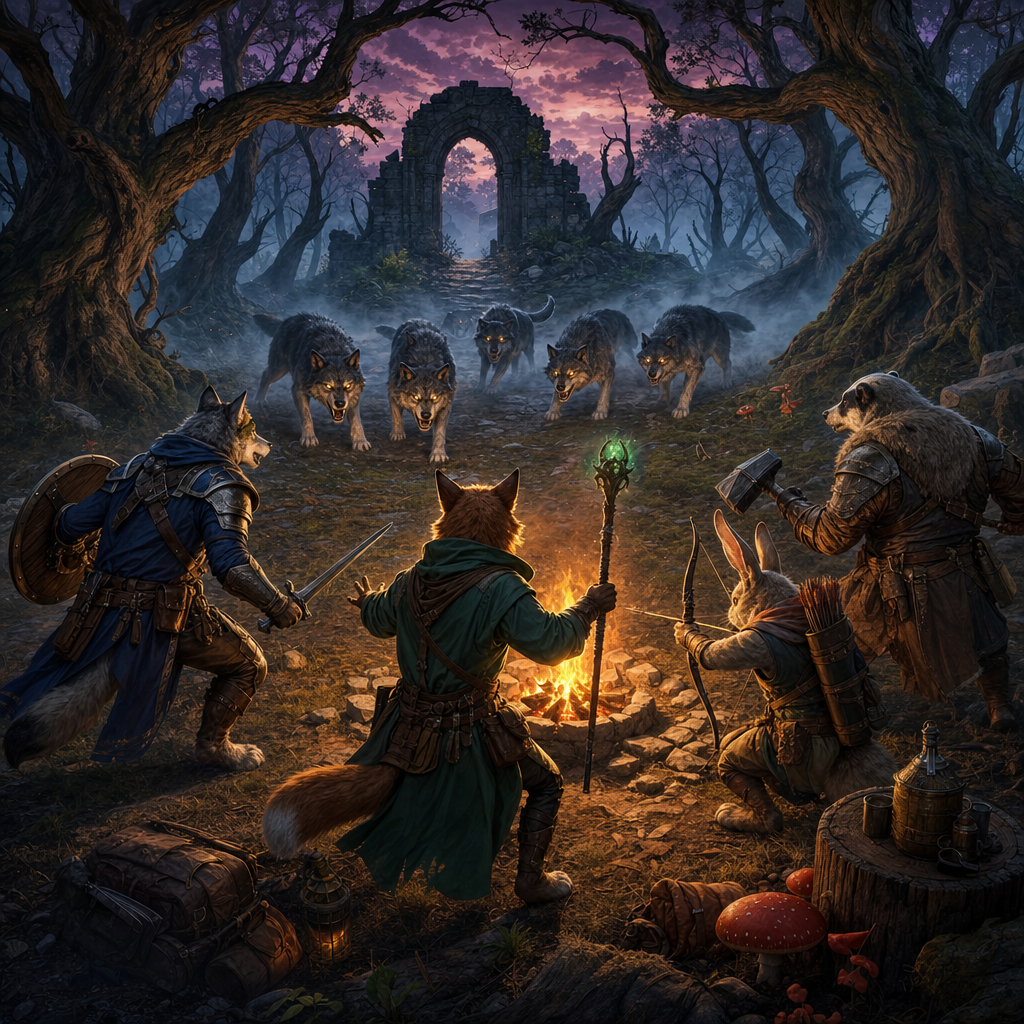
Wolves are CR 1/4 and have pack tactics, which gives them advantage on attacks when an ally is within 5 feet of the target. A lone wolf is a minor threat. A pack of four wolves flanking your party's wizard? That's a problem.
Run wolves like actual predators. They target the weakest party member. They try to separate stragglers. They retreat when bloodied, then circle back for another attempt. This creates dynamic encounters where positioning matters.
Using Challenge Rating Effectively
Challenge rating is a guideline, not a law. A CR 1/4 creature can absolutely threaten a level 2 party if you use terrain, tactics, and numbers correctly. Here's what I've learned from countless solo sessions:
- Terrain matters more than stats. Put those goblins on a cliff with ranged weapons and suddenly your party can't just charge in.
- Action economy wins fights. Four CR 1/4 creatures get four attacks per round. One CR 2 creature gets one. The math favors swarms.
- Objectives create tension. "Kill all the goblins" is boring. "Protect the NPC while goblins swarm from three directions" is interesting.
- Retreat is realistic. Smart monsters don't fight to the death. They run at half HP, regroup, and come back with friends.
Creative Encounters With Low-CR Creatures
The Ambush Predator
Take a giant spider (CR 1). Alone in an open field, it's a modest threat. Put it in a web-filled cave where movement is difficult terrain and suddenly the party is stuck in place while the spider has its mobility. Add darkness and now it's a horror encounter.
The Swarm Scenario
Eight stirges (CR 1/8 each) create a chaotic bloodsucking nightmare that forces the party to split their attacks inefficiently. Each stirge only has 2 HP, but they attach to targets and automatically deal damage each turn. Players learn to prioritize threats instead of just hitting whatever's closest.
The Time Pressure
Your party faces four zombies (CR 1/4) in a room that's slowly filling with water. The zombies aren't dangerous because they hit hard—they're dangerous because they're slow and the party needs to get past them before drowning. Suddenly it's not about optimizing damage, it's about problem-solving under pressure.
Building Your Own Low-Level Threats
Sometimes the Monster Manual doesn't have exactly what you need. That's where tools like Creature Forge AI become useful. You can generate custom monsters at any challenge rating, tweaking abilities and stats to fit your encounter design.
The real magic though? You can upload photos and get monsters that look like actual creatures. I uploaded a picture of my old rooster—the one who terrorized the henhouse for five years—and got a cockatrice variant that matched his attitude perfectly. That personal touch makes encounters feel more memorable.
Common Mistakes With Low-Level Monsters
After running these creatures dozens of times in solo play, here are the mistakes I see most often:
- Making them too dumb. Even goblins have 10 Intelligence. They make plans. They use tools. They learn from watching the party fight.
- Fighting to the death. Real creatures flee when hurt. So should your monsters. This creates recurring villains and consequences.
- Ignoring the environment. A kobold in an open field is boring. A kobold in a trapped tunnel is a problem.
- Forgetting motivations. Why are these creatures here? What do they want? Monsters with goals create better stories than monsters who exist to be killed.
Making Motivation Matter
Those goblins aren't attacking because they're evil. They're starving and desperate. The wolves aren't monsters—they're protecting their den. When low-level creatures have believable motivations, players have choices beyond "roll initiative." Sometimes the best solution isn't combat at all.
Scaling Encounters for Party Level
For a party of four level 1 characters, a single CR 1/2 creature creates a medium encounter. Four CR 1/4 creatures is the same difficulty on paper, but plays very differently. Here's a rough guide:
- Level 1 party: 2-4 creatures at CR 1/4, or 1 creature at CR 1/2
- Level 2 party: 4-6 creatures at CR 1/4, or 2-3 creatures at CR 1/2
- Level 3 party: Mix CR 1/2 and CR 1 creatures, 4-6 total
But remember: terrain, tactics, and objectives adjust difficulty more than raw numbers. Don't be afraid to adjust mid-combat if your encounter is too easy or too hard. I've had plenty of solo sessions where I improvised reinforcements or had enemies flee earlier than planned.
Why Starting Small Creates Better Campaigns
There's this urge to escalate quickly. Level 5 parties fighting giants. Level 7 parties fighting demons. But some of my most memorable encounters have been level 3 characters dealing with a particularly clever goblin tribe or a pack of worgs led by an alpha with class levels.
Low-level monsters force creativity. They demand tactical thinking. They teach players that intelligence and preparation matter more than stat blocks. And they create space for roleplay and problem-solving that gets lost when every encounter is a fight for survival against overwhelming odds.
That ranger I built based on my border collie? She's level 8 now in that solo campaign, but her most defining moment was still that early goblin fight—the one where she had to use terrain, her animal companion's abilities, and every arrow she had. The stakes felt real because the enemies were believable.
Ready to Build Your Own Encounters?
Low level D&D monsters are the foundation of good encounter design. They teach combat basics, reward creativity, and create stories that matter. Whether you're running goblins, giant rats, or that ornery rooster you turned into a custom monster, the key is using them with intention.
If you're looking for fresh creatures or want to turn a pet photo into a custom NPC, check out Creature Forge AI. Upload an image, set your parameters, and get monsters and characters that feel personal. Because sometimes the best threat to your level 2 party is based on that goat who once chased you across a pasture.
Your party doesn't need ancient evils to feel challenged. Sometimes they just need eight goblins who actually use cover.
===