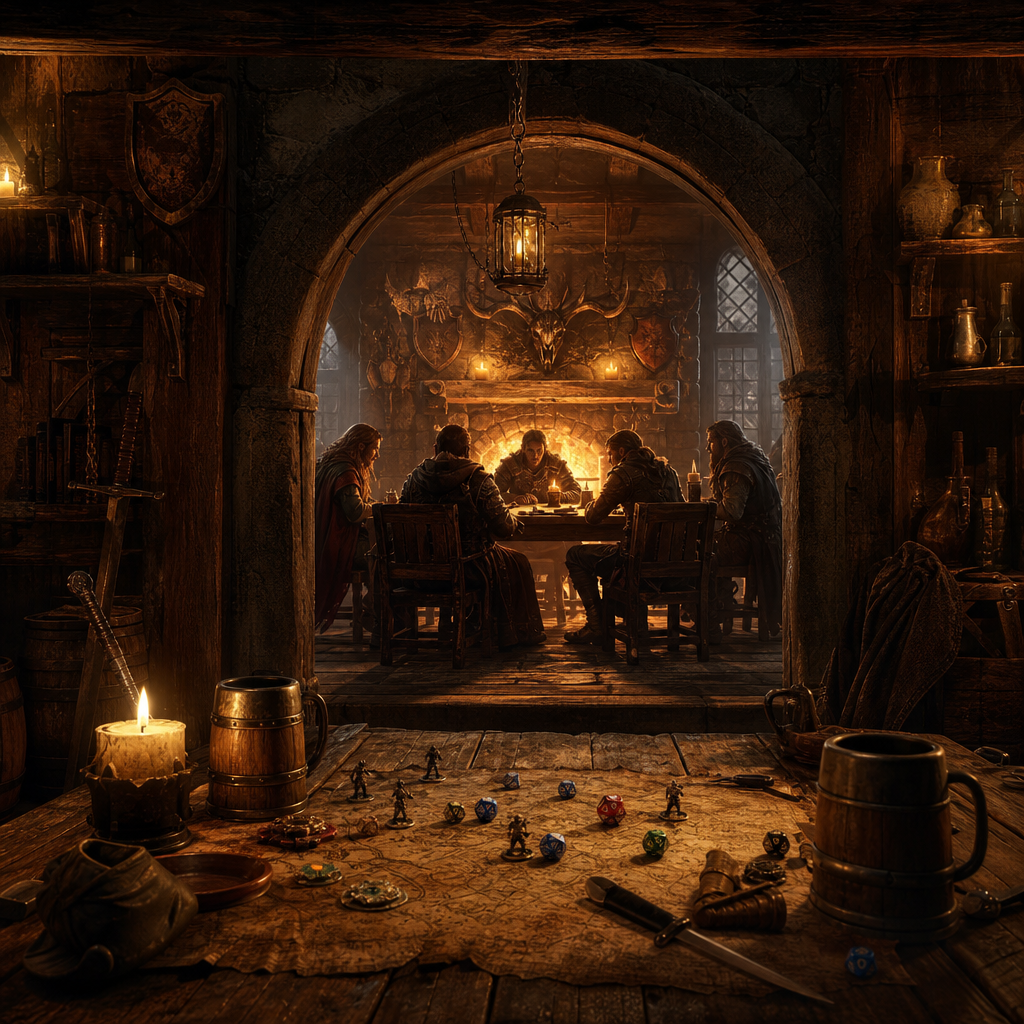
I ran my first D&D campaign on a Tuesday night after twelve hours of farm work, fueled by terrible gas station coffee and pure stubbornness. I had no players — just me, a borrowed Player's Handbook, and a spiral notebook where I'd sketched out what I thought was a brilliant plot involving a stolen goat. (Farm life influences everything, apparently.) That solo campaign taught me more about how to run your first D&D campaign than any guide ever could: start messy, stay curious, and remember that your players will surprise you every single time.
If you're thinking about stepping behind the DM screen for the first time, you're probably equal parts excited and terrified. Good. That means you care. Here's everything I wish someone had told me before I started.
Start With Session Zero (Seriously, Don't Skip This)
Session Zero isn't actually playing D&D — it's the conversation you have before you play. Think of it as laying the foundation for a house. You wouldn't skip that part, right?
This is where you and your players align on the basics:
- What kind of story do you all want? High fantasy adventure? Dark and gritty? Comedic chaos? My first real campaign went off the rails because I wanted serious political intrigue and my players wanted to open a fantasy food truck.
- What's off-limits? Everyone has topics they'd rather avoid. Talk about it now, not three sessions in.
- How often will you play? Weekly? Bi-weekly? Monthly? Consistency matters more than frequency.
- House rules and homebrew. Get everyone on the same page about what you're using and what you're ignoring.
Session Zero also gives players time to build characters together, which creates natural connections and party dynamics. It's infrastructure. Unsexy but critical.
Pick a Simple Starting Adventure
Here's the truth: you don't need to homebrew an entire continent for your first campaign. In fact, please don't. I watched my carefully crafted world map gather dust while my players spent forty-five minutes debating whether to trust an NPC I'd improvised in twelve seconds.
Instead, consider these options:
- Published starter adventures: "Lost Mine of Phandelver" is the classic for a reason. It's structured, beginner-friendly, and teaches you the rhythms of D&D.
- One-shots first: Run a single-session adventure before committing to a full campaign. Test the water. See if your group clicks.
- Simple hooks: "The mayor's daughter is missing" works better than "an ancient prophecy involving seven keys scattered across time." Save the epic scope for campaign two.
Your first campaign should teach you how to run D&D, not prove you're the next great fantasy novelist. There's time for that later.
Prep Smart, Not Hard
I spent six hours writing detailed backstories for every NPC in my first town. My players talked to exactly two of them, burned down the tavern, and left. Lesson learned: prep the encounters, not the encyclopedia.
What to Actually Prepare
- The next session's main beats: What are the 2-3 things that could happen? Not will happen — could.
- NPCs with personality, not biography: You need a voice, a quirk, and a goal. That's it. My best NPC was a blacksmith I named on the spot who spoke only in questions. Players loved him.
- A few random encounters: Combat, social, exploration. Keep them in your back pocket for when players zigging instead of zagging.
- Maps and stat blocks: If there's a dungeon or a fight coming, have that ready. Everything else can be improvised.
Tools like Creature Forge AI's NPC generator can save you hours here — I used it recently to create an entire town guard by uploading a photo of my goat Biscuit. The resulting character had more personality than anything I would've written, and it took thirty seconds.
Embrace the Rule of Cool
Your players will try things that aren't technically in the rules. A player wants to swing from a chandelier while shooting an arrow? That's not a standard action in the Player's Handbook, but it's awesome. Let them roll for it.
The Rule of Cool is simple: if something sounds cinematic and fun, find a way to make it happen. Ask for an ability check. Give them advantage or disadvantage based on circumstances. Say yes more than you say no, especially in your first campaign.
You're not running a simulation — you're telling a story together. The rules are tools, not chains.
Learn to Improvise (You'll Have To Anyway)
No plan survives contact with players. They'll befriend the villain, ignore the main quest, and ask about the name of a random bartender you invented half a second ago. (His name is... uh... Grintch. Sure. Grintch the bartender. He's great.)
Here's how to get better at thinking on your feet:
- Keep a list of random names. Seriously. Ten names for NPCs, five for towns, three for taverns. You'll use them all.
- Steal shamelessly. That bartender? He's actually just the pharmacist from your hometown with a fantasy name. No one will know.
- Ask questions. "What does your character do?" buys you five seconds to think. Use them.
- Let the dice decide. Not sure if the guards believe the party's story? Roll for it. The dice create chaos, and chaos creates story.
Improv gets easier the more you do it. Your first session will feel like controlled panic. By session five, you'll be riffing like you planned it all along.
Make Your Monsters and NPCs Memorable
Stat blocks are fine, but personality is everything. A goblin is forgettable. A goblin named Skrix who's terrified of horses and speaks in rhyming couplets? That's a character.
When I need to populate a dungeon or create a villain quickly, I use Creature Forge AI's monster generator — you can even upload a photo and it'll build a creature or character that actually looks like the image. I once uploaded a picture of my farm's rooster (absolute menace of a bird) and got a Cockatrice mini-boss that my players still talk about. The tool handles the mechanics so I can focus on making things weird and wonderful.
Give NPCs Simple Goals
Every NPC wants something. The shopkeeper wants to close early and go home. The villain wants revenge on the king. The bartender wants customers to stop breaking chairs. These wants create friction, and friction creates story.
Handle Combat Without Bogging Down
Combat in your first campaign can feel slow. Here's how to keep it moving:
- Roll initiative once and stick with it. Don't recalculate every round.
- Set a turn timer. Players get 30-60 seconds to declare their action. Keeps things urgent and cinematic.
- Describe damage narratively. "You take 8 damage" is boring. "The goblin's blade slices across your shoulder, and you feel warm blood soaking your shirt" is memorable.
- Let enemies retreat or surrender. Not every fight needs to end in total annihilation. Smart enemies run when they're losing.
Combat should feel dangerous and dynamic, not like a math problem. Describe the chaos. Make it matter.
End Sessions on a Hook
Always stop on a cliffhanger or a question. The party just opened the mysterious door — end there. Don't show them what's inside. They've decoded the villain's letter — session over. Let them wonder what it means.
This does two things: it keeps players excited for next session, and it gives you time to prep whatever's behind that door (because you definitely don't know yet).
You're Going to Make Mistakes (And That's Fine)
I've forgotten entire NPCs mid-conversation. I've called players by the wrong character name. I once accidentally made a minor villain so likeable that the party recruited him and he became a main character for eight sessions. These aren't bugs — they're features.
Your first campaign won't be perfect. It'll be messy and weird and full of moments where you have no idea what you're doing. But if your players are laughing, gasping, or leaning forward in their seats, you're doing it right.
Resources That Actually Help
Don't drown in content. You don't need to watch 400 hours of actual play shows or memorize every sourcebook. You need a few good tools and the willingness to try.
For me, that's meant keeping things simple: a notebook for session notes, a handful of dice, and tools like Creature Forge AI's character generator when I need to quickly populate the world with interesting faces. The photo-upload feature especially has been a lifesaver — turning real people and animals into fantasy characters means my NPCs feel grounded and specific, not generic.
Start Your Campaign This Week
The perfect campaign doesn't exist. The perfect first session doesn't exist. But the campaign you actually run — the one where you fumble through descriptions and forget how grappling works and accidentally give your players a magic item that's way too powerful — that one's real, and it's yours.
Grab some friends, grab some dice, and start. You'll learn more from one messy session than from months of reading guides. And when you need help fleshing out your world — when you need a monster for tonight's session or an NPC who doesn't feel copy-pasted from a handbook — tools like Creature Forge AI are there to back you up so you can focus on what matters: telling a story together.
Your players aren't expecting perfection. They're expecting you, behind the screen, trying something new and inviting them along for the ride. That's more than enough.
Now go run your first campaign. Make it weird. Make it yours.