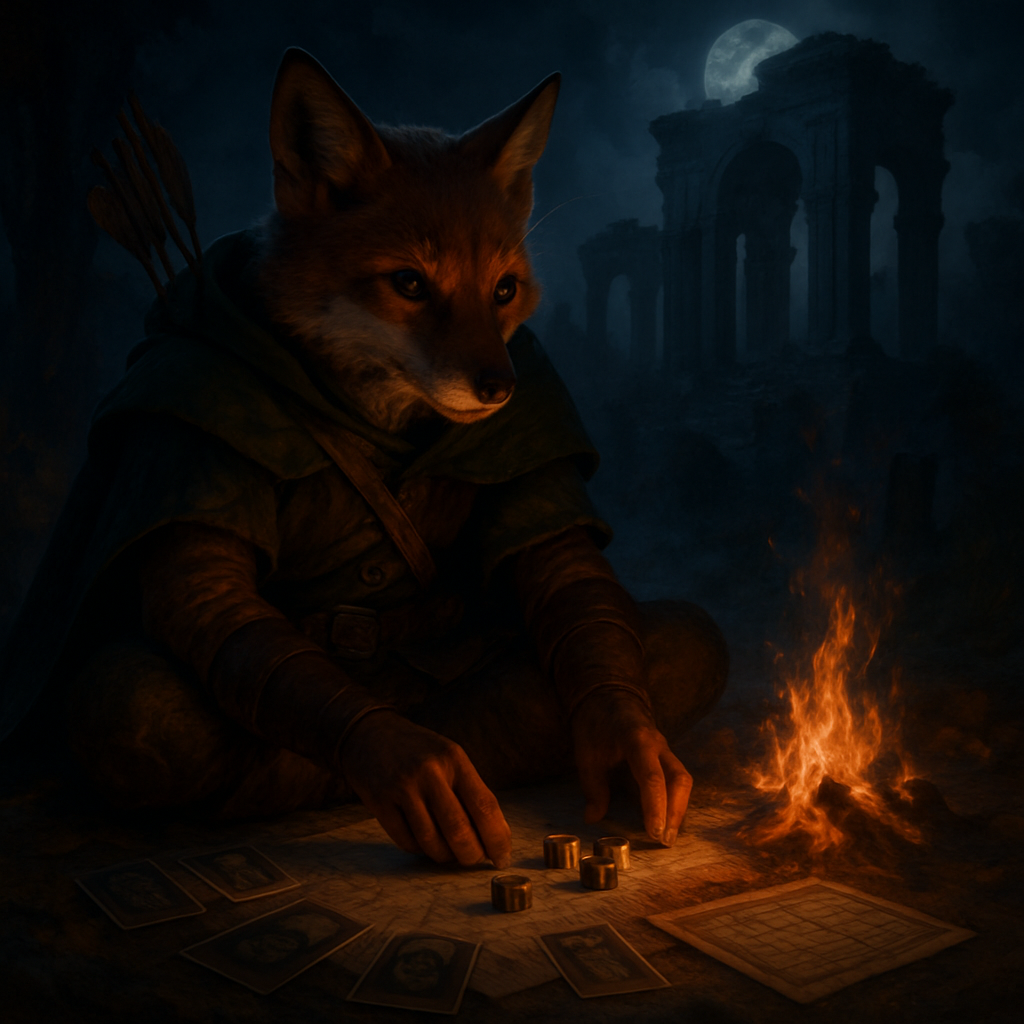
I started playing D&D solo out of pure necessity. After long days on the farm—feeding animals, mending fences, arguing with Biscuit the goat about personal boundaries—I'd pour a cup of coffee around ten PM and sit down with my dice and a notebook. No group to coordinate with. No scheduling conflicts. Just me, a character I cared about, and whatever story wanted to unfold. If you've ever wondered how to play D&D solo, I'm here to tell you it's not only possible, it's one of the most intimate and flexible ways to experience the game.
Solo D&D strips away all the social logistics and lets you focus on what drew you to the game in the first place: storytelling, character development, and that electric moment when the dice decide your fate. Here's how to get started.
Why Play D&D Solo?
Before we dive into the mechanics, let's talk about why you'd want to do this. Solo play offers some genuine advantages:
- Play on your schedule. No coordinating five adults' calendars. Start at midnight if you want.
- Deep character focus. Every scene centers on your character. You explore their backstory, motivations, and growth without sharing spotlight time.
- Total narrative control (mostly). You shape the tone, pacing, and themes to exactly what you're craving that night.
- Experiment freely. Want to try a wild multiclass build? Test new homebrew rules? Solo is your laboratory.
- Perfect for introverts. All the storytelling magic, none of the social energy drain.
The Core Challenge: Replacing the DM
The biggest question in solo D&D is obvious: who runs the world? You can't be both player and DM in the traditional sense—you'd know every trap, every plot twist, every monster's hit points. The surprise evaporates. So we need systems that generate uncertainty and discovery. Here are the main approaches.
1. Oracle Systems (The Mythic Approach)
Oracle systems are question-answering tools that inject randomness into your story. The most popular is the Mythic Game Master Emulator, but the concept is simple: when you need to know something, you ask a yes/no question and consult tables or dice rolls modified by likelihood.
Example: "Does the innkeeper know anything about the missing caravan?" Roll 2d10. If the total is under your Chaos Factor (usually 5 at the start), yes. If it's over, no. Doubles trigger a random event from another table.
This keeps you honest. You don't decide outcomes—the dice do. It creates genuine surprise. One night I asked if my ranger's childhood friend had survived the goblin raid fifteen years ago. I was certain I'd get a "no." The dice said yes. That one roll generated an entire arc I never would have written myself.
2. Solo Adventures and Modules
Published solo adventures are designed for one-player experiences. They often include branching paths, random tables for encounters, and mechanics for resolving situations without a DM. Some great options:
- D&D Solo Adventure modules from the early 1980s (rare but atmospheric)
- Ironsworn (technically its own system, but easily adapted)
- Five Torches Deep and similar OSR games with strong solo frameworks
- Choose-your-own-adventure style supplements on DMs Guild
These give you structure. You're not building everything from scratch—you're exploring a world someone else designed, making choices, and rolling to see what happens.
3. AI and Digital Tools
Modern solo players have an advantage our predecessors didn't: AI dungeon masters. Tools like AI Dungeon or ChatGPT can generate descriptions, NPC dialogue, and plot developments on the fly. You describe what your character does, and the AI responds with what happens next. It's imperfect—sometimes hilariously so—but it creates that crucial element of surprise.
I've also found Creature Forge AI invaluable for populating my solo campaigns. When I need a monster, NPC, or even a sidekick character, I can generate one in seconds. The tool's photo-upload feature is quietly brilliant—I once uploaded a picture of my border collie, Merle, and got back a stat block for a scrappy Lupine scout with her exact coloring and that same intense stare she gives me when I'm late with dinner. Now Merle's digital twin is a recurring NPC in my campaign, and it feels personal in a way random tables never could.
Building Your Solo Campaign
Once you've chosen your DM-replacement method, here's how to structure actual play.
Start Small and Specific
Don't try to run Storm King's Thunder solo on day one. Start with a single quest: investigate the abandoned mill, find the merchant's missing son, clear rats from the tavern basement. One location. One goal. Clear stakes.
As you get comfortable with your oracle or AI tool, expand. Let small quests connect into larger threads. The merchant's son was kidnapped by a cult. The cult worships something in the old mill. Suddenly you have a campaign.
Embrace Random Tables
Stock up on random tables for everything: encounters, weather, NPC personalities, treasure, rumors, complications. When you're unsure what happens next, roll. The DMG has dozens. The internet has thousands. They're your co-author.
Journal Everything
In a group, the DM tracks the world. In solo play, you need records. Keep a campaign journal noting:
- NPC names and relationships
- Unresolved plot threads
- Locations you've visited
- Treasure and experience gained
- Character thoughts and feelings (yes, this matters—it's half the fun)
Your journal becomes the campaign bible. I've got three notebooks filled with rambling entries about my ranger's moral struggles and sketches of Biscuit reimagined as a stubborn Satyr warlock.
Let Your Character Drive
In group play, you might build a character to fill a party role. In solo play, build someone whose inner life fascinates you. Give them fears, wants, contradictions. Then put them in situations that test those traits.
My current character is a cleric who left her temple because she stopped hearing her god's voice. Every session, I'm exploring that crisis through encounters and choices. Does she fake it? Seek another deity? Lose faith entirely? I genuinely don't know yet. The dice and the story will decide together.
Practical Tips for How to Play D&D Solo
Balance Encounters Carefully
You don't have a party to bail you out. Use the encounter building rules, but err on the side of slightly easier. One bad roll shouldn't mean instant death. Give yourself escape routes, healing potions, or friendly NPCs who might intervene.
Play Multiple Characters (Optional)
Some solo players run a small party instead of a single character. This gives you tactical variety and someone for your main character to talk to. I usually run my protagonist plus one companion—often that Creature Forge-generated Lupine scout version of Merle, because apparently I can't separate work from play anymore.
Set the Mood
Solo play is atmospheric. Light a candle. Put on a fantasy soundtrack. Make it a ritual. You're not just rolling dice—you're stepping into another world for an hour or two.
Don't Sweat the Rules
If you can't remember the exact grappling rules at midnight, make a judgment call and move on. Solo D&D is about story flow. You can look it up later.
Example of Solo Play in Action
Here's what a brief solo session might look like:
Setup: My cleric, Thera, is searching a ruined temple for information about her missing god.
Oracle question: "Is there anyone else here?" (Unlikely, it's been abandoned for decades.) Roll: 14. No.
Exploration: I describe Thera moving through the nave. Roll Perception: 18. I consult a random discovery table: "An old shrine still has fresh offerings."
Oracle question: "Has someone been here recently?" (Likely now.) Roll: 7. Yes.
Follow-up: Roll on an NPC table: "A young acolyte." Use Creature Forge AI to generate them. I get a nervous half-elf named Corin who's been secretly maintaining the shrine.
From there, roleplay. Thera talks to Corin. They share doubts about faith. Corin mentions rumors of a hermit in the mountains who still hears the god's voice. New quest acquired.
Twenty minutes of play. Emotionally resonant. Moved the story forward. That's solo D&D.
The Bottom Line on Solo D&D
Learning how to play D&D solo opened up the game for me in ways group play never did. It's meditative. Personal. Weird in the best way. You'll have sessions where everything clicks and the story feels magical. You'll have sessions where the oracle gives you nonsense and you have to improvise wildly. Both are fine. Both are part of it.
If you're between campaigns, if your group fell apart, if you just want to explore a character's inner world without an audience—give solo play a shot. Grab an oracle system or an AI tool, create a character you care about, and see where the dice take you. And when you need monsters, NPCs, or companions who feel genuinely personal, Creature Forge AI is there to help. Upload a photo of your dog, your cat, your stubborn goat—whatever. Turn them into characters. Let them join your story.
Some of my favorite D&D memories are from sessions where it was just me, a cup of coffee, and a notebook. No audience. No performance. Just the quiet joy of watching a story unfold one dice roll at a time.