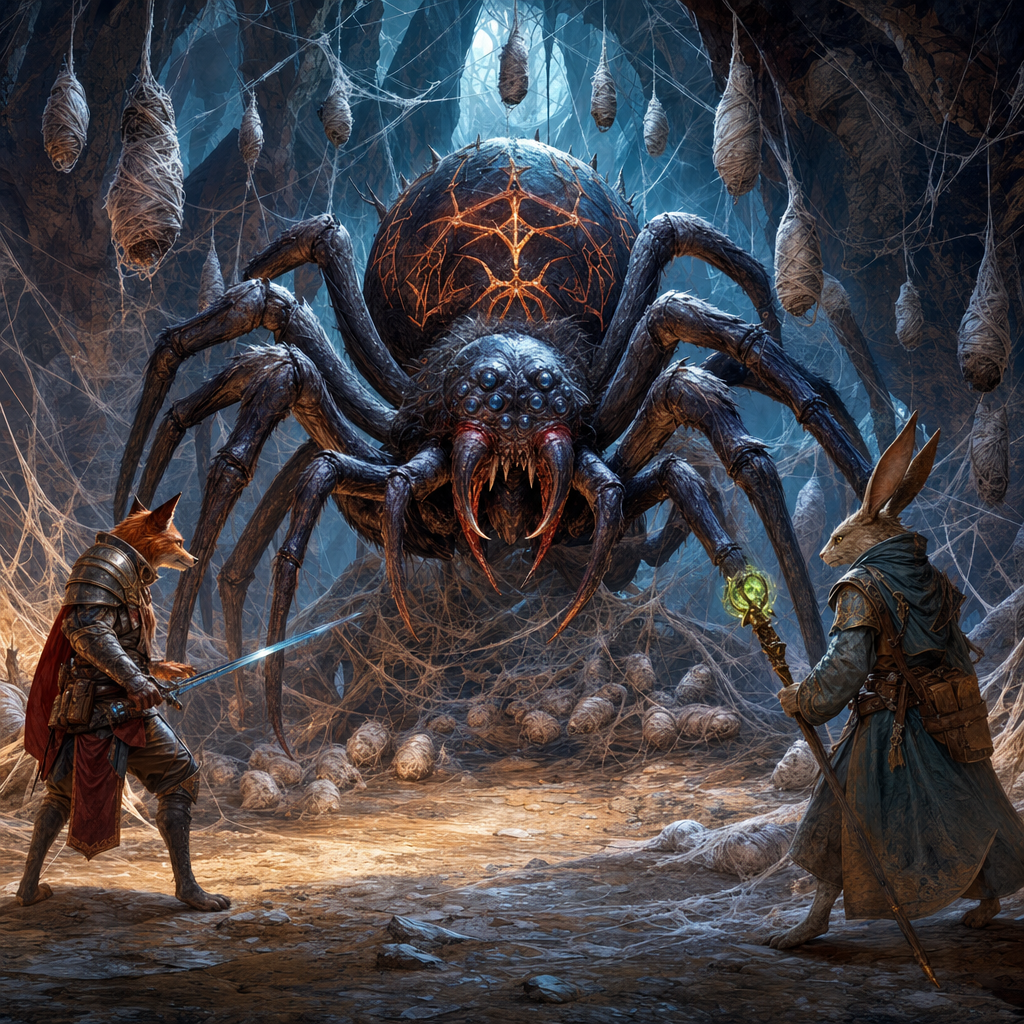
Why Most Spider Monsters Fall Flat
I spent three sessions building up to a spider encounter in my solo campaign. My ranger had been tracking signs through the woods — webbing in the trees, desiccated deer carcasses, the works. When she finally kicked down the door to that abandoned mill, I rolled initiative against two giant spiders from the Monster Manual and... it was over in four rounds. Boring. Forgettable. The spiders were just hit point sponges with a bite attack.
That's when I realized: if you want to make a spider monster in D&D that actually matters, you need to think beyond the stat block. Spiders aren't just big bugs with fangs. They're ambush predators, trap-setters, and in a fantasy world, they can be so much more.
Start With What Makes Spiders Terrifying
Real spiders (and I've dealt with plenty in the barn — black widows love hay bales) have a few things going for them:
- Ambush tactics: They wait, hidden, until prey is vulnerable
- Web control: They reshape their environment into death traps
- Venom variety: Some paralyze, some rot flesh, some just hurt like hell
- Alien movement: They can be on the ceiling, in your pack, anywhere
Your D&D spider monster should lean into at least two of these. More if you want players checking the ceiling for the rest of the campaign.
Building Your Spider Monster's Core Stats
Size and Challenge Rating
Don't default to Large. A Medium spider that's *smart* is scarier than a Huge spider that's dumb. Here's my guide:
- Tiny to Small (CR 1/4-1): Swarm spiders, scouts, the "oh god they're in my armor" variety
- Medium (CR 2-4): Hunter spiders, perfect for ambushing a single party member
- Large (CR 5-7): Your classic giant spider, broodmother material
- Huge or larger (CR 8+): Boss monsters, phase spiders on steroids, things with intelligence and plans
Essential Abilities
Every spider monster needs Spider Climb and Web Sense (tremorsense within its webs). Beyond that, pick abilities that fit your concept:
- Web Walker: Ignores movement restrictions from webbing
- Multiattack: For CR 3+, let it bite AND use a web attack in one turn
- Venomous Bite: This is where you get creative (more on this below)
Venom: The Secret to Memorable Spiders
Standard giant spider venom (2d8 poison damage, DC 11 Con save) is fine. It's also forgettable. Instead, give your spider venom a signature effect:
- Paralytic Venom: On a failed save, target is paralyzed for 1 minute (save ends at each turn). Perfect for spiders that cocoon prey.
- Necrotic Venom: 1d8 poison plus 1d8 necrotic damage. The bite wound doesn't heal naturally and requires a healer's kit or lesser restoration.
- Hallucinogenic Venom: Target makes a Wisdom save or suffers short-term madness. They might see allies as spiders or vice versa.
- Egg Injector: Okay, this one's dark. On a failed Constitution save, spider eggs are implanted. They hatch in 24 hours unless removed with lesser restoration or a DC 15 Medicine check. When my ranger faced this variant, she burned through every spell slot that night in paranoid prevention.
Web Mechanics That Actually Matter
The standard web attack is a ranged attack that restrains on hit (DC 12 Strength check to break free). Functional. Uninspired. Here are variants:
Web Terrain
Before combat even starts, the spider's lair should be difficult terrain filled with sticky webbing. Anyone who starts their turn in webbed terrain makes a DC 12 Dexterity save or becomes restrained until they use an action to break free. Now your spider has home-field advantage.
Web Snare
As a bonus action, the spider can create a 10-foot cube of webbing within 30 feet. Anyone in that space is restrained (DC 13 Strength check to escape). This lets the spider control the battlefield and separate party members.
Ceiling Drop
If your spider has Spider Climb, give it this move: as an action, it drops from above onto a creature, making a bite attack with advantage. If it hits, the target is also knocked prone and grappled. This is the "oh god it's on my face" moment players remember.
Spider Variants Worth Stealing
Once you understand the basics of how to make a spider monster in D&D, you can start experimenting with variants. Here are three I've used:
The Trapdoor Ambusher
Medium spider, CR 3. It burrows under dungeon floors (burrowing speed 20 ft.) and has tremorsense 30 ft. When a creature walks over its hiding spot, it erupts as a reaction, making a bite attack with advantage. Give it a paralytic venom and suddenly your "empty hallway" is a skill challenge.
The Broodmother
Large spider, CR 5. Once per day, as a bonus action, it spawns 1d4 tiny spiderlings (use swarm of insects stats). These act on her initiative. She doesn't need to be strong if she's never alone. I ran a Broodmother encounter in an old grain silo and the party spent half the fight just dealing with babies.
The Phase Spider (Amped Up)
The Monster Manual phase spider is cool but underused. Boost it to CR 4 and give it a trick: when it phases into the Ethereal Plane, it can immediately move up to its speed and then return, appearing in a new location. This makes it almost impossible to pin down. Add a venom that causes temporary blindness and you've got a nightmare.
Building a Spider Encounter, Not Just a Spider
Here's the thing I learned after that boring mill fight: spiders are encounter designers, not solo fighters. They set up terrain. They wait for the right moment. They don't charge in screaming.
A good spider encounter includes:
- Verticality: Use caves with high ceilings, ruined towers, multi-level dungeons. Spiders should attack from unexpected angles.
- Environmental hazards: Pits covered in webbing, chandelier-wrapped prey that could fall, flammable silk (fire spreads fast).
- Escape routes: Smart spiders retreat. They don't fight to the death. They scuttle into cracks and plot revenge.
I once had a spider monster flee through a ventilation shaft. Three sessions later, it returned during a completely different combat and webbed the party's healer to the ceiling. The players still talk about that spider.
When Your Spider Needs to Be Unique
Sometimes you don't want a spider from the Monster Manual. You want something *yours*. Maybe it's tied to your campaign's lore. Maybe you need it to look like something specific.
I've been using Creature Forge AI lately for exactly this. You describe what you need — "a spider with crystalline legs that can cast web-based illusions" or "a shadow-touched spider broodmother with necrotic venom" — and it builds the full stat block and generates artwork to match. You can even upload a photo if you want your spider to have a specific look. (I haven't uploaded a photo of a spider yet, but I did turn my extremely judgmental barn cat into a tabaxi rogue, and the resemblance was uncanny.)
The point is: when you need a spider monster that's more than a reskinned giant spider, there are tools that'll help you build it without spending two hours calculating CR.
Quick Tips for Spider Combat
- Spiders should act *before* players expect them. Roll their Stealth with advantage in webbed areas.
- Use pack tactics if there are multiple spiders. They're more terrifying when they coordinate.
- Restrained players are vulnerable. Have spiders focus fire on restrained targets.
- Don't forget Spider Climb in combat. A spider on the ceiling is out of melee range.
- Let players discover spider weaknesses. Fire works. Thunder damage collapses webs. Reward creativity.
Make Your Spider Memorable
The best spider monster in D&D isn't the strongest or the highest CR. It's the one your players remember a year from now. The one they're still paranoid about. The one that made them start checking every ceiling and dark corner.
You don't need complicated mechanics to do that. You need atmosphere, smart tactics, and a willingness to make your spider *behave* like a spider. Ambush. Trap. Poison. Retreat. Return when they least expect it.
And honestly? If you're building a spider from scratch — whether it's a unique variant or a boss monster — don't be afraid to use tools that speed up the process. Try Creature Forge AI and see what kind of arachnid nightmare you can build. Sometimes the best spider encounter is the one you actually finish prep for instead of getting lost in spreadsheets.
Now go forth and terrify your players. They'll thank you for it. Eventually.