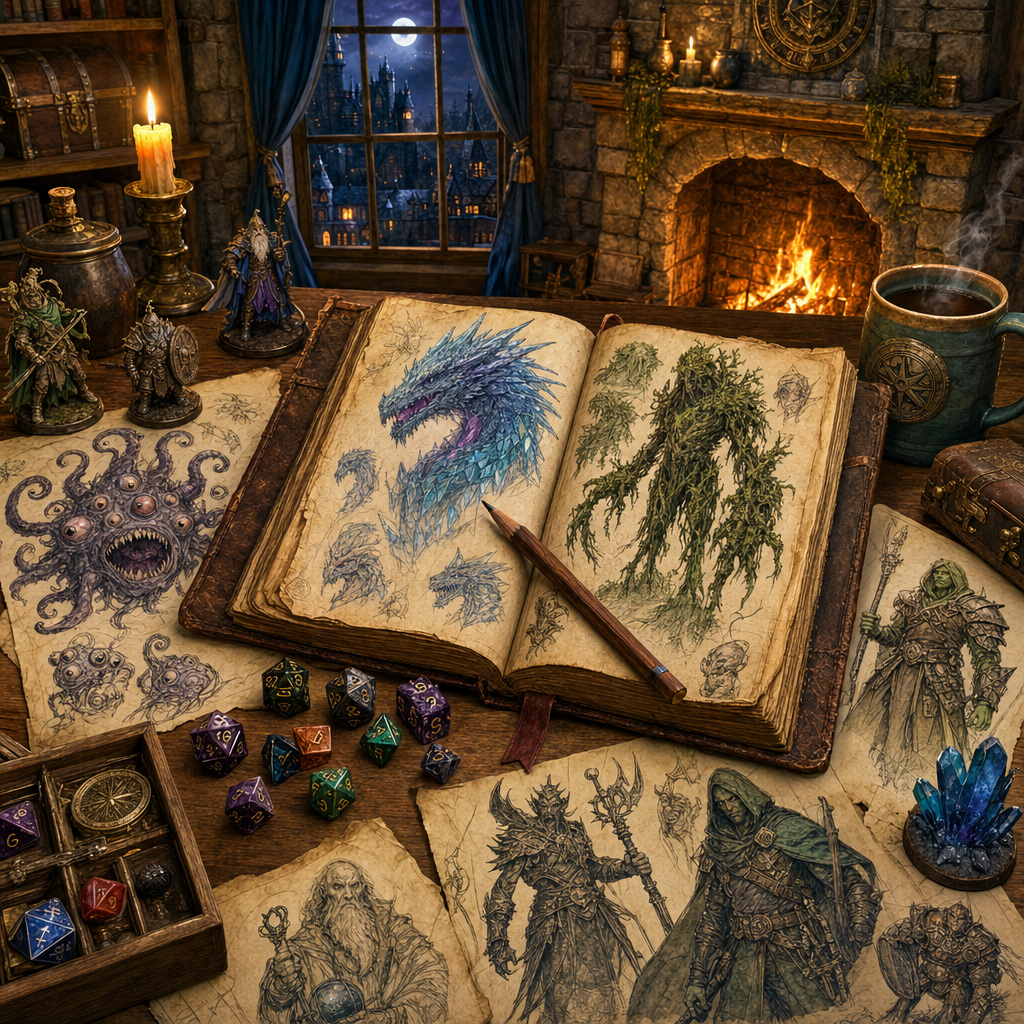
Last winter, I homebrewed a monster for my solo campaign that I was so proud of. I called it the Frost Maw—this massive wolf-bear hybrid with ice breath and regeneration. I gave it legendary actions. I gave it lair actions. I basically gave it everything except a retirement plan.
Then I ran the encounter.
My level 6 ranger didn't make it past round three. Not because of bad rolls or poor tactics—the thing was just fundamentally overtuned. I'd created a beautiful, thematic monster that had absolutely no business existing at that CR. Learning how to make a homebrew monster balanced has been one of the most valuable (and humbling) lessons in my solo DMing journey.
Here's what I've learned about creating creatures that challenge without obliterating.
Start With the DMG's Guidelines (But Don't Worship Them)
The Dungeon Master's Guide has a whole section on monster creation, complete with tables for defensive CR, offensive CR, and all the math you could want. It's genuinely useful—especially the baseline hit points and damage per round for each Challenge Rating.
But here's the thing: those tables are starting points, not sacred texts.
I've found that the DMG math works best for straightforward "bag of hit points" monsters. The moment you add interesting abilities, terrain advantages, or tactical intelligence, the numbers start getting weird. A CR 5 monster with legendary resistances plays very differently than a CR 5 monster without them, even if the math says they're equivalent.
The Three Pillars of Monster Balance
Instead of obsessing over CR calculations, I focus on three core elements:
- Survivability: How long can this thing stay in the fight?
- Damage output: How much hurt can it dish out per round?
- Action economy: How many meaningful things can it do in combat?
Get these three roughly in line with existing monsters at your target CR, and you're 80% of the way there.
Action Economy Is Your Secret Weapon (and Your Biggest Trap)
Here's something that took me way too long to understand: action economy matters more than almost anything else.
A solo monster—no matter how many hit points it has—is at a massive disadvantage against a party of four or five characters. They get four or five turns per round. It gets one. Even if you give it twice the HP and damage of a "normal" monster, the action economy imbalance often means it goes down before it can truly shine.
This is why legendary actions and lair actions exist. They're not just for drama—they're mechanical tools to help a single creature compete with multiple player turns.
When to Add Extra Actions
For boss monsters or solo encounters, consider adding:
- Legendary actions: Let it take 1-3 simple actions at the end of other creatures' turns (movement, basic attack, recharge ability)
- Multiattack: Two or three attacks per action once you're past CR 3-4
- Reactions: A interesting defensive or retaliatory option when attacked
- Minions: Sometimes the best way to balance action economy is just adding a couple of weaker creatures to the encounter
But—and this is critical—every extra action is a multiplier on the monster's effective power. My Frost Maw had legendary actions and regeneration and multiattack. That's three action-economy advantages stacked together. No wonder it was a meat grinder.
Damage-Per-Round Reality Check
There's a simple test I do now for every homebrew monster: I calculate its maximum damage output in one round if everything hits.
Here's a rough guide based on CR (assuming all attacks hit):
- CR 1-4: 10-30 damage per round
- CR 5-10: 30-60 damage per round
- CR 11-16: 60-90 damage per round
- CR 17+: 90+ damage per round
If your monster can drop a character from full HP to zero in a single turn (before they've had a chance to heal or react), that's usually a red flag. One-shot mechanics feel awful at the table. They remove player agency and turn combat into a coin flip.
The exception? Monsters with obvious tells, charge-up mechanics, or abilities that players can interrupt or avoid. A dragon's breath weapon hitting for massive damage is fine because players know it's coming and can position accordingly.
Resistances, Immunities, and the Damage Tax
Every damage resistance or immunity you add increases your monster's effective HP—sometimes dramatically.
If half the party deals fire damage and your monster is immune to fire, it effectively has double HP against them. This is fine! It creates interesting tactical puzzles. But you need to account for it when you're setting the baseline HP.
My Rule of Thumb
If your monster has:
- One common resistance: Reduce HP by about 15%
- Multiple resistances: Reduce HP by 25-35%
- Any immunity: Reduce HP by 20-30%
- Legendary resistances: Reduce HP by 10% per charge
This keeps the actual time-to-kill in a reasonable range even when the party's fireball isn't pulling its weight.
The Power of Playtesting (Even Solo)
Theory is great. Math is helpful. But nothing—and I mean nothing—replaces actually running the monster.
For solo play, I run mock combats against level-appropriate characters. I roll for both sides, tracking how many rounds it takes and how much damage flows in each direction. If the monster consistently wipes a balanced party, it needs tuning. If it goes down in two rounds without landing meaningful hits, it's undertuned.
One trick I've found useful: I sometimes use Creature Forge AI's monster generator to create a quick baseline creature at my target CR, then modify it with my unique abilities. Having a working example with proper stat blocks saves hours of math and gives me a reality check on what "balanced" actually looks like at that level.
Questions to Ask After Playtesting
- Did the combat last 3-5 rounds? (The sweet spot for most encounters)
- Did players have to make interesting decisions, or was it just a slog?
- Did anyone drop to zero? How quickly?
- Did the monster's unique abilities actually matter, or did it play like a generic sack of HP?
- Would I be excited to run this again?
That last question matters more than you might think. If an encounter is technically balanced but boring, something's still wrong.
Special Abilities: The Spice, Not the Meal
This is where I see the most homebrew monsters fall apart—designers (myself included) get so excited about unique mechanics that we forget to make sure they're actually balanced.
A CR 3 monster that can cast Power Word Kill once per day? Sure, the math might average out over multiple encounters, but the first party that faces it is going to have a very bad day.
Guidelines for Adding Special Abilities
Limit save-or-suck effects unless the CR is appropriate. Paralysis, petrification, and instant death should be rare below CR 8-10.
Add counters or telegraphs. If your monster has a devastating ability, give it a warning round, a verbal cue, or some way for clever players to interrupt or avoid it.
Compare to existing monsters. If you're adding a fear effect, look at what CR monsters normally have fear auras. If you're adding flight, check how that's priced into the CR of creatures like gargoyles or harpies.
Test the worst-case scenario. What happens if the monster gets lucky and crits on round one? What if it rolls maximum damage? If that scenario feels catastrophic, tune it down.
My Current Process (Refined Through Many TPKs)
These days, when I create a homebrew monster, I follow this sequence:
- Start with concept: What's the theme, the story role, the vibe?
- Pick a target CR based on when I want to use it
- Find a similar existing monster as a baseline (or generate one as a starting point)
- Adjust HP and damage to fit the CR range, accounting for any resistances
- Add one or two unique abilities that reinforce the theme
- Check action economy—does it need legendary actions, multiattack, or minions?
- Playtest in a mock combat
- Iterate based on results
It's not sexy. It's not complicated. But it works.
The 80/20 Rule of Monster Balance
Here's the truth: perfect balance doesn't exist. Every table is different. Every party composition changes the math. A monster that's deadly for a group without healing is a cakewalk for a party with two clerics.
Your goal isn't perfection—it's "good enough that everyone has fun."
I've had theoretically "imbalanced" monsters create some of my favorite encounters because they were interesting. The CR was probably off by one or two, but the fight had tension, required creativity, and told a story. That's worth more than mathematical precision.
Tools to Make Your Life Easier
You don't have to build every monster from scratch using nothing but the DMG tables and a prayer.
There are tools that can give you solid starting points. I've been using Creature Forge AI lately for quick monster generation—it's especially useful when I want something that looks like a specific concept. I actually uploaded a photo of my old rooster Cornelius once, just to see what would happen, and got back this absolutely perfect cockatrice variant with his exact aggressive energy. Having a visual reference that matches the stat block makes the monster feel more real at the table.
But whether you're using generators, modifying existing monsters, or building from scratch, the core principles stay the same: match your damage and survivability to the CR, respect action economy, and actually test the thing before you unleash it on your players.
Final Thoughts
Learning how to make a homebrew monster balanced is less about mastering complex math and more about developing intuition through practice. Every overtuned monster that accidentally wipes your party teaches you something. Every undertuned creature that gets steamrolled shows you where you miscalculated.
The Frost Maw? I eventually rebalanced it. Dropped the regeneration, tuned down the legendary actions, reduced the breath weapon damage by about 30%. Now it's a legitimately challenging CR 6 encounter that doesn't feel like a death sentence.
And you know what? It's a better monster for it. The fight has tension without being unfair. Players feel accomplished when they win, not just relieved that they survived.
That's the real goal of monster balance—creating encounters that make your players feel like heroes, not victims.
Want to experiment with balanced monster design without spending hours on math? Try Creature Forge AI's monster generator—you can even upload photos to create creatures inspired by real animals (or that one particularly dramatic pet you know). Sometimes the best way to learn balance is to see what properly-tuned monsters look like, then tweak from there.
Now go forth and create something dangerous. Just... maybe playtest it first.