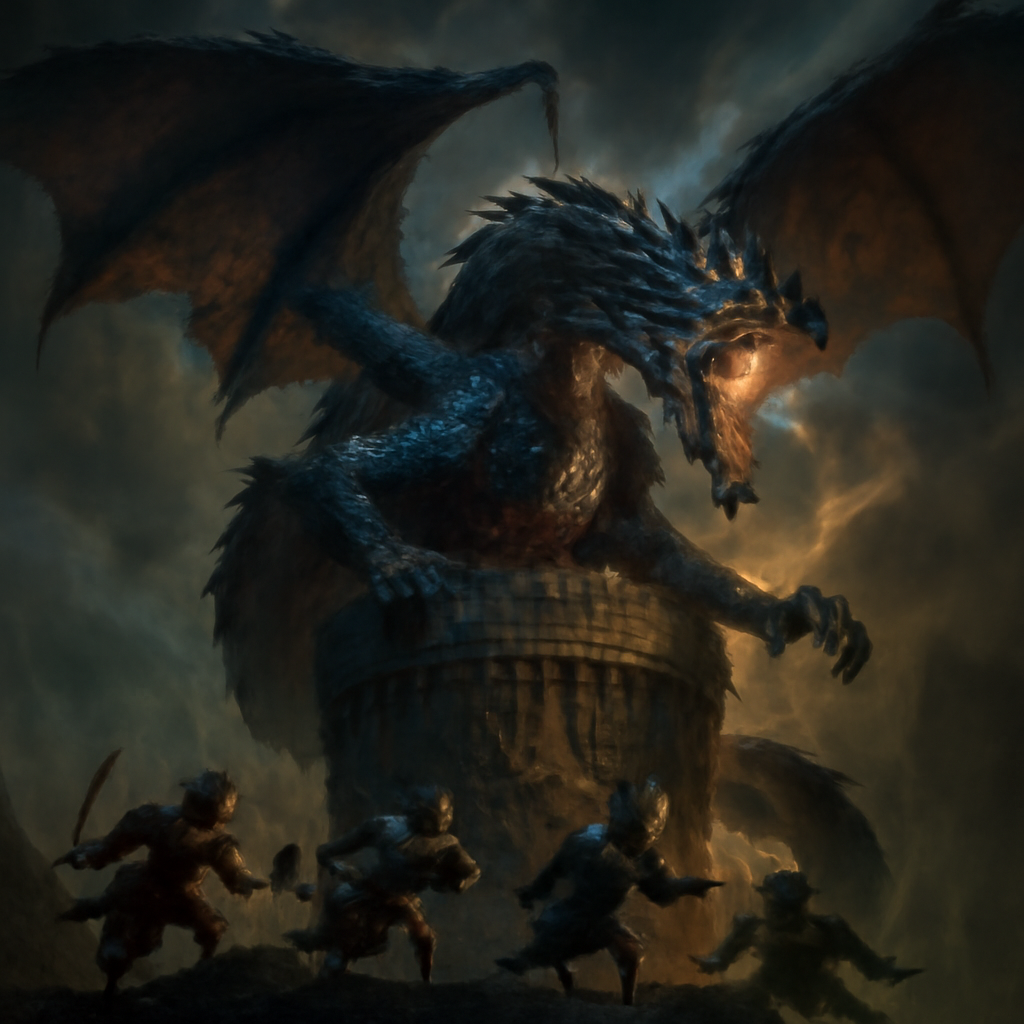
I ran my first boss fight alone at my kitchen table on a Tuesday night that stretched past 2 a.m. My solo character—a half-elf ranger I'd been playing for months—faced down what I thought would be a climactic encounter with a necromancer. I'd given him double hit points. I'd placed him in a tower. And the fight was... boring. Just trading blows until his numbers ran out. No drama. No tension. I learned that night that knowing how to make a boss fight in D&D isn't about making the bad guy harder to kill—it's about making the fight *matter*.
Here's what actually works.
Start With Why This Fight Matters
Before you touch a stat block, answer one question: what are the stakes? The best boss fights aren't just combat encounters—they're the culmination of story threads your players have been pulling for sessions.
Maybe this villain killed someone the party loved. Maybe they're seconds away from completing a ritual that will doom the city. Maybe the barbarian's estranged father is standing on the other side of that throne room. When you anchor a boss fight to something your players actually care about, every hit point becomes personal.
I once uploaded a photo of my old border collie, Maggie, into Creature Forge AI's character generator and built her as a Lupine druid NPC for a solo campaign. Three sessions later, she was kidnapped by a corrupt archdruid. When I finally reached that boss fight, it wasn't about XP or loot—it was about getting Maggie back. That emotional hook made every dice roll feel like it mattered.
Questions to Ask Yourself:
- What does this villain want, and why can't the party let them have it?
- What personal connection does at least one PC have to this fight?
- What happens if the party loses?
Legendary Actions Are Your Best Friend
Here's the mechanical reality: action economy wins fights. If you've got one boss against four or five players, that boss gets one turn while the party gets four or five. Unless you address this imbalance, your big bad will get shredded before they do anything cool.
Legendary actions fix this. They let your boss act between player turns, keeping pressure constant and making combat feel dynamic. Even if you're homebrewing a boss from scratch, giving them 2-3 legendary actions per round transforms the pacing.
Sample Legendary Actions for a Boss Fight:
- Attack (Costs 1 Action): The boss makes one weapon attack or cantrip.
- Move (Costs 1 Action): The boss moves up to half their speed without provoking opportunity attacks.
- Wing Buffet or Tail Sweep (Costs 2 Actions): All creatures within 10 feet must succeed on a Strength saving throw or be knocked prone and take damage.
- Spell or Ability (Costs 2-3 Actions): The boss casts a spell or uses a signature ability—something thematic and dangerous.
Legendary actions keep your boss dangerous even when it's not their turn. Players can't just nova damage and walk away—they have to think tactically the entire fight.
Use Lair Actions and Environmental Hazards
The room itself should be a character in the fight. Static battlefields are forgettable. Lairs that shift, crumble, or actively threaten the party make combat three-dimensional.
On initiative count 20 (losing ties), the lair does something. Maybe the necromancer's tower raises skeletons from alcoves in the walls. Maybe the ancient dragon's volcano lair spews jets of lava across random squares. Maybe the archfey's forest causes roots to erupt and grapple anyone standing on the ground.
Lair Action Ideas:
- Tremors knock everyone prone unless they succeed on a Dexterity save.
- Spectral hands reach from the walls to grapple a random PC.
- A section of the floor collapses into a pit or lava flow.
- Magical darkness spreads across half the room, heavily obscuring vision.
- The boss teleports to a different location in the lair.
Environmental hazards don't just add danger—they force players to adapt. Suddenly the wizard can't just stand still and cast. The rogue has to decide whether to Disengage or risk the grasping vines. The battlefield becomes a puzzle as much as a fight.
Give Your Boss Multiple Phases
When a boss hits half health or some other threshold and changes tactics, it feels like a video game in the best way. Players love that moment when the music shifts and the villain reveals their true power.
This doesn't have to be complicated. At half health, your boss might:
- Summon reinforcements (minions, elementals, undead)
- Gain resistance to damage types they weren't resistant to before
- Activate a powerful aura that damages or debuffs nearby creatures
- Transform into a more dangerous form
- Destroy part of the arena, changing the battlefield
That necromancer who bored me to tears in my solo game? I rebuilt him later with a second phase. When the party dropped him below half, the spirits he'd been consuming erupted out of him in a wave of necrotic energy, and he transformed into a ghostly wraith-form with resistance to nonmagical damage. Suddenly players had to scramble, reassess, and fight differently. That's what a boss fight should feel like.
Add Minions (But Not Too Many)
A lone boss can work, but minions add tactical complexity without turning the fight into a slog. The key is keeping minions weak enough that they die in one or two hits but threatening enough that ignoring them is a bad idea.
Use minions to:
- Protect the boss from melee attackers
- Harass backline casters and healers
- Control space and force movement
- Trigger special abilities (e.g., the boss gets stronger for each minion alive)
Keep the count reasonable—two to four minions for a party of four is plenty. If you want waves, have new minions appear at specific HP thresholds or via lair actions. Don't overwhelm the table with twenty monsters to track.
Give Players Choices During the Fight
The best boss fights aren't just about damage—they're about decisions. Create moments where players have to choose between bad options or clever plays.
Examples:
- The boss is channeling a ritual that completes in three rounds. Do you focus damage on the boss or destroy the ritual circles around the room?
- A hostage (or friendly NPC) is suspended over a pit. Do you split the party to attempt a rescue?
- The boss has a powerful magical shield. Do you burn actions destroying it first or work around it?
- Pillars around the room can be toppled to deal damage, but they also provide cover. Do you collapse them?
Choices create stories. When the paladin has to decide between stopping the ritual or saving the hostage, that moment becomes the story they retell for years.
Make Failure Interesting (Not Just Death)
Not every boss fight should end in total party kill if things go south. Sometimes the most memorable outcomes are partial victories, pyrrhic wins, or defeats that propel the story forward.
If the party is losing, maybe:
- The boss completes their goal and escapes, but the party survives
- A powerful NPC intervenes to save them—but now they owe a debt
- The party is captured instead of killed, opening a prison-break arc
- The boss spares them out of arrogance or amusement
Death is one outcome. Drama is better.
Describe the Moment, Not Just the Mechanics
This is where you earn your keep as a DM. When the rogue crits with their poisoned blade, don't just say "You hit for 47 damage." Describe the blade sinking between armored plates, the boss staggering, black ichor spreading across their chest.
When the lair action triggers, don't say "The floor cracks." Say "The ancient stonework beneath you splinters with a sound like breaking bone—choose where you leap."
Your descriptions are what players remember. The mechanics fade. The image of the dragon roaring as its wing tears through a stone column stays.
Tools to Build Better Boss Fights
If you're homebrewing a boss or need a unique monster fast, Creature Forge AI's monster generator can spin up creatures with full stat blocks, abilities, and lore in seconds. You can customize to fit your campaign's tone and difficulty, and honestly, it's saved me more than once when I needed a boss on short notice.
The real magic? You can upload a photo of anything—a pet, a drawing, a character concept—and it builds a creature or character that actually looks like what you envision. I've turned my old rooster (who terrorized the henhouse for years) into a fiendish cockatrice boss. It was petty and perfect.
Playtest and Adjust
Here's the truth: you won't know if your boss fight works until you run it. Maybe your legendary actions are too punishing. Maybe the lair actions aren't threatening enough. Maybe the second phase needs better foreshadowing.
That's fine. Adjust mid-fight if you need to. If the boss is going down too fast, give them an extra legendary resistance or spawn an extra minion. If the fight is dragging, drop some hit points or skip a minion wave. Your job is to make the experience good, not slavishly follow your prep notes.
Final Thoughts
The best boss fights I've ever run—solo or with a group—weren't the ones with the highest CR or the most complex stat blocks. They were the ones where something was at stake, where the room tried to kill everyone, where a choice mattered, where a player made a desperate move that somehow worked.
Start with story. Add legendary actions. Make the lair dangerous. Give players choices. Describe the moment.
And if you need a creature built fast—something unique, something personal—Creature Forge AI is here for exactly that. Upload a photo, generate a boss, and make your table lean in.
Your players are waiting for a fight they'll never forget. Go give it to them.