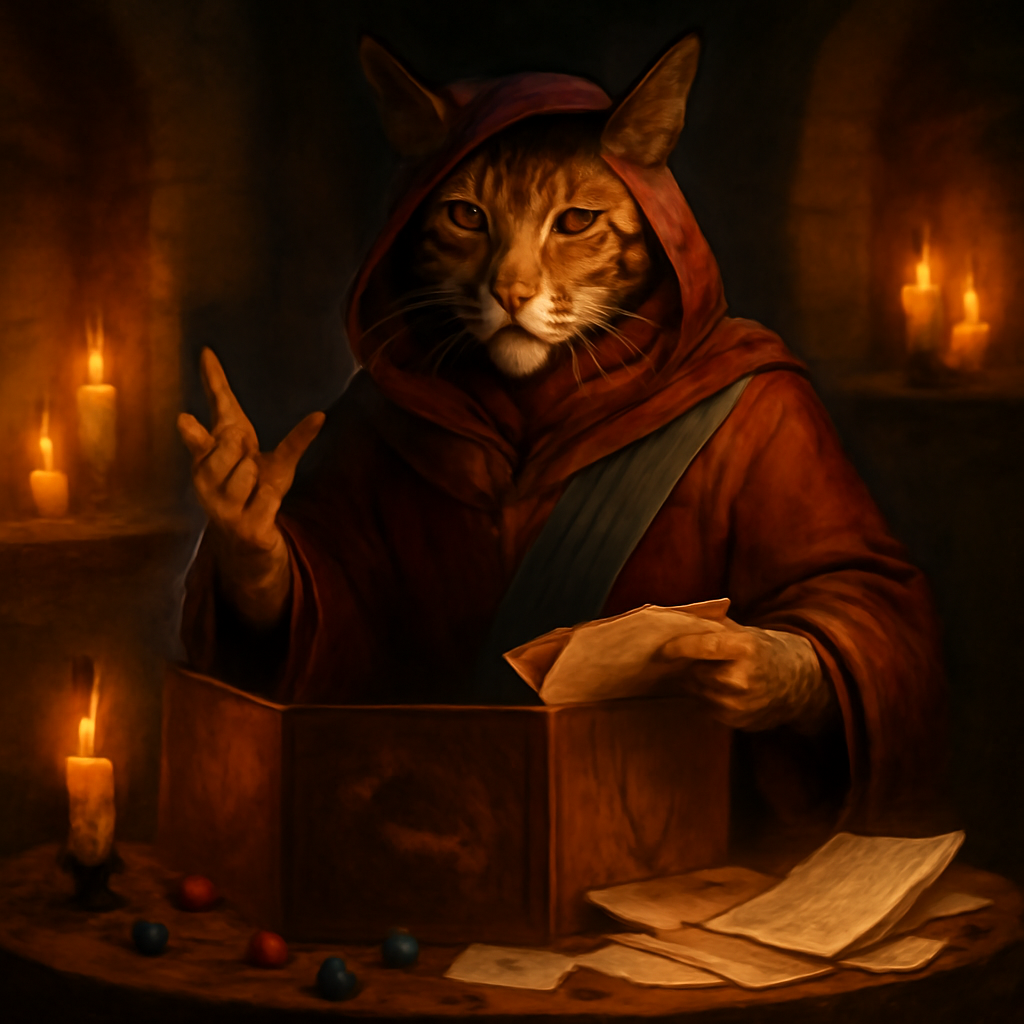
The Night My Players Decided the Villain Was Their Friend
I'll never forget the session where my carefully crafted necromancer villain walked into the tavern for a dramatic reveal, and my players—bless them—immediately tried to buy him a drink. Not interrogate him. Not attack him. Buy him a drink and ask about his childhood.
This is what learning how to improvise as a dungeon master actually looks like. It's not about quick wit or endless creativity. It's about accepting that your beautiful three-page villain monologue is now a conversation about his mother's pot roast recipe, and somehow making that work.
I run most of my campaigns solo—late nights with coffee, dice, and a notebook that's more crossed-out ideas than actual plans. My border collie Murphy usually sits at my feet, occasionally looking up like he's judging my plot choices. And honestly? Running solo taught me more about improvisation than any group session ever could, because when you're playing both sides, you learn real fast that rigid planning is a fantasy.
Why Improvisation Matters More Than Your Notes
Here's the thing about being a dungeon master: your players haven't read your notes. They don't know the merchant was supposed to be a throwaway NPC. They don't know the random forest encounter was filler. When they spend forty minutes interrogating the merchant about his supply chains and completely ignore the mysterious hooded figure in the corner, that merchant better have answers.
Improvising well means your game feels alive, responsive, real. It means your players trust that their choices matter, because the world bends and breathes around their decisions instead of railroading them back to your outline.
The Real Secret: You're Not Making It Up—You're Remixing
Nobody expects you to invent entire storylines from thin air mid-session. That's not how to improvise as a dungeon master effectively. Instead, you're pulling from:
- Things you've already established in your world
- NPCs you've mentioned in passing
- The players' own backstories and goals
- Generic fantasy tropes you can twist slightly
- That one cool idea you had three sessions ago that didn't fit anywhere
You're a DJ, not a composer. You're remixing existing material in response to what's happening at the table.
Practical Techniques That Actually Work
Keep a List of Names and Personality Quirks
I keep a running list in the back of my notebook: twenty names, five personality traits, three physical descriptions. When players suddenly want to talk to the random guard I never planned for, I glance down and that guard becomes "Maris, nervous habit of adjusting his helmet, recently widowed." Boom. He's real now.
This sounds basic, but it's the single most useful improvisation tool I've found. You're never scrambling for a name. You always have something to make an NPC memorable.
The "Yes, And" Rule from Improv Comedy
When a player suggests something that isn't explicitly forbidden by your world's rules, try responding with "yes, and..." instead of "no, but..."
Player: "Is there a chandelier I could swing from?"
Instead of: "No, it's just a regular tavern."
Try: "Yes, and it's that old crystal one the owner is weirdly proud of—he's going to be furious if you break it."
You're not saying yes to everything. You're building on their ideas while adding complications that make the scene more interesting.
Steal from Your Players' Backstories
Your players gave you a whole document of free plot hooks. Use them.
When you need an NPC motivation on the fly, think about which player character would find this situation most personally relevant. The wizard's estranged mentor? The rogue's former fence? The fighter's sibling? Your players will be more invested in improvised scenes that connect to their characters, and you'll look like you planned it all along.
Description Buys You Time
When you're genuinely stuck and need ten seconds to think, describe something in detail. The texture of the stone walls. The smell of the marketplace. The way the NPC's hands shake slightly as they speak. Your players experience this as atmospheric immersion. You're using it to figure out what happens next. Everyone wins.
Tools That Make Improvisation Easier
I'm not above using generators when I'm truly stuck. There's no shame in having backup. I've used Creature Forge AI's NPC generator mid-session when my players wandered into a district I hadn't detailed yet and suddenly wanted to talk to everyone. In about thirty seconds, I had a merchant with stats, personality, and even a portrait that looked suspiciously like my neighbor's golden retriever—because yes, you can upload actual photos and get fantasy characters that look like real people or pets.
That feature has saved me more than once. Last month I uploaded a photo of Biscuit, my goat who has more personality than most people, and got back a stubborn Satyr merchant with the exact same judgmental expression. My players loved him. He's a recurring NPC now.
Build a Mental Library of Set Pieces
Keep a collection of generic scenes you can drop into any campaign:
- A tense negotiation
- A chase through crowded streets
- An ambush in a narrow space
- A puzzle that requires cooperation
- A social event where everyone's hiding something
When you need to improvise a whole scene, pick one of these frameworks and fill in the details based on where your players are and what they're doing. The structure handles the heavy lifting. You just customize the specifics.
What to Do When You're Completely Stuck
Sometimes you hit a wall. The players ask a question you genuinely don't have an answer for, or they make a choice that breaks your entire next three sessions. Here's what actually helps:
Take a Break
Seriously. Call for a bathroom break, a snack run, whatever. Five minutes away from the table can unstick your brain. I've solved entire plot problems while making another pot of coffee.
Ask the Players a Question
Turn it around. "What do you think is behind the door?" "How do you imagine this organization operates?" "What would your character expect to find here?" Players will often suggest something more interesting than what you would've planned, and they'll be invested in it because it came from their imagination.
You're not giving up control. You're collaborating.
Introduce a Complication
When in doubt, make something go wrong. Not a combat necessarily—though that works too—but a complication. The contact doesn't show up. The information is encrypted. The artifact is a fake. The person they're looking for is already dead.
Complications buy you time and create tension. You can figure out the resolution while the players are freaking out about the problem.
The Mindset Shift That Changes Everything
The best advice I ever got about how to improvise as a dungeon master came from a forum post I read at two in the morning during a particularly frustrating solo campaign: your job isn't to tell a perfect story. Your job is to facilitate an interesting experience.
That takes so much pressure off. You're not performing. You're not writing a novel. You're creating a space where surprising, memorable things can happen. Some of those things you'll plan. Many of them you won't. The ones you don't plan are often the ones your players remember years later.
My goat Biscuit has taught me more about improvisation than any DM guide. Animals don't follow scripts. They do weird, unpredictable things, and you roll with it because that's the whole point of having animals. Your players are the same way. They're going to do weird, unpredictable things. That's the whole point of playing with them.
Practice Doesn't Mean Perfection
You'll have sessions where your improvisation is smooth and brilliant. You'll have sessions where you completely blank and stammer through awkward NPC conversations. Both are fine. Both are normal. The more you do it, the more natural it feels, but you never reach a point where you're perfect at it.
I still freeze sometimes. I still say "uh, give me a second" and frantically flip through my notes. The difference is that now I trust myself to figure it out, and my players trust that too.
Start Small and Build Up
If improvising terrifies you, start with low-stakes practice. Improvise minor NPCs before major villains. Improvise side quest details before main plot points. Let yourself experiment in moments that won't derail the campaign if they go weird.
Solo play is great for this, by the way. You can improvise entire sessions with no pressure, no audience, just you figuring out what works. I've improvised full dungeon layouts while playing solo, mapping them as I go, seeing what feels right. Some of my best dungeons came from those experimental solo sessions.
Your Table, Your Style
Every DM improvises differently. Some are character actors who do voices and physicality. Some are descriptive narrators who paint scenes with words. Some are mechanical tacticians who improvise encounters and challenges. None of these is better than the others.
Figure out what kind of improvisation feels natural to you. Play to your strengths. If you're good with voices, lean into NPC conversations. If you're good with tactical thinking, lean into improvised combat scenarios. If you're good with description, lean into environmental storytelling.
You don't have to be good at everything. You just have to be good at enough things that you can keep the game moving when your plans fall apart.
Try It and See What Happens
Learning how to improvise as a dungeon master is less about technique and more about trust—trusting yourself, trusting your players, trusting that even the messy, awkward, completely unplanned moments can become the stories you talk about for years.
And hey, if you need a little backup when the improvisation gets intense, tools like Creature Forge AI can generate monsters, NPCs, and characters on the fly. Upload a photo of your pet, your friend, yourself—get a fully-realized fantasy character in seconds. It's like having a creative partner who never judges your weird ideas and always has your back when you need something right now.
Your players are going to derail your plans. That's not a bug. That's the whole point. Roll with it. Make something up. See where it goes. Some of the best sessions you'll ever run will be the ones you never could have planned.