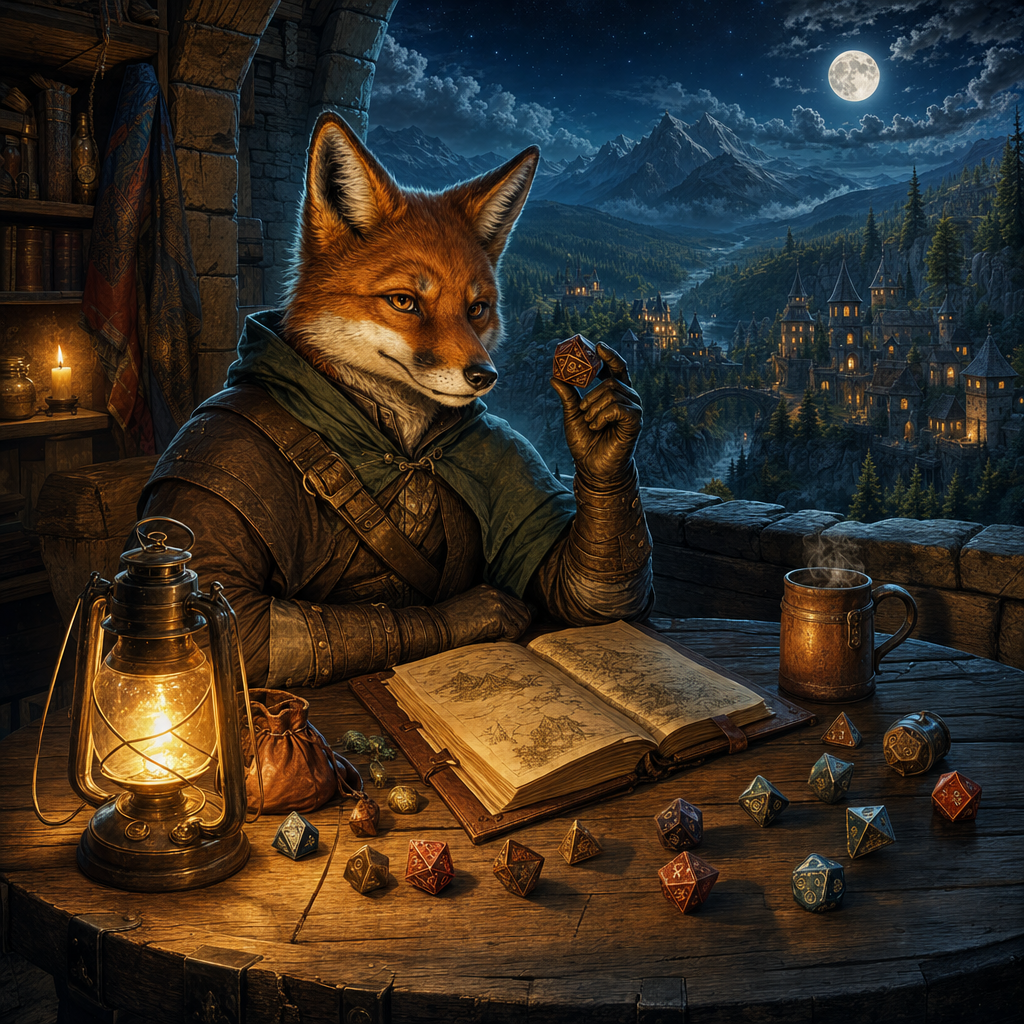
Why I Started Running Games for Myself
Let me tell you about the night I decided to learn how to GM a game for yourself. It was late—past midnight—and I'd just finished moving hay bales in the barn. My back ached, my hands smelled like livestock, and I had exactly zero energy for human interaction. But I wanted to play D&D.
The problem? My usual group had dissolved months earlier. Scheduling conflicts, life changes, the usual suspects. I stared at my dice collection and thought: why do I need four other people to tell a story? That night, with nothing but coffee, a notebook, and my trusty d20, I ran my first solo session. My character was a ranger modeled after my border collie, Scout—loyal, tenacious, terrible at staying on the path. I uploaded a photo of her to Creature Forge AI's character generator, and suddenly Scout was a lupine beastfolk ranger with her same eager eyes and that characteristic head tilt.
I've been running solo games ever since. Not because I'm antisocial, but because there's something magical about playing on your own terms.
The Fundamentals: What Makes Solo GMing Different
When you GM a game for yourself, you're wearing two hats: the Game Master who creates the world, and the player who experiences it. This dual role requires a different mindset than traditional play.
Embrace Randomness and Surprise
The biggest challenge is avoiding predetermined outcomes. You already know what's behind the door because you're the one who put it there. The solution? Lean heavily on random tables, dice, and generators. I never plan more than one scene ahead. Instead, I roll for everything:
- NPC reactions and personalities
- Dungeon layouts and room contents
- Plot twists and complications
- Weather, encounters, and environmental details
This randomness creates genuine surprise. When you roll that a friendly merchant is actually a disguised hag, and you had no idea until the dice told you—that's real tension.
Let Your Character Make Mistakes
Don't give your player character information they wouldn't have. If there's a trap, and your PC didn't check for traps, they trigger it. Period. The temptation to fudge in your own favor is strong, but resisting it makes victories meaningful.
Building Your Solo Framework
Here's the system I've developed over countless late-night sessions.
The Oracle System
You need a way to answer questions you don't know the answer to. When your character asks an NPC "Do you know where the bandits are hiding?" you can't just decide—that's cheating. Instead, I use a simple oracle:
- Roll 1d6: 1-2 = No, 3-4 = Yes but (complication), 5-6 = Yes
- For uncertain situations, roll with advantage or disadvantage based on likelihood
- Add context with a second roll for details
This tiny system has generated some of my favorite plot developments. The time I rolled that the village elder did know about the cult, but was secretly a member? Pure gold.
Keep a Campaign Journal
Write everything down. Not just what happened, but what questions remain unanswered, which NPCs you've met, what rumors you've heard. Your journal becomes your campaign bible. I date every entry and often write in-character, like my PC is keeping a log.
This practice has an unexpected benefit: when you return to a campaign after weeks away, your journal brings you right back. No struggling to remember what the mysterious symbol meant or why you were heading to Thornhaven.
Populating Your World
A solo game needs vivid NPCs. They're your scene partners, and they need personality fast.
The Five-Second NPC
When you need an NPC on the fly, give them exactly three things:
- A distinctive physical trait (scarred hands, nervous laugh, impeccable posture)
- A want (what do they need right now?)
- A secret (even if it never comes up, knowing it changes how you play them)
That tavern keeper? Bushy eyebrows, wants to sell information about the roads, secretly sends messages to the thieves' guild. Boom. You've got a character.
Use Character Generators Strategically
Sometimes you need more than a quick sketch. For recurring NPCs or important story figures, I use Creature Forge AI's NPC generator. The depth it provides—full stat blocks, personality traits, plot hooks—gives you someone you can really develop over multiple sessions.
The photo upload feature is especially powerful here. I once built an entire questline around an NPC modeled after my neighbor's grumpy rooster, Clarence. Became a cockatrice-blooded beastfolk alchemist with Clarence's exact same attitude problem. Every interaction wrote itself.
Combat and Challenge Without a Party
Solo combat requires adjustment. You can't tank hits like a full party, and action economy matters more.
Companion Characters
Give your PC allies. Not full player characters—that's too much to track. Instead, use simplified companion stat blocks:
- One or two key abilities
- Simple attack routines
- Clear personalities but limited decision-making
My ranger Scout traveled with a hired shield-bearer named Tam. Tam had one job: stand between Scout and danger. His personality was "stoic, religious, scared of magic." That's it. But he made combat viable and provided someone for Scout to talk to during long marches.
Adjust Encounter Difficulty
Use monsters designed for lower-level parties, or reduce enemy HP by half. The goal isn't to make things easy—it's to make them survivable. Retreat should always be an option. Some of my best sessions came from running away and regrouping.
Structuring Your Sessions
Solo sessions can be any length. Twenty minutes while your coffee brews. Three hours on a rainy Sunday. Here's how I structure mine:
Start With Recap and Goal
Read your last journal entry. Set one specific goal for this session: "reach the wizard's tower" or "investigate the missing livestock." Having focus prevents aimless wandering.
Scene-Based Play
Think in scenes, not real-time. You don't need to roleplay buying rations or walking for three days. Cut to the interesting parts:
- The ambush on the road
- The tense negotiation with the gate guard
- The puzzle in the ancient library
Montage the boring bits. "After two days of travel, you arrive at the mountain pass, exhausted and low on supplies."
End on a Question
Stop your session at a decision point or revelation. "You open the chest and find a letter bearing the royal seal—addressed to you." This creates natural momentum for your next session.
Advanced Techniques
Once you're comfortable with the basics, these techniques add depth.
Faction Turns
Between sessions, roll for what the world's factions are doing. The bandit gang, the town council, the mysterious cult—each gets a simple roll to see if their plans advance, stall, or face setbacks. This makes the world feel alive and reactive.
Mythic GME
For more complex solo play, look into the Mythic Game Master Emulator. It's a robust system for generating scenes, unexpected events, and plot threads. I don't use it for every session, but for campaign-defining moments, it's invaluable.
Mix Media
Use maps, music, even props. I keep a box of small objects—a bent coin, a raven's feather, a broken compass—that become quest items in my games. Physical tokens make abstract concepts tangible.
Common Pitfalls and How to Avoid Them
Every solo GM hits these walls. Here's how to push through.
Analysis Paralysis
When you're both GM and player, it's easy to overthink. Give yourself time limits. You have thirty seconds to decide what your character does. The oracle has spoken—don't second-guess it.
Going Too Easy (or Too Hard)
Balance is tricky when you control both sides. Stick to your systems. If the dice say you fail, you fail. If a monster's ability would wreck your character, it does. Trust the mechanics.
Losing Narrative Thread
Solo campaigns can sprawl. Use your journal to identify dangling plot threads every few sessions. Either tie them off or promote them to active storylines. Not everything needs resolution, but nothing should be forgotten.
Tools That Transform Solo Play
Good generators save time and spark creativity. I keep a rotation:
- Random dungeon generators for exploration
- Name generators for NPCs
- Weather and event tables for world-building
- Creature Forge AI's monster generator when I need an encounter with teeth
That last one is particularly useful. When your character wanders into unknown territory, generate a creature on the spot. I've created some of my favorite encounters this way—a crystalline beast that was drawn to magic, a swarm of tiny fey that stole memories instead of gold.
The Joy of Solo GMing
Here's what I've learned after hundreds of hours running games for myself: solo play isn't a compromise. It's a different experience, and in many ways, a better one for certain moods and moments.
There's no pressure to entertain others or keep things moving for the group. You can spend twenty minutes describing a sunset if that sunset matters to your character. You can pursue weird plot threads without worrying if everyone else is bored. You can fail catastrophically and find it hilarious instead of disappointing.
My ranger Scout eventually retired after clearing out a necromancer's tower and saving a village. I didn't plan that ending. It emerged from the story we—me and myself—told together. That's the magic of solo GMing. You're having a conversation with the dice, the world, and your own imagination.
Start Tonight
You don't need much to begin. A character, a simple scenario, some dice, and a notebook. Maybe a warm drink and a quiet hour. That's it.
If you want to dive in with ready-made tools, Creature Forge AI can help you build that first character—and if you've got a photo of a pet or someone who inspires you, you can upload it and see them transformed into a fantasy hero. There's something special about adventuring alongside a character that looks like someone you know.
The hardest part of learning how to GM a game for yourself is giving yourself permission. Permission to play alone. Permission to tell stories just for you. Permission to fail, experiment, and discover what makes solo play your kind of magic.
The dice are waiting. The world is vast. And you don't need anyone's schedule but your own.