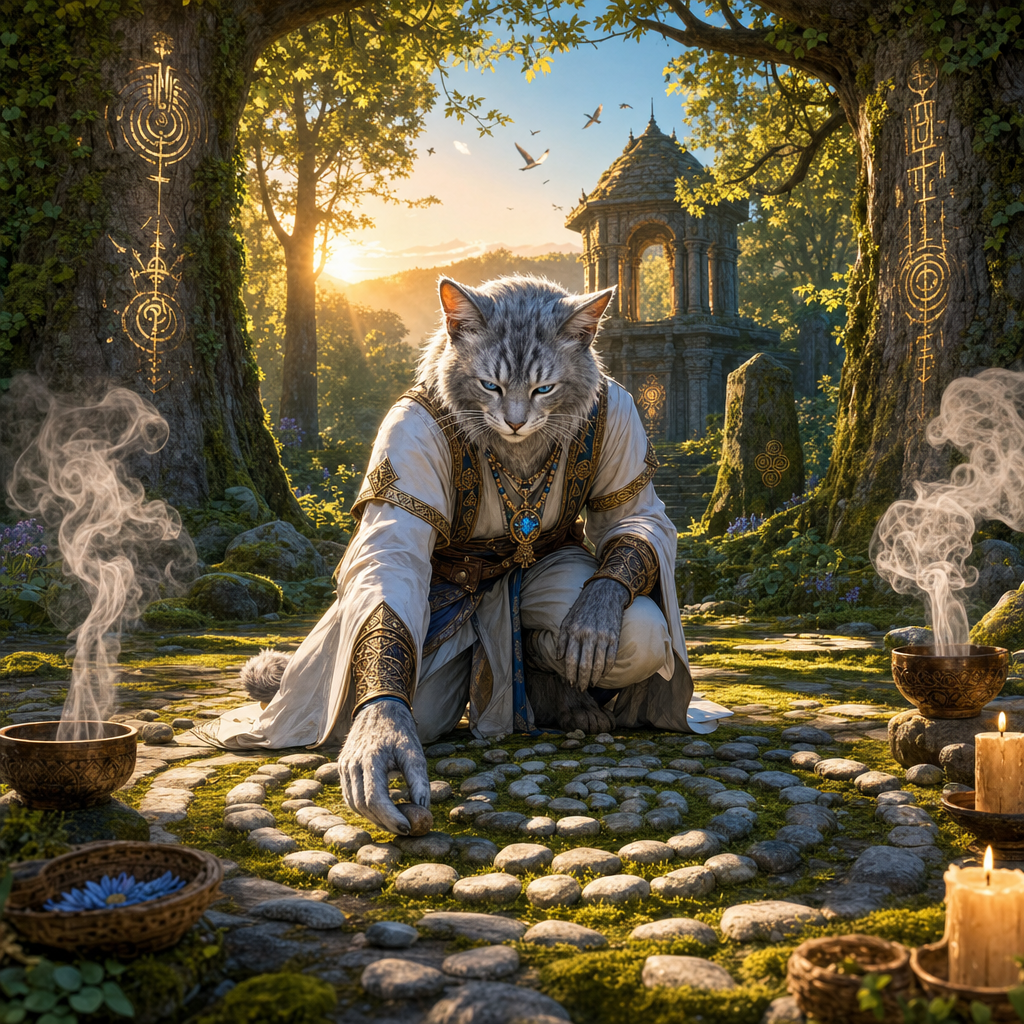
I've been running solo campaigns for years now, usually late at night with terrible coffee and a notebook that's more doodles than words. Last month I was building out a coastal trading city when I realized something: every temple I'd created felt... empty. Beautiful architecture, sure. Detailed deity names and domains. But no soul. That's when it hit me—learning how to create a fantasy religion for D&D isn't about the gods themselves. It's about the people who believe in them.
Here's the thing. I grew up on a farm where we had rituals for everything. You fed the chickens at dawn because that's when you fed the chickens. You didn't walk behind the horses without announcing yourself. You left a corner of the garden for the rabbits because Grandma said it kept them from the good vegetables. None of this was "religion" exactly, but it was belief translated into daily action. That's what was missing from my fantasy faiths.
Start With What the Gods Actually Do
Forget the stat blocks for a minute. Before you worry about domain spells or divine intervention mechanics, ask yourself: what does this deity do for their followers on a random Tuesday?
The best fantasy religions answer practical needs:
- Protection — from disease, war, storms, bad harvests, angry spirits
- Explanation — why crops fail, where the dead go, what thunder means
- Community — shared identity, moral framework, celebration
- Hope — that things can get better, that suffering has meaning
My coastal city worships a tide goddess not because she's "cool" but because fishing villages literally live or die by her moods. When you anchor religion in survival and daily life, it stops being set dressing and becomes essential.
Build From the Ground Up, Not the Pantheon Down
Here's where most DMs (including past me) go wrong: we start with a full pantheon of twelve gods, write elaborate creation myths, then wonder why players' eyes glaze over.
Instead, start small:
- Pick ONE deity that matters to your current story or location
- Define their core promise to followers (what do you get for worshiping them?)
- Create one specific ritual that regular people actually perform
- Decide what breaks taboo (what pisses off this god?)
That tide goddess I mentioned? Her followers pour the first catch back into the sea every morning. It's a tax, basically—you give her the first fish, she gives you a full net. Simple. Memorable. And when my solo character forgot to do it one session, I had the narrative weight to make the next day's fishing miserable.
The Power of Small Rituals
Real religions are full of tiny, repeated actions. Crossing yourself. Removing shoes. Facing east to pray. Covering your head. Not mixing meat and dairy.
Your fantasy religion needs these too:
- A forge-god's followers might tap their hammers three times before starting work
- Death priests could wear bone tokens for every soul they've guided to the afterlife
- A harvest deity's temples might require you to leave seed offerings in small clay pots
- Storm worshipers might refuse to take shelter during the first rain of spring
These details cost you nothing but give players concrete, actionable ways to engage with faith. And when an NPC does one of these things without explanation? Your players notice. They start asking questions. Suddenly your religion feels real.
Give Your Clergy Actual Jobs
Priests aren't just spell dispensers. In most historical societies, religious figures were:
- Educators (teaching reading, history, moral law)
- Healers (both spiritual and medical)
- Record-keepers (births, deaths, marriages, contracts)
- Mediators (settling disputes, witnessing oaths)
- Counselors (guidance for the lost and grieving)
When you need an NPC cleric, don't just stat them out for combat healing. Ask: what do they do the other 99% of the time? The priest of a knowledge god might run the only library in town. A war deity's champion could train the city guard. A trickster god's clergy might operate as licensed messengers and spies.
I once created a priest of a minor agricultural goddess who spent her days breeding disease-resistant wheat strains. No combat stats. Never cast a spell on-screen. But my solo character kept coming back to her because she had purpose beyond "person in temple."
Create Conflict Within the Faith
Nothing makes a religion feel alive like internal disagreement. Real faiths fracture into denominations, reform movements, heretical sects, and rival interpretations.
Easy ways to add this texture:
- Orthodox vs. Reform — old guard vs. progressive interpreters
- Regional Variations — coastal tide-worshipers vs. river delta tide-worshipers interpret the same goddess differently
- Fundamentalists vs. Syncretists — purists who reject outside influence vs. those who blend traditions
- Ascetics vs. Pragmatists — those who demand strict observance vs. those who allow flexibility
My favorite NPC priest was a reformer trying to convince her temple that their goddess of mercy should extend forgiveness to undead, not just the living. Half the clergy thought she was brilliant. Half thought she was dangerously heretical. Neither side was wrong. That's interesting.
Let Players Shape It Through Action
Here's the secret: you don't have to build the entire religion before the campaign starts. Sketch the basics, then let player questions and actions fill in the gaps.
Player asks, "Can I get married in this temple?" You didn't plan wedding rites, but now you make them up—and suddenly you've added depth. Player wants to atone for breaking a taboo? Invent a penance ritual on the spot. Write it down. Now it's canon.
The best worldbuilding is collaborative. Your players will surprise you with the things they care about, and when you build the religion around those moments, it becomes something you both own.
Use Tools to Bring Believers to Life
The hardest part of creating a fantasy religion isn't the theology—it's populating it with memorable clergy and followers who embody the faith.
This is where Creature Forge AI's NPC generator has honestly saved me hours. Instead of agonizing over what a specific priest looks like or fleshing out their personality, I can generate a full character in seconds—complete with appearance, traits, and even backstory hooks that fit the religious role I need. Even better, if I have a specific vision (or, say, want to base a beloved temple guardian on my old farm dog), I can upload a photo and the tool builds a character that actually captures that essence.
I turned my border collie into a Lupine cleric of a shepherd deity once. Gave her the same tireless devotion, the same protective instincts, the same "I'm watching you" intensity. Sounds silly, but it worked—that NPC became the moral center of an entire story arc because she felt real to me.
Don't Forget the Apostates
Every religion has people who left. Lapsed believers. Bitter ex-priests. Heretics. People who were excommunicated or walked away.
These characters are gold for storytelling because they can:
- Explain the faith from an outside perspective (useful for players unfamiliar with it)
- Reveal the religion's flaws and hypocrisies
- Show what happens when you break with the community
- Represent doubt and crisis of faith (which makes belief more meaningful by contrast)
One of my favorite NPCs was a former war-priest who'd abandoned his god after seeing too many atrocities committed in divine name. He still wore the symbols—couldn't quite let them go—but refused to pray. That contradiction made him unforgettable.
Make the Gods Weird
Real-world religions are strange when you step back and look at them. We eat symbolic flesh. We pour liquid on babies' heads. We circle buildings counterclockwise. We refuse certain foods because a text said so thousands of years ago.
Your fantasy religions should be weird too. Not random-for-random's-sake weird, but logically strange—practices that make sense within the faith's internal logic but seem odd from outside.
Examples I've used:
- A death goddess whose followers keep their fingernail clippings in tiny vials (you'll need them to reassemble your body in the afterlife)
- A sun god whose priests must never cast a shadow on a holy day (they position mirrors and lights to eliminate their shadows)
- A trickster deity who demands all prayers be told as jokes (the better the joke, the more likely you get answered)
- A forge god whose followers ritually break one tool every year and bury it (returning metal to the earth to be reborn)
Weird details stick in memory. They give your world texture and make religions feel like they evolved over centuries, not last Tuesday.
Putting It All Together
When you sit down to create a fantasy religion for D&D, remember: you're not building a theology textbook. You're building something people live. Something that shapes daily choices, community bonds, and personal identity.
Start with practical needs. Add small rituals. Give clergy real jobs. Create internal conflicts. Let players shape it through play. Make it a little weird. And always, always ask yourself: what would a regular person actually do because they believe this?
The gods can be as vast and mysterious as you want. But the religion—the human (or elven, or dwarven) response to those gods—that needs to be tangible, specific, and lived-in.
Now if you'll excuse me, I need to go figure out why my pantheon's goddess of dawn has the exact same energy as my rooster Ferdinand. Loud, territorial, absolutely convinced the world can't function without her intervention. Maybe that's the secret—base your gods on chickens. Works better than you'd think.
Ready to populate your new faith with memorable clergy and devoted followers? Head over to Creature Forge AI and start bringing your religious characters to life—complete with the personality and presence your world deserves.