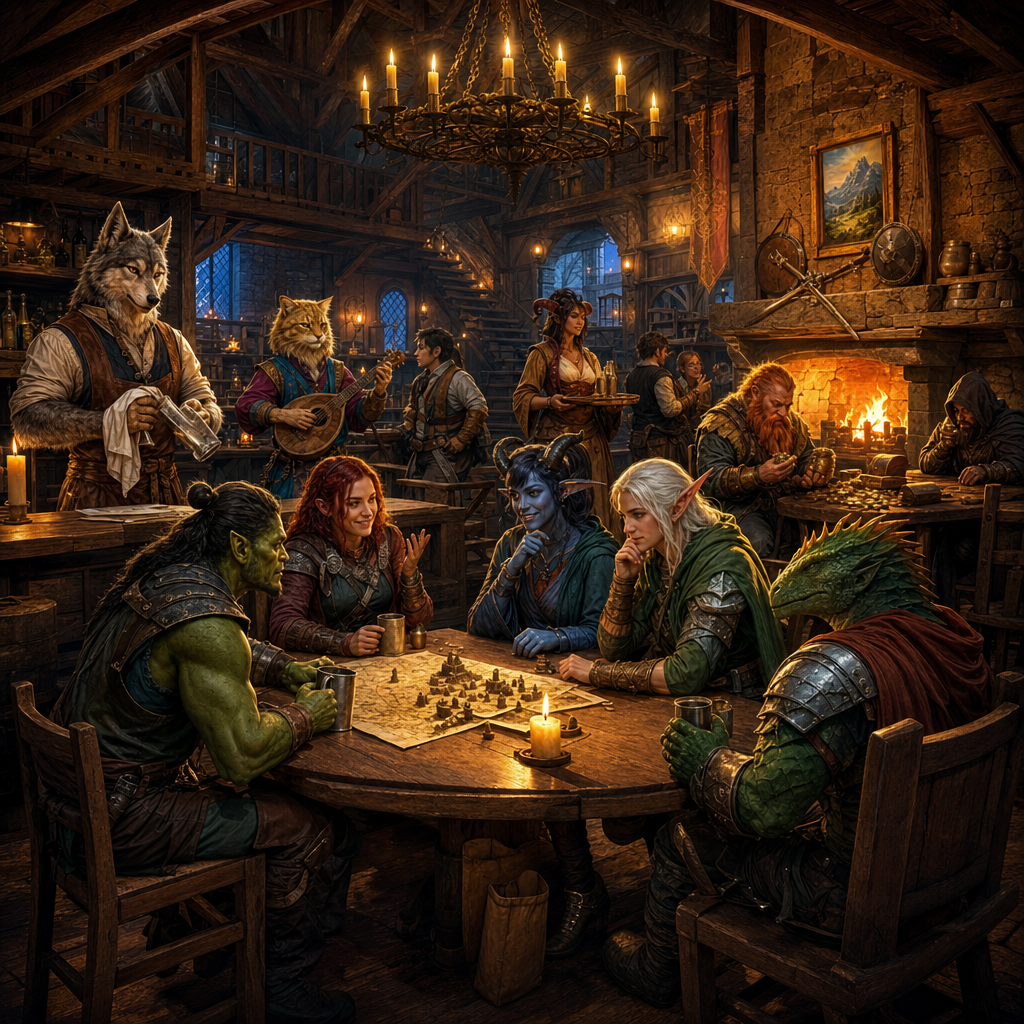
The Question Every DM Asks (And Gets Wrong)
When I first started running solo campaigns late at night with just coffee and dice for company, I made a classic mistake: I built seventy-three NPCs for a single town. Seventy-three. I had backstories, voice notes, relationship webs. I was so proud of myself.
Players—well, me playing multiple characters—met exactly four of them. The rest lived in my notebook like some kind of fantasy census bureau that would never see daylight.
So when people ask how many NPCs does a campaign need, I've learned the answer isn't a number. It's a strategy. But if you want the practical breakdown first, here it is:
- Per session: 3-5 meaningful NPCs
- Per arc/chapter: 8-12 recurring NPCs
- Per campaign: 20-30 total named NPCs (but only 6-10 will matter)
Let me explain why these numbers work, how to decide which NPCs actually deserve names, and the shortcut that saved my sanity.
Start With Your Campaign's Heartbeat
How many NPCs your campaign needs depends entirely on what kind of story you're running. A political intrigue game in a noble court? You'll need more faces. A wilderness survival hex-crawl? Maybe six total if you're lucky.
Urban vs. Wilderness Campaigns
City-based campaigns naturally require more NPCs because civilization means infrastructure. Your players need:
- A quest-giver or patron (1-2 people)
- Merchants and service providers (2-3 recurring favorites)
- Authority figures—guards, officials, guild leaders (2-4)
- Allies and contacts (3-5)
- Antagonists and their lieutenants (2-3 at any given time)
That's about 10-17 named NPCs for a city arc, but here's the trick: most of them don't appear every session. They're there when needed, like a good toolkit.
Wilderness campaigns flip the script. You might go three sessions with nothing but wolves and weather. When you finally reach that remote trading post, the one grizzled shopkeeper you meet becomes incredibly memorable because of scarcity. In my solo games, I've had entire month-long story arcs with five total NPCs. It worked beautifully.
The Anchor NPC Rule
Every campaign needs what I call anchor NPCs—the 3-5 characters players return to again and again. These are your tavern keeper, your quest-giver, your rival, your mentor, your comedic relief. They provide continuity and emotional investment.
Everyone else? They can be sketched in light detail until players show interest.
The Three Tiers of NPC Importance
Not all NPCs are created equal, and treating them like they are will bury you in prep work. I sort mine into three tiers:
Tier 1: The Core Cast (5-8 NPCs)
These are fully developed characters with:
- Names, backstories, and motivations
- Distinct personalities and speech patterns
- Plot relevance and recurring appearances
- Stats if they might fight alongside or against the party
These NPCs get the full treatment. For my solo campaigns, I actually started using Creature Forge AI's NPC generator to build these out—it creates full stat blocks, personality traits, and even generates art. The time savings meant I could focus on playing instead of prepping.
Tier 2: Supporting Characters (10-15 NPCs)
These NPCs have names and one memorable trait, but limited backstory. The blacksmith who always hums sea shanties. The nervous city guard with the lazy eye. The halfling courier who's faster than she looks.
They add flavor and can be promoted to Tier 1 if players latch onto them. I keep these in a simple list: name, role, one quirk. That's it.
Tier 3: Scenery NPCs (Unlimited)
These are the unnamed masses. "The barkeep." "A dock worker." "Three street urchins." You improv these on the fly. No prep needed. If a player starts a conversation with one and it goes somewhere interesting, then you give them a name and promote them.
Most of your world's population lives here, and that's fine.
Session-by-Session: The Practical Numbers
Here's how many NPCs typically appear in a single session, based on my solo play experience and years of overthinking this:
Combat-heavy session: 1-2 NPCs (a quest-giver at the start, maybe an ally or traitor reveal)
Roleplay-heavy session: 4-6 NPCs (social encounters, investigations, shopping, gathering information)
Mixed session: 3-4 NPCs (the sweet spot for most tables)
If you're introducing more than six NPCs in one session, players will forget who's who. I learned this the hard way when I ran a dinner party scene with nine named guests. My notes said "the players enjoyed meeting everyone." My actual play report said "they only remembered the one who spilled wine and the one who was secretly a vampire."
Building NPCs Players Actually Remember
Quality beats quantity every single time. One NPC with a distinct personality will outshine a dozen generic ones.
Here's what makes an NPC stick:
- A physical quirk: nervous habits, unusual appearance, distinctive voice
- A clear want: even minor NPCs want something, and it's not always to help the players
- A connection: tie them to the plot, a player's backstory, or another NPC
- A moment: one memorable scene beats ten forgettable interactions
My border collie Maggie has more personality than most NPCs I see in published modules, and that's not a joke. She's stubborn, loyal to a fault, suspicious of strangers, and has this way of tilting her head when she's judging you. So when I needed a scout NPC for a solo campaign, I uploaded her photo to Creature Forge AI's character generator and got back a lupine ranger with those exact traits—complete with the head-tilt in the portrait. Players loved her immediately.
That's the secret: base NPCs on real personalities, whether that's your pets, people you know, or characters from media you love. Maggie-the-ranger got more roleplay attention than the perfectly statted villain I'd spent hours balancing.
The Shortcut: Let Tools Do the Heavy Lifting
Look, you don't need to hand-craft every NPC from scratch. For Tier 2 and Tier 3 NPCs especially, speed matters more than perfection.
I used to spend Sunday afternoons building NPCs in spreadsheets. Now I generate them in minutes, tweak what needs personality, and move on. The NPC generator gives me stats, traits, and art that's actually usable. For a solo DM or anyone prepping between work and life, that's not lazy—it's sustainable.
Save your creative energy for the NPCs that matter. Let the tools handle the rest.
Signs You Have Too Many (Or Too Few)
You have too many NPCs if:
- You're checking your notes constantly to remember who's who
- Players ask "wait, who was that again?" more than once per session
- You're prepping NPCs that never appear
- The story feels cluttered or unfocused
You have too few NPCs if:
- The world feels empty or lifeless
- Players have no one to talk to or get information from
- The same NPC is awkwardly filling multiple roles
- You're improvising forgettable randos every session
The sweet spot feels effortless. Players know the core cast by name. They look forward to seeing certain NPCs again. The world feels populated but not overwhelming. You're not drowning in prep.
Adjust for Your Table Size
One last consideration: how many players do you have?
A table of six players needs fewer NPCs than a table of three, because the players themselves provide social dynamics and roleplay opportunities. Solo play—my bread and butter—needs more NPCs to create the feeling of a living world since you're the only voice at the table.
Scale accordingly. Start conservative. Add more if the world feels empty. Cut back if you're overwhelmed.
The Real Answer
So how many NPCs does a campaign need? Enough to make the world feel alive, but few enough that you can give them personality.
For most campaigns, that means 20-30 total named NPCs across the whole story, with 5-8 core characters who really matter. Per session, aim for 3-5 meaningful interactions. Build your Tier 1 NPCs with care, sketch your Tier 2 NPCs with speed, and improv your Tier 3 NPCs without guilt.
And when you need to populate a town, staff a tavern, or bring a rival faction to life, don't torture yourself with blank-page syndrome. Tools exist for a reason. Creature Forge AI can spin up a fully statted NPC with personality traits and art in seconds—and if you want them to look like your actual dog, cat, or that one friend who's basically a halfling bard already, you can upload a photo and watch the magic happen.
Your campaign doesn't need a phone book of NPCs. It needs a handful of characters your players will remember, miss, and talk about long after the campaign ends. Start there. The rest is just set dressing.