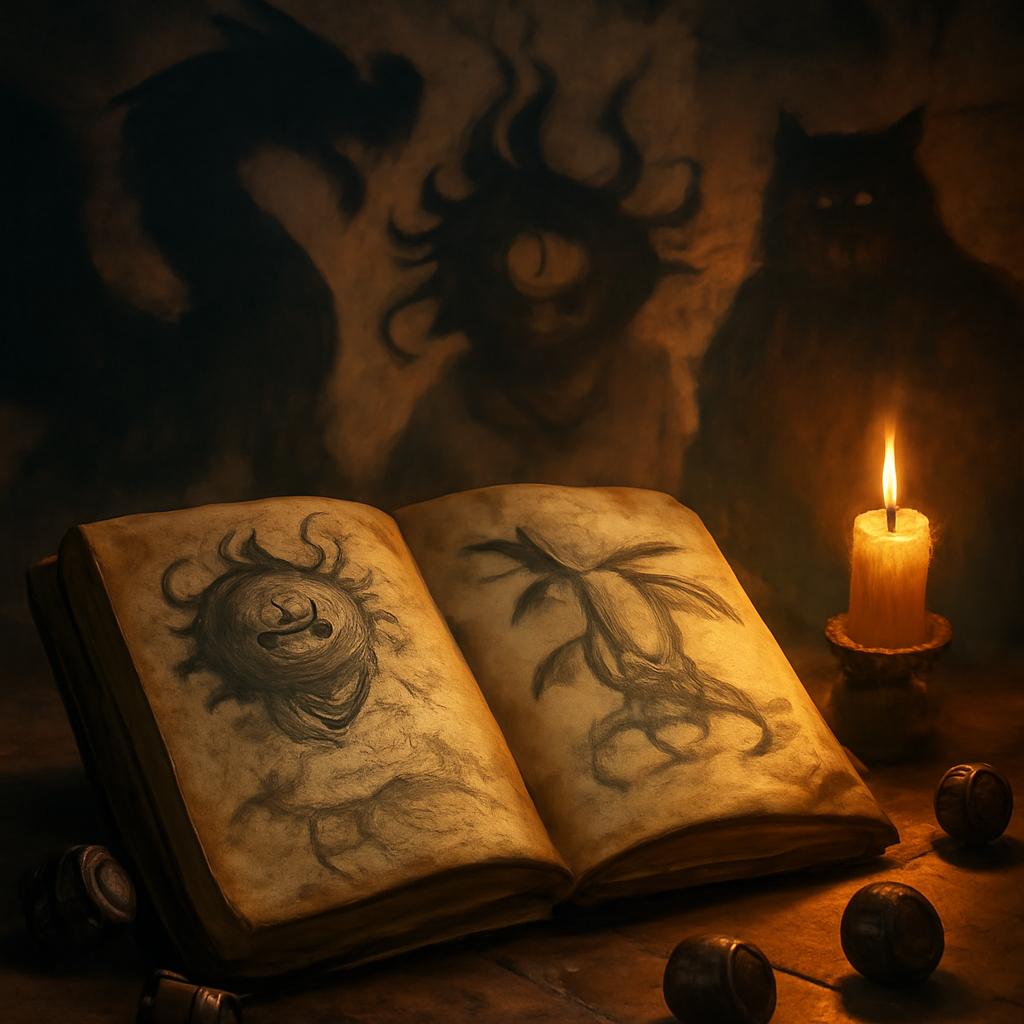
I'll never forget the first homebrew monster I threw at my solo campaign. It was supposed to be a "moderate challenge"—a corrupted dire goat inspired by Biscuit, my actual goat back on the farm who had a habit of headbutting anything that moved. I gave it some necrotic damage, boosted its HP, and called it CR 4.
My level 4 ranger lasted exactly one round.
That's when I learned that making up cool monster abilities is the fun part. Making sure they won't accidentally murder your entire party? That's where a homebrew monster CR calculator becomes your best friend.
Why Challenge Rating Actually Matters
Challenge Rating is D&D's way of answering the question: "Will this kill my players?" It's an imperfect system—anyone who's run the game knows a CR 2 can be deadly in the right circumstances, and a CR 10 can go down like a chump if the dice hate it. But it gives us a baseline.
When you're homebrewing monsters, especially if you play solo like I do, you need that baseline. There's no party of four to balance out bad luck or poor tactics. It's just you, your character sheet, and whatever nightmare you've decided to statblock into existence.
The official rules in the Dungeon Master's Guide give you formulas for calculating CR based on offensive and defensive statistics. But let's be honest—those tables are about as user-friendly as my rooster at 5 AM. You need Hit Points, Armor Class, attack bonuses, damage per round, and then you cross-reference multiple tables while accounting for special abilities.
The Core Components of CR Calculation
A good homebrew monster CR calculator breaks the process into manageable pieces. Here's what actually determines your monster's challenge rating:
Defensive CR
- Hit Points: How much punishment can it take? More HP means higher defensive CR.
- Armor Class: How hard is it to hit? This modifies your HP-based calculation up or down.
- Resistances and Immunities: These effectively multiply your HP against certain damage types.
- Saving Throw Bonuses: Good saves can keep your monster alive through crowd control.
Offensive CR
- Damage Per Round: The big one. How much damage can this thing dish out in three rounds?
- Attack Bonus or Save DC: Modifies your damage calculation—higher accuracy means more effective damage.
- Special Abilities: Things like Pack Tactics or Legendary Actions can swing this wildly.
You calculate both separately, then average them. That's your baseline CR, before you start accounting for all the weird edge cases that make monster design interesting.
Where Manual Calculation Gets Messy
Here's where I ran into trouble with Biscuit the Corrupted Dire Goat. I calculated his defensive CR just fine—decent HP for CR 3, okay AC. But I gave him this cool ability where his headbutt did normal damage plus knocked the target prone plus did necrotic damage equal to half the target's current HP.
In my head, it was cinematic. In practice, it was a one-shot mechanic I hadn't properly accounted for in the offensive CR calculation.
This is where automated calculators save you. The math gets complicated fast when you add:
- Legendary Actions (multiply effective damage by 1.5 or more)
- Multiattack (three attacks at once? You're adding all that damage together)
- Save-or-Suck abilities (how do you CR-value "save or die"?)
- Conditional bonuses (advantage on attacks, bonus damage in certain situations)
- Action economy tricks (can it do things outside its turn?)
A good homebrew monster CR calculator accounts for these variables with dropdown menus and checkboxes instead of making you reference six different tables.
Using Digital Tools Effectively
I've used several CR calculators over the years. Some are bare-bones—you input numbers, it spits out a CR. Others try to be comprehensive and end up feeling like you're filing taxes.
The best approach I've found is to use a calculator as a starting point, not gospel. Input your basic stats and get a baseline CR. Then actually think about how the monster plays:
- Does it have a glass cannon build? (High damage, low survivability—might play above its CR in round one, then drop fast)
- Is it a tank? (The opposite problem—it'll drag combat out but might not threaten players much)
- Does it have abilities that interact with the environment? (Calculators can't account for "fights you on a crumbling bridge")
- What's the action economy? (One big monster vs. five players is different from five smaller monsters vs. five players, even at the same total CR)
Playtesting Your Homebrew
This is where solo play becomes incredibly valuable. Before I unleash something on a group, I'll run it through a simulated encounter with myself. I'll pilot both sides honestly—no fudging dice, no pulling punches.
If my test character steamrolls the monster, it's probably under-CRed. If my character is struggling hard or dies, I overshot. After Biscuit-gate, I've learned to test before I wreck (my campaigns).
Tools That Actually Help
When I need to create homebrew creatures quickly—especially when I want them to look like something specific—I turn to Creature Forge AI's monster generator. The thing I love about it is that you're not just getting a stat block. You can upload a photo (yes, I've absolutely uploaded pictures of farm animals) and get a fully-realized creature that actually looks like your inspiration.
The generator handles the CR calculation in the background while you focus on the fun parts—abilities, flavor, personality. And because it shows you the complete stat block, you can see exactly how it arrived at that CR and adjust from there.
For characters and NPCs with more complex builds, the character generator applies the same photo-to-fantasy magic. I once turned my border collie into a Lupine ranger NPC, complete with appropriate CR for the party's level.
Common CR Calculation Mistakes
Over countless solo sessions and homebrew experiments, these are the errors I've made (so you don't have to):
Forgetting About Multiattack Damage
Don't just calculate one attack's damage. If your creature makes three attacks per turn, you're calculating damage per round across all of them. This is the #1 way people accidentally create murder machines.
Undervaluing Resistances
Resistance to common damage types (like fire, cold, or non-magical weapons) effectively doubles relevant HP. If most damage in your campaign comes from weapons, resistance to weapon damage is huge.
Overvaluing Weird Abilities
That cool ability that turns enemies to stone on a failed save? Sounds CR-breaking. But if the save DC is reasonable and it requires the monster to hit first, it's probably fine. Context matters.
Ignoring Legendary Resistance
Three automatic save successes doesn't directly increase CR, but it definitely increases effective survivability against caster-heavy parties. Bump your CR estimate up if you're adding these.
Not Accounting for Player Resources
A monster that's a perfect challenge when the party is fresh becomes a TPK machine when they're out of spell slots and healing. Consider where in the adventuring day this encounter happens.
Making It Work for Solo Play
Solo players like me have unique considerations. You can't rely on party synergy to overcome CR miscalculations. My approach:
- Err on the side of caution: A too-easy fight is disappointing but survivable. A too-hard fight ends your campaign.
- Build in escape options: Give yourself narrative outs if things go sideways. The monster isn't trying to kill you; it's territorial and will stop chasing at some point.
- Use CR as a range: A CR 5 monster might be fine for a level 4 solo character with good gear and tactics, or deadly for a level 6 character caught unprepared.
- Track actual outcomes: I keep notes on every homebrew monster I use. Did the CR feel accurate? I adjust my calculations based on real play experience.
Beyond the Numbers
Here's what I've learned after years of solo campaigns and homebrew monster creation: CR is a tool, not a straitjacket. Some of my most memorable encounters were "incorrectly" balanced on paper.
The corrupted dire goat that killed my ranger in round one? I eventually brought him back at proper CR 2, and he became a recurring villain in that campaign. Getting the CR wrong taught me more about monster design than getting it right would have.
Use calculators to get in the ballpark. Test your creations honestly. Adjust based on how they actually play. And remember that the best monsters aren't the ones with perfect math—they're the ones that create stories worth remembering.
Whether you're turning your farm animals into fantasy creatures or building something from pure imagination, start with the calculator, but trust your instincts about what makes an encounter interesting. The math keeps players alive. The story makes them care about staying that way.
Ready to create balanced homebrew monsters without the spreadsheet headaches? Try Creature Forge AI and see how fast you can go from concept to complete stat block—no math degree required, just your creativity and maybe a photo of your favorite animal.