Why Most Homebrew Magic Items Fall Flat
I've been running solo campaigns for years now, and I've learned something important about homebrew magic item ideas 5e: if your item is just a +2 version of something in the Dungeon Master's Guide, you're missing the point entirely.
The best magic items I've ever created came from weird places. Last spring, I was mucking out the goat pen—Biscuit was being particularly stubborn about moving—and I had this thought: what if there was a pitchfork that could magically relocate manure? And then, because my brain works this way, I thought: what if it was sentient and deeply offended by its purpose?
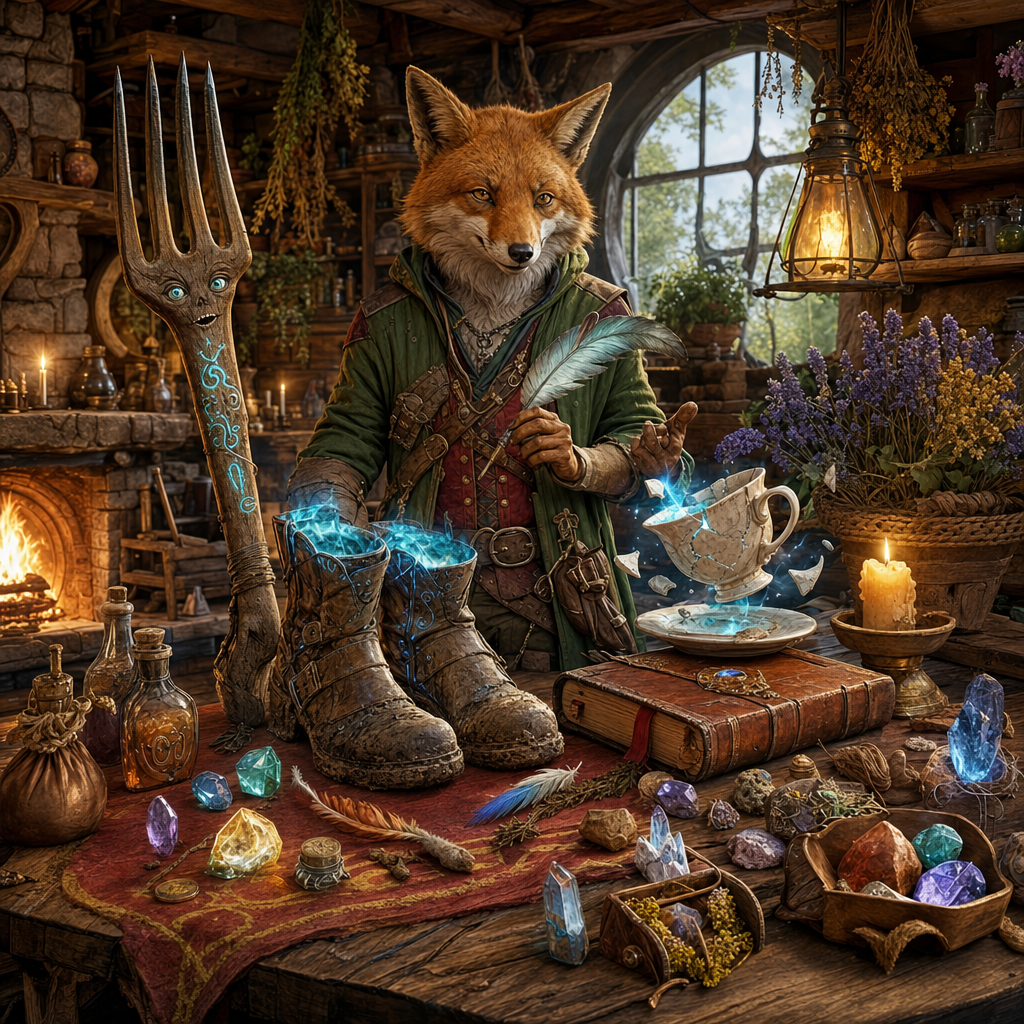
That's how the Forktine of Dignified Labor was born. A +1 pitchfork that deals an extra 1d4 psychic damage while constantly complaining in a posh accent about being used for "such pedestrian tasks." My ranger loved it. The magic wasn't powerful, but the personality made every combat memorable.
The Three Rules of Memorable Homebrew Items
Before we dive into specific homebrew magic item ideas 5e, here are the principles I use:
- Personality over power — A talking item with opinions is worth ten silent +1 swords
- Drawbacks create stories — The best items have interesting costs or quirks
- Solve problems creatively — Give players tools that open new approaches, not just bigger numbers
Homebrew Magic Item Ideas That Actually Work
The Uncommon Tier: Items for Early Adventures
Boots of Unreliable Teleportation
Uncommon, requires attunement
As a bonus action, you can teleport up to 30 feet to an unoccupied space you can see. When you do, roll a d20. On a 1-5, your socks teleport instead, appearing in a random location within 60 feet. You arrive at your destination barefoot.
Why it works: Useful mobility with a hilarious drawback. I've seen players risk the sock-loss in crucial moments, and it never stops being funny when the barbarian's footwear lands in the dragon's hoard.
The Teacup of Truthful Gossip
Uncommon
When you pour any liquid into this cracked porcelain teacup and drink it, you learn one true rumor about a person, place, or event within 100 miles. The rumor is always accurate but may be trivial, outdated, or uselessly specific. Once used, the cup can't be used again until the next dawn.
Why it works: Perfect for investigation-heavy campaigns. The truth is guaranteed, but you might learn that "the mayor's sister really does make the best apple tarts" when you were hoping for blackmail material.
The Rare Tier: Items Worth Questing For
Cloak of the Loyal Hound
Rare, requires attunement
This weathered traveling cloak smells faintly of wet dog. Three times per day, you can summon a spectral mastiff that appears in an unoccupied space within 10 feet. The hound uses the statistics of a dire wolf but is translucent and glowing. It obeys your commands perfectly and lasts for 1 hour or until reduced to 0 hit points. The hound has advantage on tracking any creature you've touched in the last 24 hours.
Why it works: Companion fantasy without the bookkeeping burden of permanent pets. I grew up with border collies on the farm, and I actually uploaded a photo of my old dog Keeper to Creature Forge AI to create a fantasy character version—a lupine ranger who became my go-to solo campaign protagonist. This cloak captures that loyal companion energy.
The Ledger of Unfinished Business
Rare, requires attunement
This leather journal writes itself, recording the names of everyone who dies within 60 feet of you. Once per long rest, you can open the ledger and ask one question of a deceased person whose name appears in its pages. You receive a brief, truthful answer (25 words or fewer) as the text appears on the page. The spirit isn't compelled to be helpful, only honest.
Why it works: Investigation tool with built-in roleplay. Dead NPCs can be snarky, cryptic, or bitter. It creates moments instead of just solving mysteries.
The Very Rare Tier: Campaign-Defining Items
The Wandering Doorway
Very rare
This ornate door frame folds down to the size of a book. As an action, you can unfold it and place it against any solid vertical surface. The doorway attunes to that location. You can carry the frame to any other location and, as an action, open it to create a portal back to the attuned surface. The portal remains open for 1 minute or until you close it. Once used, the doorway can't create a portal again until the next dawn. You can change the attuned location by spending 8 hours in a ritual.
Why it works: Instant home base connection. Players will get creative—attune it to a tavern wall, a treasury, their ship. It's powerful but limited enough to stay balanced.
Building Items From Your Table's Story
The best homebrew magic item ideas 5e come from your actual campaign. Listen to your players:
- Did the ranger mourn their fallen wolf companion? Create an item that echoes that bond.
- Does the rogue constantly wish they could talk to the victims? That's where the Ledger came from in my game.
- Did someone make a joke about teleporting socks? Make it real.
When I design items now, I think about the moment more than the mechanics. What will make the table erupt in laughter? What will make a player lean forward and say "wait, I want to try something"?
The Power of Personalized Items
Here's something I've started doing: creating items that literally look like your players' pets or favorite things. I uploaded a photo of my cat Merlin—a grumpy orange tabby who acts like he owns the farm—and used Creature Forge AI to generate a character version. That became the inspiration for The Amulet of Merlin's Disdain, which summons a spectral cat that judges enemies so harshly they take psychic damage.
Your players have pets, family photos, favorite objects. Imagine handing your wizard an item that's actually modeled on their real-life dog, transformed into a fantasy companion. That's the kind of personal touch that makes homebrew items legendary.
Quick-Build Formula for Your Own Items
When you need a homebrew item fast:
- Pick a mundane object (farming tool, piece of furniture, article of clothing)
- Add one clear magical function (teleportation, summoning, information-gathering)
- Include one quirk or cost (talking, unreliable, requires a sacrifice)
- Tie it to your world (who made it? why? what's its history?)
Example: A shepherd's crook (mundane object) that can summon a protective sheep spirit (function) but the sheep is extremely anxious and narrates all the dangers it perceives (quirk). Boom—you've got the Crook of the Worried Shepherd, and your players will remember it forever.
Balancing Homebrew Without Breaking Your Game
I'm not a mathematician, and I don't pretend to optimize everything. But here's what keeps my homebrew items from breaking campaigns:
- Limited uses per day — Most powerful effects work 1-3 times before a rest
- Attunement slots matter — Make players choose what to attune to
- Costs beyond charges — Social consequences, strange requirements, annoying personalities
- Let players shine — If an item makes a cool moment happen, that's working as intended
That pitchfork I mentioned earlier? It's not overpowered. But when my ranger used it to defeat a devil while the fork complained about "the indignity of stabbing something that isn't properly composted"—that was perfect.
Start Simple, Then Iterate
Your first homebrew items don't need to be complex. Start with reskins: take a +1 longsword and make it the Blade of Evening Song that hums your grandmother's lullaby when drawn. Same stats, different soul.
Then add small tweaks: maybe that humming gives you advantage on Charisma checks with anyone who heard their grandmother sing the same song. Suddenly you have a magic item that creates roleplay opportunities.
The homebrew magic item ideas 5e that stick with your players aren't always the most powerful. They're the ones with stories attached. They're the fork that complains, the boots that lose socks, the ledger that lets the murder victim be sarcastic from beyond the grave.
Make It Real: Tools to Bring Your Ideas to Life
If you're looking to add even more personality to your homebrew items—especially ones connected to companions, familiars, or guardian spirits—Creature Forge AI can help you visualize them. Upload a photo of your pet, a player's dog, or even that weird statue in your aunt's garden, and generate a full fantasy character or creature that actually looks like them. It's the fastest way I've found to turn "I wish my ranger had a magical wolf companion" into a fully realized character with stats, art, and personality.
Your table deserves magic items that feel like they belong to YOUR world, not a generic loot table. Start small. Make something weird. Give it a voice. And watch your players light up when they realize the treasure isn't just powerful—it's theirs.