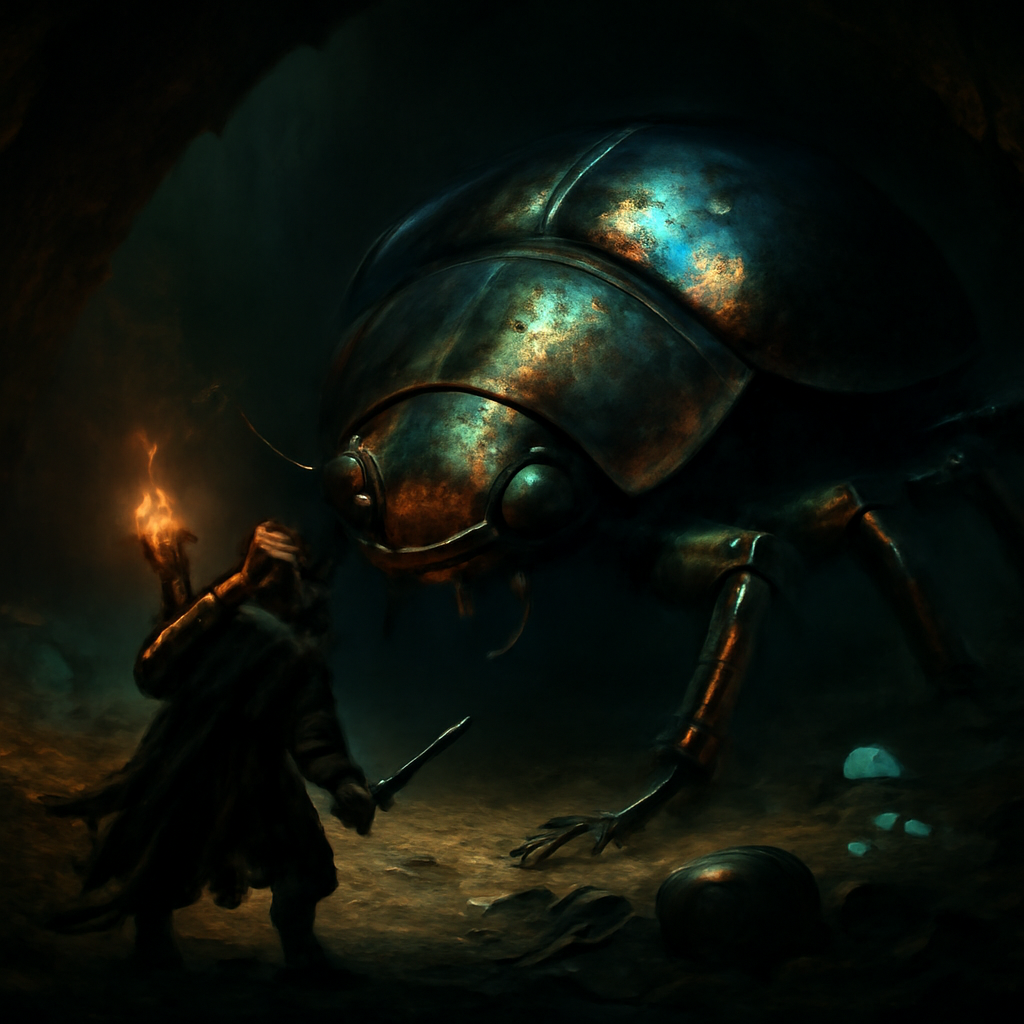
I'll be honest: the first time I threw giant insect monsters at my party, they laughed. "Spiders? Really?" one player asked. Then the ambush spider dropped from the ceiling, grappled the wizard, and started hauling him up into the webbed darkness. No one was laughing after that.
Giant insect monsters for D&D have this weird reputation — they're often treated like filler encounters, throwaway dungeon dressing. But when you lean into what makes them actually alien and horrifying, they become some of the most memorable encounters you'll run. No monologues. No mercy. Just relentless, chittering hunger.
Here's how to make your giant bugs more than just stat blocks with extra hit points.
Why Giant Insects Work in D&D
Real insects are already nightmare fuel when you think about them too hard. They're everywhere, they survive everything, and their anatomy is profoundly wrong compared to mammals. Scale that up to horse-sized or larger, and you've got a monster that doesn't need to be explained — players already have a visceral reaction.
Giant insect monsters for D&D also fill a specific ecological and narrative niche:
- They're mindless threats — no negotiation, no persuasion checks, just survival
- They come in swarms or colonies — great for overwhelming numbers without complex tactics
- They inhabit liminal spaces — caves, sewers, deep forests, forgotten ruins
- They're modular — easy to reskin and customize for any environment
Plus, they're weird. A dragon might be terrifying, but it's also majestic. A giant centipede scuttling up your leg with twenty pairs of clicking legs? That's just wrong.
Classic Giant Insect Monsters and How to Use Them
Giant Spiders
The go-to. Giant spiders are ambush predators — don't run them as front-line brutes. Have them drop from above, shoot webs from range, and retreat into tight spaces where larger party members can't follow. Their Web ability is a free battlefield control tool that players will remember.
Encounter twist: The spiders aren't attacking — they're defending egg sacs. If the party destroys them, hundreds of finger-sized spiderlings pour out. Not dangerous individually, but psychologically devastating.
Giant Scorpions
Armored, venomous, and built like living siege weapons. Giant scorpions work best in desert, badlands, or underground environments. Their poison is nasty, and their claw grapples make them excellent at isolating targets.
Lair idea: A ruined temple half-buried in sand, now home to a nest of scorpions. The party has to navigate collapsed halls while avoiding tail strikes and cave-ins.
Giant Centipedes
Fast, relentless, and deeply unsettling. Centipedes are pursuit predators — once they catch a scent, they don't stop. Use them in narrow corridors or sewers where their speed and poison bite become real threats.
Variant: A carrion centipede that's been feeding on plague victims. Its bite inflicts both poison damage and disease.
Ankhegs
The farmland terror. Ankhegs burrow, spit acid, and drag prey underground. I grew up on a farm, and let me tell you — the idea of the ground suddenly opening up beneath a cow and swallowing it whole? That's the kind of rural horror that sticks with you. Our old barn cat, Mitts, used to refuse to walk across certain parts of the pasture, and I always wondered if he knew something we didn't.
Ankhegs are perfect for mid-level parties and work great as environmental hazards during overland travel.
Making Giant Insects Memorable
If you want your giant insect encounters to stand out, don't just run them as generic monsters with insect skins. Emphasize their alien nature.
Describe the Wrongness
Don't just say "a giant beetle attacks." Say: "You hear clicking — rhythmic, mechanical, wrong. Then you see it: a beetle the size of a wagon, mandibles opening and closing with hydraulic force, compound eyes reflecting your torchlight in a thousand tiny flames."
Make players feel the uncanny valley of a creature that shouldn't exist at this scale.
Use Terrain and Environment
Giant insects should feel at home in spaces where the party feels vulnerable:
- Low ceilings — spiders above, limited movement below
- Sticky surfaces — webs, resin, mucus trails that slow movement
- Narrow passages — where centipedes can pursue but the fighter in plate mail gets stuck
- Vertical terrain — insects can climb. Your party probably can't.
Layer in Consequences
Insect encounters should leave marks — literal and metaphorical. Poison that lingers. Paralysis that takes hours to shake off. A web-wrapped NPC who wasn't quite dead yet when the spiders started feeding.
This isn't about being grimdark for grimdark's sake. It's about making the encounter matter after the dice stop rolling.
Customizing Giant Insects for Your Campaign
The Monster Manual gives you the baseline, but giant insects are incredibly easy to reskin and modify.
Environmental Variants
- Fire Beetles — volcanic regions, they ignite flammable gases and can cause area damage
- Ice Spiders — tundra ambush predators, their webs cause cold damage and difficult terrain
- Carrion Crawlers — already in the MM, but lean into the paralysis and rot
- Phase Spiders — ethereal hunters that pop in, attack, and vanish
Swarm Encounters
Sometimes the threat isn't one giant insect — it's fifty medium-sized ones or ten thousand small ones. Use swarm mechanics from the MM, but describe the mass: a living carpet of chittering bodies, a cloud of stinging flies, a wave of beetles that devours everything organic in its path.
Swarms force players to think tactically. Area damage becomes crucial. Retreat becomes necessary.
Boss Fight Insects
Scale up a giant insect into a lair boss and give it regional effects:
- A colossal spider matriarch whose lair is filled with trapped webs — failed saves mean permanent restraint until cut free
- A queen ankheg whose burrow network destabilizes the entire battlefield — random cave-ins each round
- A hive-mind wasp swarm that can split into multiple smaller swarms and reform
Building Giant Insect Lairs
Giant insect lairs should feel lived in — not in the way a dragon's hoard feels curated, but in the way a wasp nest feels like organized chaos.
What to Include:
- Egg chambers — viscous, pulsing, and full of future problems
- Feeding pits — where prey is stored, sometimes still alive
- Shed exoskeletons — brittle, hollow shells that crunch underfoot
- Pheromone trails — glowing or scented paths that attract more insects
- Structural instability — tunnels carved by acid or mandibles, always on the verge of collapse
Let the environment tell the story. Players should piece together what kind of creature lives here before they ever see it.
Tools for Creating Custom Giant Insects
If you want to build your own giant insect monsters tailored to your campaign, you don't have to start from scratch. I've found that Creature Forge AI's monster generator is great for spinning up custom stat blocks and getting art that matches your exact vision — whether you need a bioluminescent beetle for an Underdark arc or a crystalline mantis for a Feywild encounter.
The nice thing about starting with a tool is that it handles the math and CR balancing, so you can focus on the flavor: what makes this insect unique? What's its hunting behavior? What does it want besides food?
When Not to Use Giant Insects
Look, I love a good bug fight, but not every campaign needs them. If your party is deep into political intrigue or planar mysteries, dropping a random ankheg encounter might feel jarring. Giant insects work best when:
- The environment supports them (wilderness, ruins, underground)
- The tone fits (survival horror, exploration, dungeon crawl)
- The party is looking for a tactical, no-talking fight
If you're running a city-based campaign, save the bugs for the sewers or a specific quest. Don't force it.
Final Thoughts: Make It Weird
The best giant insect encounters are the ones players talk about afterward — not because they were mechanically complex, but because they were visceral. Lean into the body horror. Describe the sounds. Make the environment hostile. Give players a fight they can't negotiate their way out of.
And remember: bugs don't care about your carefully constructed backstory or your diplomatic solutions. They just want to eat.
If you're ready to build some truly unsettling insect encounters for your table, try out Creature Forge AI and see what nightmare fuel you can cook up. Your players will thank you — or maybe they won't. Either way, they'll remember it.