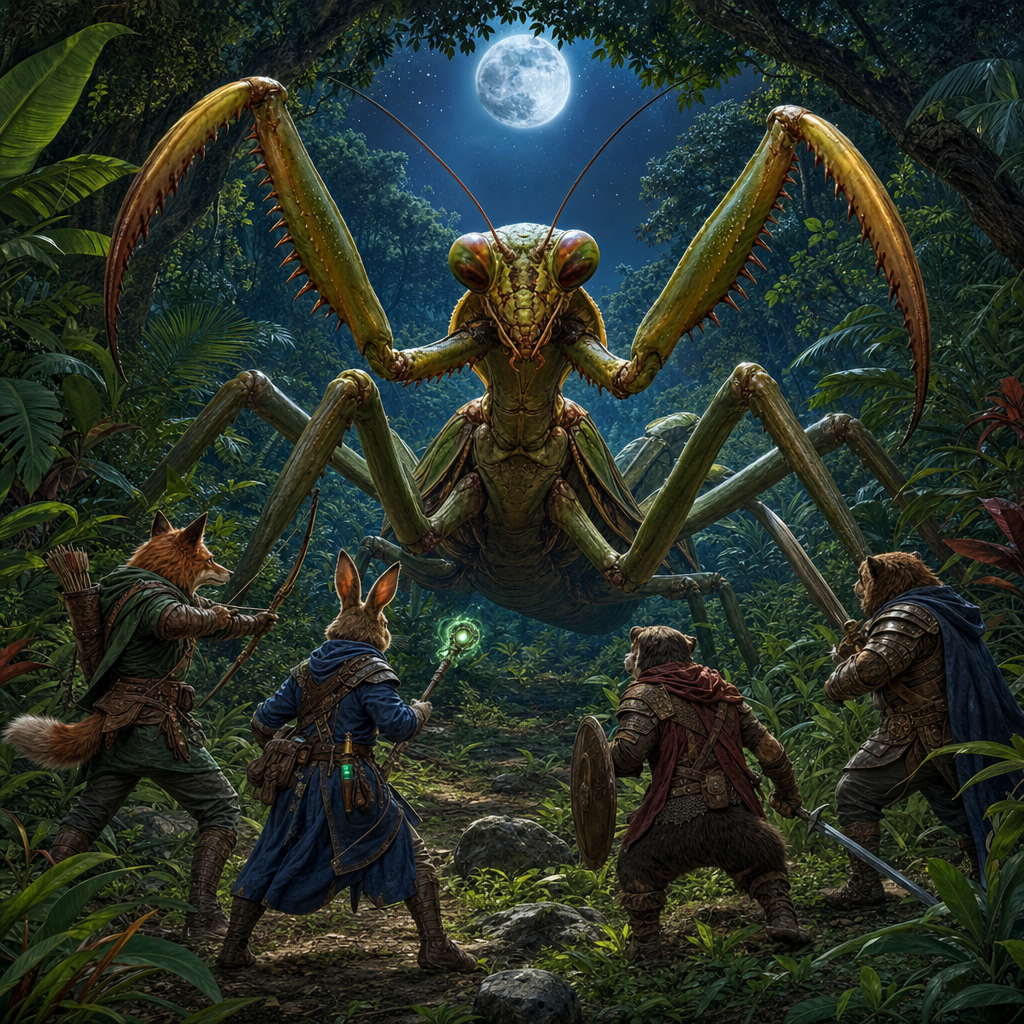
Why Giant Insects Make Perfect D&D Monsters
I'll be honest: I didn't fully appreciate giant insect D&D encounters until one night during a solo campaign when I randomly rolled a giant spider ambush in a forest hex. My ranger—modeled after my old barn cat Juniper, who used to hunt everything that moved—got webbed to a tree in round one. What I thought would be a throwaway encounter turned into thirty minutes of desperate survival tactics, poison saves, and the kind of edge-of-your-seat tension I usually reserve for dragon fights.
Giant insects work because they tap into something primal. We're hardwired to find oversized bugs unsettling. A wolf the size of a horse is dangerous. A spider the size of a horse is nightmare fuel. And in D&D, that visceral discomfort translates directly into memorable encounters that don't require complex stat blocks or elaborate backstories.
The Core Giant Insect Options in 5e
The Monster Manual and supplemental books give us a solid selection of giant insect D&D creatures, each with distinct tactical uses:
- Giant Spider (CR 1) — The classic. Web attacks, climb speed, and poison. Perfect for ambushes in forests, caves, or abandoned buildings.
- Giant Centipede (CR 1/4) — Fast, poisonous, and easy to swarm. Great for underground environments or tropical regions.
- Giant Scorpion (CR 3) — Multiattack with claws and a tail sting. Desert encounters or gladiatorial arena staple.
- Giant Wasp (CR 1/2) — Flying threat with a painful sting. Territorial and aggressive, perfect for roadside ambushes.
- Ankheg (CR 2) — Technically an arthropod, but close enough. Burrows, ambushes, and has acid spray. Terrifying in farmland or plains.
- Phase Spider (CR 3) — Can phase into the Ethereal Plane. Turns a simple spider fight into a tactical puzzle.
Building Encounters That Don't Feel Random
Here's where giant insects shine compared to typical monster encounters: they don't need motivation beyond animal instinct. A bandit has goals. A dragon has a hoard. A giant beetle just wants to eat or defend its territory, and that simplicity makes them incredibly easy to deploy.
Environmental Integration
Giant insects should feel like part of the ecosystem, not dropped randomly on the battle map. Consider:
- Ambush predators — Spiders drop from trees. Centipedes burst from rotting logs. Scorpions hide beneath sand.
- Territory markers — Webbing coating the trees signals spider territory long before the encounter. Acid-scarred earth warns of ankhegs.
- Environmental hazards — Webs create difficult terrain. Wasp nests provoke swarm attacks if disturbed. Centipede eggs make the party debate whether to destroy them.
Scaling for Level
One of my favorite things about giant insect D&D encounters is how easily they scale:
- Levels 1-2: Single giant centipede or swarm of insects. Introduction to poison saves and mobility challenges.
- Levels 3-4: Giant spider with web traps, or a pair of giant wasps defending a nest.
- Levels 5-7: Multiple giant scorpions, or a phase spider that requires tactical thinking to corner.
- Levels 8+: Ankheg pack, or reskinned/buffed versions with class levels or sorcerous mutations.
Tactics That Make Players Squirm
Giant insects aren't smart—most have Intelligence 1 or 2—but they operate on predator logic that creates interesting combat dynamics.
Hit and Run
Flying insects like giant wasps shouldn't stand and trade blows. They dive, sting, and retreat to the canopy. Force ranged attackers to waste arrows and melee fighters to feel useless. Few things frustrate a barbarian more than a wasp they can't reach.
Grapple and Drag
Giant spiders excel at singling out one party member. Web attack from hiding, then drag the webbed victim toward a lair while the party scrambles to give chase. Split the party organically without railroading.
Burrow and Surprise
Ankhegs should attack from below, grab a victim in their mandibles, and retreat underground. The party has one round to act before their companion disappears into a tunnel—it's tense, it's scary, and it works.
Using the Giant Insect Spell
Don't sleep on the 4th-level druid spell Giant Insect. It transforms normal-sized bugs into giant versions for the duration, which creates hilarious and horrifying possibilities:
- A druid collects centipedes in jars as living grenades
- Emergency spider cavalry when the party needs mounts
- That one player who really wants to ride a giant beetle into battle
The spell lasts 10 minutes with concentration, so it's not a permanent solution, but it rewards creative thinking and preparation. I once had a druid player who carried a box of wasps "just in case." The looks from the rest of the party never got old.
Building Custom Giant Insect Variations
Standard stat blocks work fine, but customization makes giant insect D&D encounters memorable. Try these modifications:
Regional Mutations
- Arctic giant spiders with cold resistance and ice-web attacks that create slippery terrain
- Volcanic centipedes that deal fire damage instead of poison
- Underdark wasps that inject paralytic venom, delivering victims to mind flayers
Magical Corruption
What happens when wild magic saturates an insect nest? Maybe spiders gain limited telepathy. Maybe scorpions develop the ability to teleport short distances. The creepy factor multiplies when insects start acting wrong.
Hive Mind Intelligence
Individual insects are mindless, but what if the colony has collective intelligence? Suddenly your simple ambush becomes a coordinated assault with flanking, feints, and tactical retreats. Use this sparingly—it's a significant difficulty spike.
Creating Giant Insect NPCs and Companions
Not every giant insect needs to be an enemy. Rangers, druids, and beast master characters might want insectoid companions with personality. I ran a solo campaign where I used Creature Forge AI's character generator to create an NPC druid who'd bonded with a giant beetle she'd raised from a grub. The tool let me upload a photo reference and build out her stats, personality, and the beetle's quirks (it loved mushrooms and made a chirping sound when content).
Giant insects as allies create interesting roleplay opportunities:
- A ranger's giant spider companion that townspeople fear despite its gentle nature
- A wizard's familiar transformed into a giant dragonfly via experimental magic
- A captured phase spider the party must decide whether to kill, release, or attempt to train
When to Use Giant Insects vs. Other Monsters
Giant insects work best when you want:
- Wilderness survival themes — They reinforce that nature is dangerous
- Low-prep encounters — Simple stat blocks, straightforward tactics
- Body horror undertones — Poison, webbing, and being grabbed by mandibles hits different than sword wounds
- Environmental storytelling — An infested forest tells a story without dialogue
They work less well when you need:
- Complex social dynamics or negotiation
- Villains with long-term plans
- Encounters that showcase player wit over tactics
Bringing Your Giant Insect Encounters to Life
The difference between "meh, random bug fight" and "oh god, GET IT OFF ME" comes down to description and pacing. Emphasize the wrong things about giant insects:
- The clicking sound of chitin on stone
- Too many legs moving in coordination
- Mandibles large enough to wrap around a torso
- Eyes that reflect torchlight like gems—too many eyes, unblinking
If you want to prep visual aids, Creature Forge AI's monster generator can help you create custom giant insect stat blocks and reference images. Seeing a visual representation before the session helps you describe encounters more vividly, and if you're playing online, having creature art ready keeps immersion high.
Ready to Deploy Your Giant Insect Encounters?
Giant insect D&D encounters are the unsung heroes of wilderness campaigns. They're easy to run, inherently creepy, and scale beautifully across all tiers of play. Whether you're dropping a lone giant spider on a level-two party or orchestrating an ankheg siege against a fortified settlement, oversized bugs deliver tension without requiring elaborate prep.
Next time you need an encounter that'll make your players uncomfortable in the best way possible, reach for the giant insects. Just maybe warn them beforehand if anyone at the table has serious arachnophobia.
Want to build your own custom creatures, complete with stats and artwork? Head over to Creature Forge AI and start creating. Your next nightmare bug is just a few clicks away.