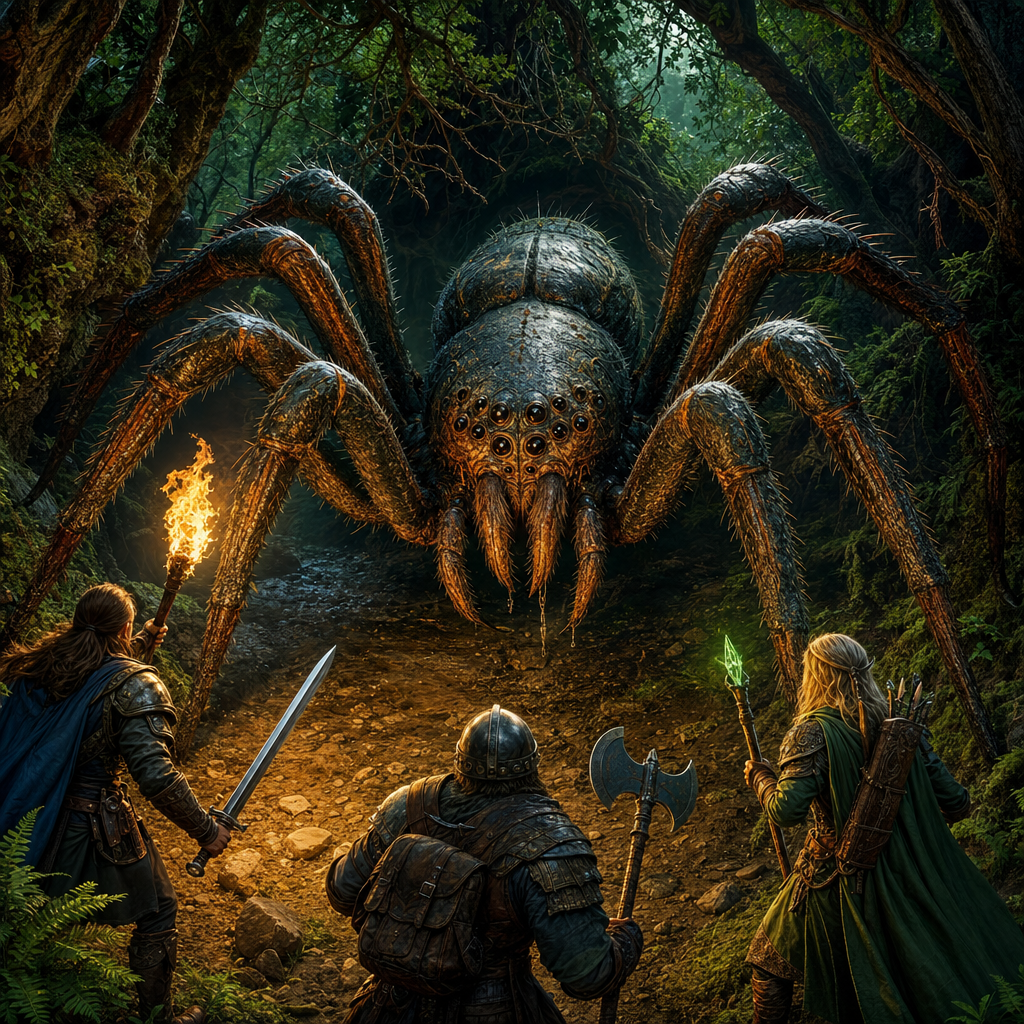
I'll be honest: I used to think giant insect 5e encounters were boring. Just take a normal bug, make it horse-sized, add some hit points, done. Then one night during a solo campaign, I decided my ranger was going to take a shortcut through the Whisperwood, and I rolled a random encounter. Giant centipede. I almost rerolled it.
But I didn't. Instead, I leaned into the horror — the sound of hundreds of legs scraping stone, the smell of decay, the way its antennae twitched as it sensed heat. That centipede became one of the most memorable fights I've ever run for myself. My ranger still has the scars, and I learned something important: giant insects aren't boring. We just run them wrong.
Why Giant Insects Work in 5E
Giant insects occupy a weird space in D&D. They're not intelligent enough to monologue, not cute enough to befriend, and not rare enough to feel special. But that's exactly what makes them work. They're alien. They operate on instinct and hunger, and players can't negotiate with them or predict them the way they can with a bandit or even a dragon.
The giant insect 5e stat blocks are deliberately simple — most hover between CR 1/4 and CR 1, with a few exceptions. This makes them perfect for:
- Early-level threats that feel dangerous without being fatal
- Environmental hazards in dungeons, forests, or underground
- Swarm encounters where numbers matter more than individual power
- Body horror moments that unsettle players used to fighting humanoids
The Core Giant Insect Options
Fifth edition gives us several giant insect varieties, each with distinct tactical roles. Here's what you're working with:
Giant Spider (CR 1)
The classic. Web attack for restrain, spider climb for tactical mobility, and a bite with poison damage. Giant spiders work best in vertical environments — cave ceilings, forest canopies, ruins with plenty of climbing surfaces. They're ambush predators. Don't just have them charge in. Have them drop from above, use webs to separate the party, then retreat and reposition.
Giant Centipede (CR 1/4)
Surprisingly nasty for its CR. The bite does piercing plus poison damage, and on a failed Constitution save, the target takes additional poison damage. Multiple centipedes can drop a low-level character fast. Use them in narrow spaces where the party can't maneuver around them — tunnels, sewer pipes, collapsed hallways.
Giant Scorpion (CR 3)
The heavy hitter. Two claw attacks plus a sting that does piercing and poison damage. The claws can grapple, which means the scorpion can lock down one character while stinging them repeatedly. These work great as solo boss monsters for a level 2-3 party, or as elite guards in a larger encounter.
Giant Wasp (CR 1/2)
Flying speed of 50 feet and a sting that can drop a character to 0 hit points and automatically stabilize them. These are terrifying for players who realize the wasp isn't trying to kill them — it's trying to paralyze and carry them off to feed larvae. Use them in open outdoor encounters where their flight matters.
Giant Fire Beetle (CR 0)
Not dangerous, but the glands that glow with bright light for 1d6 days after death make these worth including. They're functional treasure and a light source. I like using them as a "training wheels" encounter for brand new players — something to fight that won't kill them but teaches action economy.
Running Giant Insects That Feel Alien
Stats are one thing. Atmosphere is everything. Here's how to make giant insect encounters genuinely unsettling:
Describe the Movement
Insects don't move like mammals. They skitter. They pause unnaturally. Their legs make clicking sounds on stone. A giant spider doesn't lumber toward the party — it moves in bursts, utterly still one moment, then crossing twenty feet in a blink. Describe that. Make it wrong.
Use the Environment
Insects interact with terrain in ways humanoids can't. Spiders walk on walls and ceilings. Centipedes squeeze through cracks the party can't follow. Beetles burrow. Wasps fly. Don't put these creatures in an empty room and run them like wolves. Give them a space where their abilities matter.
Leverage Instinct Over Tactics
Giant insects don't retreat strategically or focus fire on the wizard. They respond to stimuli — heat, movement, vibration, smell. A giant centipede doesn't "know" the rogue is low on hit points. It attacks whatever disturbed its hiding spot. This randomness can be scarier than smart tactics because players can't predict it.
Swarms and Numbers
One giant spider is a monster. Six giant spiders is a nightmare. Don't be afraid to use multiple weaker insects instead of one big one. The action economy swings wildly, and suddenly your party is juggling web restraints, poison saves, and the creeping realization they're surrounded.
Creative Encounter Ideas
Here are some scenarios I've run or played through that made giant insects memorable:
- The Collapsing Hive: The party needs to retrieve something from a ruined tower, but the upper floors are home to giant wasps. The floors are unstable. Loud combat risks collapse. Do they sneak, rush, or fight carefully?
- Web Maze: A section of forest is choked with giant spider webs. The party can burn through (alerting everything), cut through carefully (slow, tense), or find another route. Either way, spiders are hunting.
- The Thing in the Well: Villagers report something in the old well. It's a giant centipede that's been feeding on livestock that fall in. The party has to go down a narrow shaft to fight it. Claustrophobia plus poison equals fun.
- Carrion Beetles: Use giant fire beetles or reskin other insects as scavengers feeding on a battlefield or mass grave. The party investigates the lights, finds the beetles, then discovers what they're eating.
Scaling Giant Insects for Higher Levels
Most official giant insect stat blocks cap out around CR 3, which makes them irrelevant past Tier 1 play. Here's how to keep them viable:
Add Abilities
Give a giant spider Pack Tactics. Let a giant scorpion make a tail attack as a bonus action. Grant a giant centipede Aggressive from orc stat blocks so it can close distance as a bonus action. Small tweaks keep them threatening.
Environmental Buffs
Put them in difficult terrain or dim light. Add obstacles the insects can bypass but the party can't. Suddenly that CR 1 spider is landing attacks more often and retreating before retaliation.
Use Them as Minions
Pair giant insects with a higher-CR controller — a drider herding giant spiders, a myconid sovereign commanding beetles, a yuan-ti using wasps as guards. The insects become battlefield complications instead of primary threats.
Homebrew Variants
Create advanced versions. A "giant elder spider" with higher AC, more HP, and multi-attack. A "giant bombardier beetle" that explodes when killed. A "giant flea" with a massive jump distance. The core mechanics are simple enough to modify without breaking anything.
When I Brought My Chickens to the Table (Sort Of)
Last spring, one of my hens — a particularly cranky Buff Orpington named Gretchen — got into it with a praying mantis in the garden. I watched this bird, who's afraid of leaves, go full predator mode on this bug. Peck, grab, shake, done. It was shockingly violent and weirdly graceful.
That image stuck with me. A few weeks later, I was prepping an encounter and thought: what if I turned Gretchen into a giant insect hunter? I uploaded a photo of her to Creature Forge AI's character generator, and it created this brilliant aarakocra ranger — all the fussy, aggressive energy of Gretchen but with a longbow and a hatred of anything with more than four legs.
I ran her as an NPC in a solo game. She was glorious. Terrible at small talk, obsessed with tracking a giant mantis that had killed her clutch-mate, utterly fearless in combat. The generator nailed her personality just from the photo. Sometimes the best characters come from the weirdest inspirations.
Tools for Building Better Bug Encounters
If you want to expand beyond the Monster Manual options, Creature Forge AI's monster generator is solid for creating custom giant insect variants. Need a giant moth with hypnotic wing patterns? A giant ant that secretes acid? You can generate stat blocks, abilities, and even artwork that fits your specific encounter needs. It's especially useful when you want something that feels like a giant insect but has mechanics tailored to your party's level.
Final Thoughts: Respect the Bug
Giant insect 5e encounters get dismissed because they seem simple. And they are — mechanically. But simplicity isn't weakness. These creatures are pure, alien threat. They don't banter. They don't retreat. They don't care about your backstory. They just are, and that's terrifying in its own way.
The next time you need an encounter, don't skip the giant centipede. Lean into the horror of too many legs and eyes that don't blink. Describe the smell and the sound. Make it wrong. Your players will remember it longer than the dragon fight two sessions ago.
And if you need help statting up the perfect oversized nightmare — maybe one based on that spider you saw in your garage last week — Creature Forge AI has your back. Sometimes the scariest monsters are the ones that look just real enough to make your skin crawl.