Why Giant Bugs Hit Different
I'll never forget the night I ran a solo session where my ranger stumbled into a cave system that turned out to be an ant colony. Not just any ants—soldier ants the size of mastiffs, with mandibles that could snap a longsword. The encounter itself was straightforward enough, but what made it memorable was the sound I imagined: that clicking, chittering chorus echoing through the tunnels, getting louder as more ants arrived. Giant bug encounter ideas work best when they tap into that primal unease we all feel about insects, then amplify it to fantasy proportions.
Here's the thing about giant bugs: they're everywhere in the monster manual, but they're often treated as throwaway combat encounters. A giant spider here, some stirges there, maybe an ankheg if you're feeling spicy. But insects at that scale stop following the rules we expect. They become alien, unpredictable, and—if you play them right—genuinely unsettling in a way that makes your players lean forward in their chairs.
Environmental Encounters: The World is Their Weapon
Giant bugs don't fight like wolves or bandits. They fight like insects, which means they use their environment in ways that can catch players completely off guard.
The Collapsing Web Network
Giant spiders don't just sit in the middle of a web waiting to be shot with arrows. Picture this: the party enters what looks like a normal forest, but the trees are connected by massive web cables at every level—ground, canopy, everything between. The spiders can move across this three-dimensional battlefield faster than the party can track. When combat starts, cutting one strand causes tension to shift elsewhere. Cut the wrong one, and a whole section collapses, potentially dropping characters thirty feet or tangling them in sticky silk. Suddenly it's not just "fight the spider"—it's "navigate a dynamic, hostile architecture while fighting the spider."
The Beetle Stampede
I grew up on a farm, and let me tell you: when the cattle decided they were moving in one direction, you got out of the way or you got trampled. Now imagine that with giant bombardier beetles, each one the size of a wagon, charging through a canyon because something spooked the herd. The encounter isn't "kill all the beetles"—it's "survive the stampede." Players need to find cover, timing their movements between waves, maybe even trying to redirect the herd. Add in the beetles' acid spray as a defensive reflex when they're panicked, and you've got chaos.
The Living Ceiling
Cockroaches climb on everything. Giant cockroaches climb on everything while being the size of shields. An encounter in a ruined temple where the entire ceiling is a seething mass of giant roaches creates instant tension. They're not aggressive until disturbed—but noise, light, or vibration brings them skittering down. Combat becomes a balancing act: fight the undead in the temple quietly, or deal with both threats at once.
Social Encounters: Yes, Really
This is where giant bug encounters get interesting. Insects have complex behaviors—hive minds, territorial displays, symbiotic relationships. At giant scale with a touch of magic, these behaviors can become the foundation for non-combat encounters.
The Mantis Meditation
Giant mantises are ambush predators with an unsettling stillness. What if the party encounters one that's been alive for centuries, perched motionless in a sacred grove? It's not hostile—it's meditating, or guarding something, or simply existing in a way that transcends normal insect behavior. Approaching it becomes a ritual in itself. Move too quickly, speak too loudly, and it perceives you as prey. But if you can match its patience, it might allow you to pass or even share knowledge through some alien form of communication. I ran a version of this once where my solo character had to sit perfectly still for what I decided was three in-game hours. The mantis eventually tilted its head, stepped aside, and revealed a hidden path. Most memorable non-combat encounter I've ever played.
The Hive's Request
Ant colonies operate on chemical signals and collective decision-making. A giant ant colony with a spark of magical intelligence might "speak" through pheromone clouds that translate into empathic impressions. The hive needs something—an invasive species removed, a flooded chamber drained, a rival colony dealt with. The encounter becomes a negotiation conducted through sensation and symbol rather than words. The reward? Safe passage through their tunnels, or workers who'll help clear rubble, or soldiers who'll fight alongside the party for one battle.
Combat Encounters with Actual Tactics
When you do run combat with giant bugs, give them the tactics their real-world counterparts use—just scaled up.
The Trapdoor Ambush
Trapdoor spiders wait beneath concealed burrows and explode upward when prey passes overhead. A giant version turns this into a battlefield hazard: certain spots in the combat zone are trapped burrows. Step on one, and a spider erupts from below with a grapple attempt. The party has to figure out where the safe ground is while fighting other threats. Bonus tension: the spiders might drag grappled characters underground to their lair.
The Moth Swarm and the Flame
Giant moths are drawn to light sources—compulsively, dangerously. An encounter in darkness where the party needs light to navigate, but every light source attracts a swarm of giant moths that batter and grapple anyone holding it. Do you fight blind, or do you accept becoming a target? Add a secondary objective—protect the NPC, retrieve the artifact, escape within a time limit—and the pressure multiplies.
The Cooperative Hunters
Wasps hunt in coordinated groups. Giant wasps should too. Instead of each wasp acting independently, they use pack tactics: one distracts from the front while another stings from behind, or they focus fire on the weakest-looking character, or they drag incapacitated prey back to their nest while the fight is still happening. Give them an actual battle plan, and suddenly wasps are terrifying instead of trivial.
Building Your Own: The Monster Mashup Method
Here's my secret for coming up with weird, specific giant bug encounter ideas when I hit creative block: I use the Monster Mashup tool. It's completely free, doesn't need a sign-in, and doesn't use AI—it's just a random roller that draws from real animals (living and extinct) and fuses them into creature concepts. I'll roll until I get an insect combined with something unexpected. Last week I got "mantis + sea urchin," and suddenly I'm imagining a giant mantis with a shell covered in poisonous spines. Can't grapple it, can't get in close, have to fight at range or find a creative solution. The mashup sparks the idea, and I build the encounter from there.
The beauty of the Monster Mashup for giant bug encounters specifically is that insects are already bizarre enough that adding any other element makes them immediately distinctive. Beetle + porcupine? Armored beetle that fires quills. Dragonfly + chameleon? Invisible aerial hunter. You get the idea.
Personalizing Your Bugs
If you really want to make a giant bug memorable, give it personality or history. Not anthropomorphized personality—that's a different thing entirely—but the kind of presence that comes from age, experience, or magical influence.
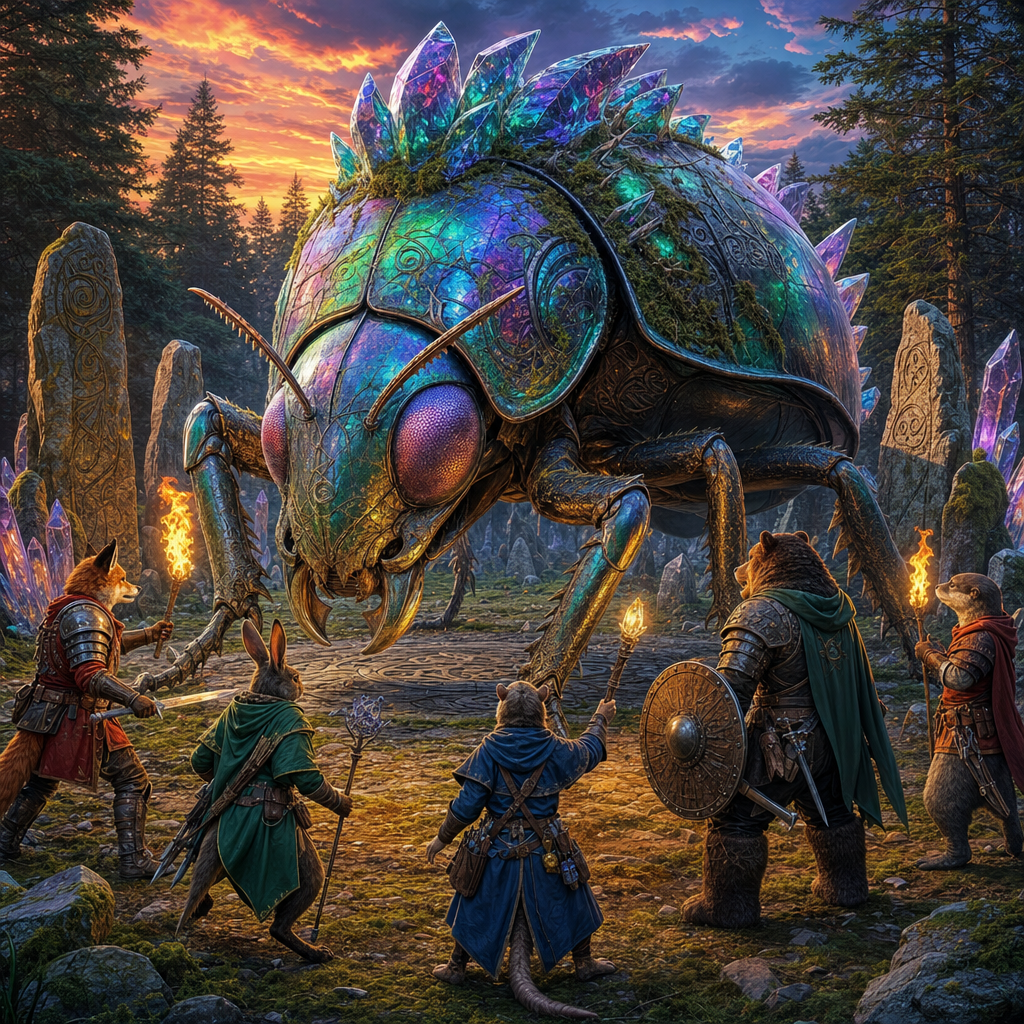
For instance: I once created a giant stag beetle that had been the guardian of a druid grove for so long that its shell had moss growing in patterns that matched the seasons. It didn't speak, but it remembered. Characters who'd helped the grove in the past were recognized and allowed through. Those who hadn't were tested. The beetle wasn't a monster—it was a gatekeeper with context.
Or consider scars and adaptations. A giant spider missing three legs because it survived an encounter with a previous adventuring party fights differently—more cautious, more vicious, with webbing strategies that compensate for reduced mobility. That's an encounter that tells a story through mechanics.
The Photo-to-Character Angle
Here's something I didn't expect to love: Creature Forge AI has this feature where you can upload a photo of a real bug—or any creature—and it'll build you a stat block and character sheet based on the actual appearance. I uploaded a photo of a praying mantis from my garden (yes, the farm had those too, though considerably smaller), and the generator created this ethereal, blade-limbed creature with abilities that actually matched how mantises hunt. It's weirdly perfect for turning "I saw a cool bug" into "I have a boss encounter."
Make Them Squirm (In the Best Way)
The best giant bug encounter ideas lean into what makes insects alien to us: their movements, their life cycles, their sheer indifference to mammalian comfort. A beetle doesn't care about your feelings. A wasp operates on pure instinct and chemical programming. At giant scale, that alienness becomes a feature, not a bug (sorry).
Use environment. Use tactics. Use the weird, specific behaviors that real insects have. And when you need inspiration, don't be afraid to mash some creatures together or build something custom. Your players will remember the beetle stampede or the mantis guardian long after they've forgotten the tenth goblin ambush.
Now go forth and make your table uncomfortable in the best possible way. The giant bugs are waiting.