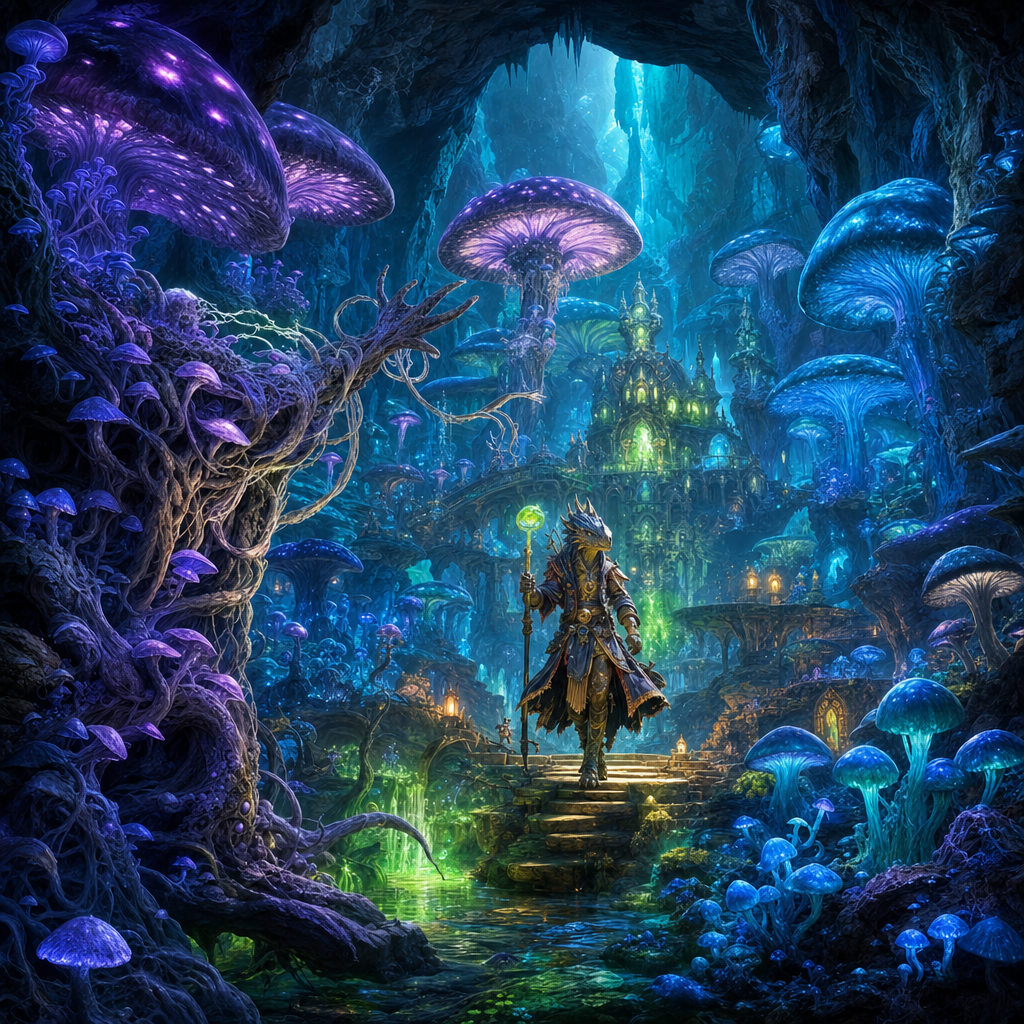
I've spent more late nights than I care to admit sitting at my kitchen table, rolling dice and drinking coffee that's gone cold, trying to make the Underdark feel less like a checklist and more like a place. And somehow, every time I plan an underground encounter, I end up defaulting to myconids. Again. They're fine — peaceful mushroom people make for interesting roleplay — but after your third myconid circle discussing spore rapport, you start craving something with a little more bite. That's when I started digging into fungal creature ideas for D&D that actually surprised me.
The thing about fungal life is that it's genuinely alien. Mushrooms aren't plants. They're closer to animals than trees, and real-world fungi do things that sound like they came straight out of a monster manual: mind control, networked communication, parasitic takeovers. There's so much material here that never makes it into our games.
Why Fungal Creatures Hit Different
Fungi occupy this perfect sweet spot between body horror and natural wonder. They're decomposers — they break things down, recycle death into life. That gives you built-in story hooks. A fungal creature isn't just a monster to fight; it's part of an ecosystem, often ancient, sometimes intelligent in ways that don't map to normal thinking.
I ran a solo campaign once where I needed a guardian for a forgotten library deep underground. Instead of another construct or undead, I created a fungal entity that had been feeding on the paper and ink for centuries. It didn't speak — it showed you things by releasing spores that triggered memories. Fighting it felt wrong because it wasn't hostile, just protective. That's the kind of encounter you remember.
Spore-Touched Beasts
Start with something familiar and add fungus. Take any beast your players know — wolves, bears, giant spiders — and reimagine it after years of exposure to aggressive spores.
The Cordyceps Treatment
Real cordyceps fungi infect insects and take over their bodies, puppeting them around until they're positioned perfectly to spread more spores. Apply this to larger creatures. Your spore-touched wolf isn't alive anymore, not really. The fungus is driving. Its movements are jerky, unnatural. Mushrooms sprout from its joints. When it dies, it bursts into a cloud of infectious spores.
- Mechanics: Use the base beast stat block but drop Intelligence to 1 and add resistance to poison. On death, each creature within 10 feet makes a Constitution save or becomes infected (track this as a disease).
- Ecology: These things hunt in the deep woods or Underdark edges, spreading their infection. They're not evil — they're ecosystem engineers, in a horrifying way.
- Plot hook: A druid seeks the party's help. Something is puppeting the forest's predators, and the infection is spreading.
Sentient Fungal Colonies
Not every fungal creature needs to be an individual. Some are networks — thousands of fruiting bodies connected by underground mycelium, thinking as one.
The Memory Morel
This one came from an odd place. I had a goat on the farm named Biscuit, the most stubborn creature I've ever met. She'd stand in doorways just to be difficult, refuse to move for anyone, but somehow always knew when you were sneaking her grain. I turned her into a fungal creature for a game — a colony of mushrooms that absorbed the memories and personality of everything that died near it. It had Biscuit's stubbornness, her strange intelligence, but expressed through thousands of mushroom caps that would tilt toward you like they were listening.
A Memory Morel isn't hostile unless threatened. It's curious. It wants to know things. It might trade information — memories it's absorbed from centuries of decomposing adventurers — for something new to experience. Let players negotiate with it, feed it interesting objects or stories.
- Mechanics: Treat it as an environmental intelligence rather than a single creature. It can't move, but it can release spores that cause hallucinations (Wisdom saves) showing memories from things it's consumed.
- Knowledge: It knows everything that's died within a mile of its center in the last 500 years. That's campaign gold.
Parasitic Personality Thieves
Here's where fungal creatures get really unsettling. Imagine a fungus that doesn't just infect bodies — it integrates with minds.
The Hollow Folk
These look human, elf, dwarf, whatever. They walk upright, they talk, they remember their lives. But they're not those people anymore. The original person died, and the fungus that consumed them learned to mimic their patterns, wear their memories like a mask. They're not undead — they're something stranger. The body is alive, kept functional by the mycelial network threaded through every organ.
The horror here is subtlety. Maybe an NPC the party knows comes back from a solo expedition changed. Small things are off. They don't blink as much. Their skin has a faint earthy smell. They avoid bright light. Are they infected, or just traumatized by whatever happened down there?
This is the kind of creature you can build using the NPC generator at Creature Forge AI — start with a normal person, then layer in the fungal details. The tool's photo upload feature even lets you base it on someone specific, which makes the eventual reveal that much more personal.
Symbiotic Guardians
Not all fungal creature ideas for D&D need to be threats. Some fungi form partnerships.
Lichen Walkers
Picture this: ancient stone statues in a forgotten temple, so old that lichen has completely covered them. But the lichen isn't just lichen — it's a slow-growing fungal intelligence that bonded with the dormant constructs centuries ago. Now they're both. The stone provides structure and protection; the fungus provides something like thought, slow and patient and utterly alien.
Lichen walkers move maybe once a decade. They're not defenders — they're witnesses. They've watched empires rise and fall from these halls. If you can communicate with them (druids, speak with plants, creative use of spores), they'll share what they've seen, but on a timescale that makes dwarves seem impatient.
Building Fungal Ecosystems
The best fungal encounters aren't isolated. They're part of a system. When you introduce one fungal creature, think about its niche:
- Decomposers: Creatures that break down organic matter (Memory Morels, cleaning slimes with fungal elements)
- Parasites: Those that need hosts (Cordyceps beasts, Hollow Folk)
- Symbionts: Partnerships that benefit both parties (Lichen walkers, fungal-enhanced treants)
- Apex consumers: Big, rare, terrifying (think a purple worm whose tunnels spread spore colonies, or a fungal dragon that exhales clouds of hallucinogenic powder instead of fire)
When you layer these together, you get an environment that feels alive. The party doesn't just fight monsters — they're disrupting an ecology, with consequences that ripple outward.
Practical Creation Tips
If you're homebrewing fungal creatures from scratch, here are some mechanical elements that sell the concept:
Spore Abilities
- Spore burst (recharge 5-6): Area effect, Constitution saves, conditions like poisoned, frightened, or hallucinating
- Infection mechanics: Failed saves start a disease track; encourage creative cures beyond "lesser restoration"
- Bioluminescence: They glow, which creates interesting tactical considerations in darkness
Resistances and Weaknesses
- Resistant to poison and necrotic (they feed on decay)
- Vulnerable to fire and radiant (sunlight withers mushrooms)
- Immunity to being charmed (alien intelligence doesn't work like normal minds)
Non-Combat Interaction
Give them something players can do besides roll initiative. Can they be reasoned with? Bribed with rare organic material? Redirected by controlling their spore spread?
Make It Personal
The wildest thing about Creature Forge AI is that you can upload a photo of anything — a pet, a weird mushroom you found, that one tree in your backyard — and it'll build a D&D creature that actually looks like it. I've turned houseplants into myconid variants and that stubborn goat into more creatures than I can count. There's something special about looking at a stat block and recognizing the personality underneath, even when it's covered in magical fungus.
The photo upload feature works for characters too. Want a druid who's slowly becoming one with the fungal network? Upload a photo, describe the transformation, and suddenly you've got art and stats that match. It makes homebrew feel less like work and more like discovery.
Final Spores of Wisdom
Fungal creatures offer something most monster types don't: genuine alienness paired with natural familiarity. We've all seen mushrooms, but we rarely think about what they are — the unseen networks, the chemical communication, the way they experience time differently than we do. Bring that strangeness into your games.
Don't just reskin a zombie and call it spore-touched. Think about what fungi do: connect, decompose, transform, persist. Give your fungal creatures motivations that make sense for those functions. Make them weird, make them beautiful, make them unsettling in ways that stick with your players long after the encounter ends.
And if you need a starting point — or if you just want to see what your cat would look like as a mushroom-infected ranger — head over to Creature Forge AI and start experimenting. The tools are built for exactly this kind of creative chaos, and they're way more fun than my 2 AM coffee-and-notebook method, trust me.
Your Underdark is waiting. Give it something to grow.