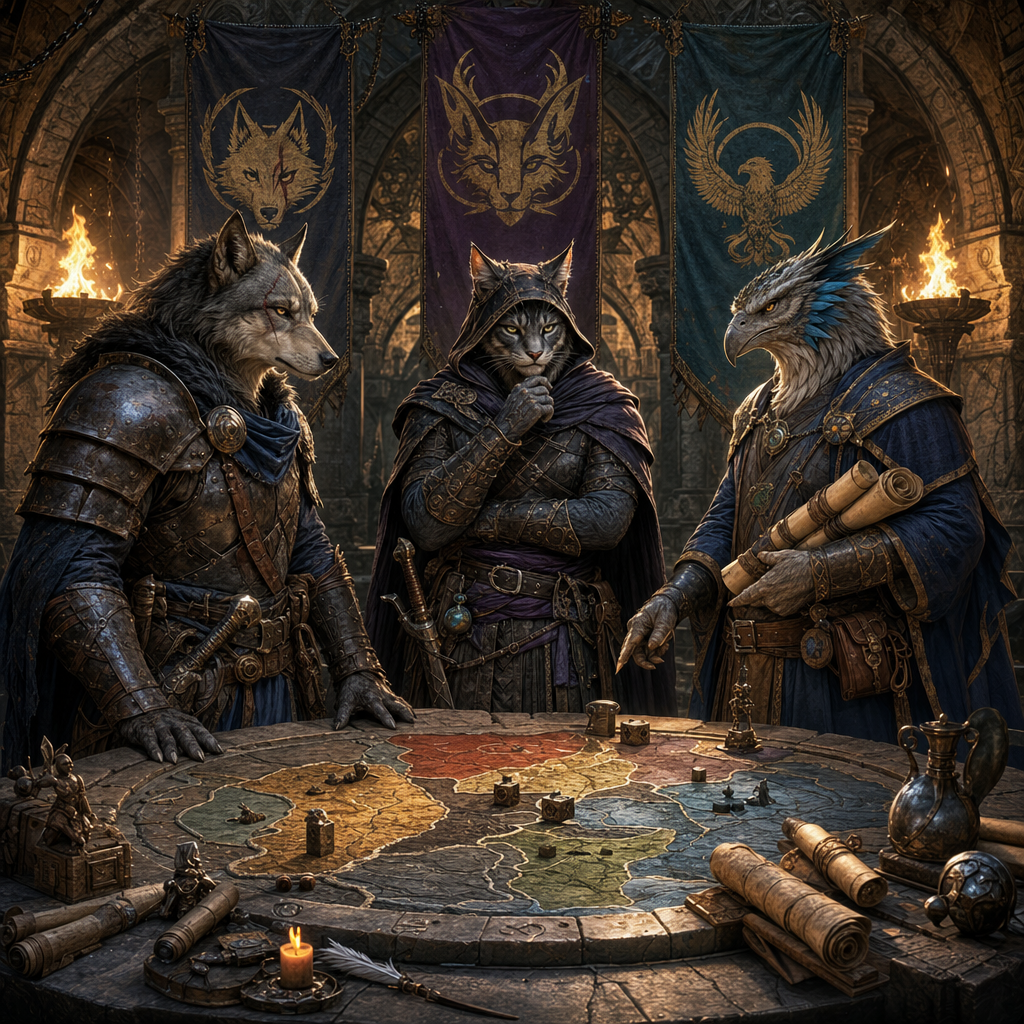
Why Most Fantasy Factions Fall Flat (And How to Fix It)
I've run enough solo campaigns to know the signs. You write up three fantasy factions for your world—the Merchant's Guild, the Knight's Order, the Shadow Thieves—and they all blur together into generic fantasy window dressing. Your players nod politely when you mention them, then immediately forget which one wanted what.
The problem isn't your creativity. It's that most of us build factions the same way we'd fill out a form: name, goal, aesthetic. Done. But a faction that feels alive needs the same thing a good NPC needs—personality, contradiction, and something to lose.
Last spring, I was running a solo game where I'd created this faction called the Greenwardens—druids protecting an ancient forest. On paper, fine. Boring, but fine. Then I uploaded a photo of my old border collie Scout to Creature Forge AI's NPC generator, turned her into a grizzled canine ranger who'd left the Greenwardens after a philosophical split, and suddenly the whole faction snapped into focus. They weren't just tree-huggers. They were zealots who'd excommunicated one of their best for showing mercy to a logger's family.
That's when the faction became real.
The Three Pillars of Factions Players Remember
1. A Belief They'd Kill For (Or Die For)
Every compelling faction has a core belief that sounds almost reasonable until you push it to its extreme. Not "we like nature" but "civilization is a disease, and every stone road is a scar that must be healed—even if people starve without the trade routes."
Strong faction beliefs create instant drama because they collide with other factions' beliefs. The Architect's Collective believes progress demands sacrifice. The Remembrance keeps every building exactly as the ancestors made it. Both think they're preserving the city. Both are willing to burn the other's headquarters down.
When you're building your fantasy factions, write down the one thing each group considers non-negotiable. Then ask: what happens when that collides with basic human decency? That's where your stories live.
2. Internal Conflict (Factions Should Be Messy)
Monolithic factions are boring. Real organizations have internal politics, reformers, old guard, and that one person everyone wishes would just retire already.
I've got this faction in my current solo game—the Covenant of the Sealed Door. They guard an ancient vault that supposedly contains something catastrophic. Simple enough. But I split them into three camps:
- The Literalists who believe the vault must never be opened, even if everyone's dying and the cure is inside
- The Pragmatists who think the founders would've wanted them to adapt to changing circumstances
- The Curious who secretly want to know what's actually in there, consequences be damned
Now when players interact with the Covenant, they're not dealing with a unified front. They're navigating a cold war, and they can exploit those cracks or try to heal them. Either way, it's compelling.
3. A Face Players Can Picture
This is the piece most people skip, and it kills their factions every time. You need NPCs your players can see. Not just stat blocks—actual personalities with voices, quirks, and appearance.
Back on the farm, we had this rooster named General Patton who would attack anything that moved, including the tractor. Absolute menace. When I needed a faction leader for the militant wing of the Sunbrand Crusade, I used him as inspiration—uploaded a photo to Creature Forge AI and got this incredible avian warrior character, all righteous fury and terrible tactical decisions. Suddenly the Crusade wasn't an abstract holy army. It was a group of zealots led by someone who'd charge a dragon because backing down isn't in his vocabulary.
That's the magic of giving factions memorable faces. Players don't remember organizations. They remember the scarred lupine general who drinks too much, or the serpentfolk diplomat who's clearly lying but you can't prove it.
Making Factions Matter: Integration, Not Decoration
The difference between factions that enhance your game and factions that clutter it comes down to integration. Every faction should intersect with your players' goals in at least two ways:
- One faction wants something the players have (or will get)
- One faction offers something the players need (with strings attached)
- Two factions are fighting, and both sides want the players' help
- One faction's internal conflict mirrors a player character's personal arc
If a faction doesn't touch your players' story, cut it or scale it back to background flavor. You don't need fifteen factions. You need three good ones that actually do something.
Tools That Help (Without Doing the Work for You)
I'm not big on letting generators replace creativity, but they're fantastic for breaking creative blocks. When I'm stuck on what a faction's enforcers actually look like, I'll use Creature Forge AI's character generator to produce a few options. The photo-upload feature especially helps when you want that faction lieutenant to feel specific—turn your friend's cat into a feline spymaster, and suddenly you've got a face that sticks in everyone's head.
The key is using these tools to spark ideas, not replace them. Generate an NPC, then ask: why did they join this faction? What do they secretly doubt? Who inside the organization do they despise?
Common Faction Pitfalls (And How to Dodge Them)
The "All Evil" Faction
If your faction is cartoonishly villainous with zero redeeming qualities, players will just kill them and move on. Even your antagonist factions should think they're the heroes. The Death Cult isn't evil—they're liberating souls from the prison of flesh. Horrifying? Yes. Cardboard? No.
The Faction That Never Does Anything
Factions need agendas that advance whether the players help or not. If the players ignore the Glasswright's Guild for five sessions, maybe the Guild successfully monopolizes all potion bottles in the city, and suddenly healing potions cost triple. Consequences make factions real.
Too Many Factions
I've done this. You get excited and build nine factions with complex relationships, and then you spend every session reminding players which one is which. Start with three. Add more only when your players are begging for deeper political complexity.
Bringing It All Together
Last month, I wrapped a solo campaign where three factions had been jockeying for control of a disputed temple. The Ember Covenant wanted to reignite an ancient fire. The Archivists wanted to study it safely. The locals just wanted their holy site back without it exploding.
I'd built each faction with a true believer, a skeptic, and a wildcard NPC. By the time I reached the climax, I genuinely didn't know which side my character would choose, because all three had made compelling cases and all three had done questionable things in pursuit of their goals.
That's what good fantasy factions do. They turn your world from a backdrop into a living ecosystem of competing interests, flawed people, and genuine stakes. Your players stop asking "what's in this room?" and start asking "who benefits if I do this?"
Start small. Pick three organizations with beliefs that can't coexist peacefully. Give each one a face—a leader, an enforcer, a reformer. Use tools like Creature Forge AI to make those faces vivid and specific. Then let them move—factions with agendas that advance, splinter, and collide.
Your players will remember the factions that made them choose. Build those, and the rest is just world-building decoration.