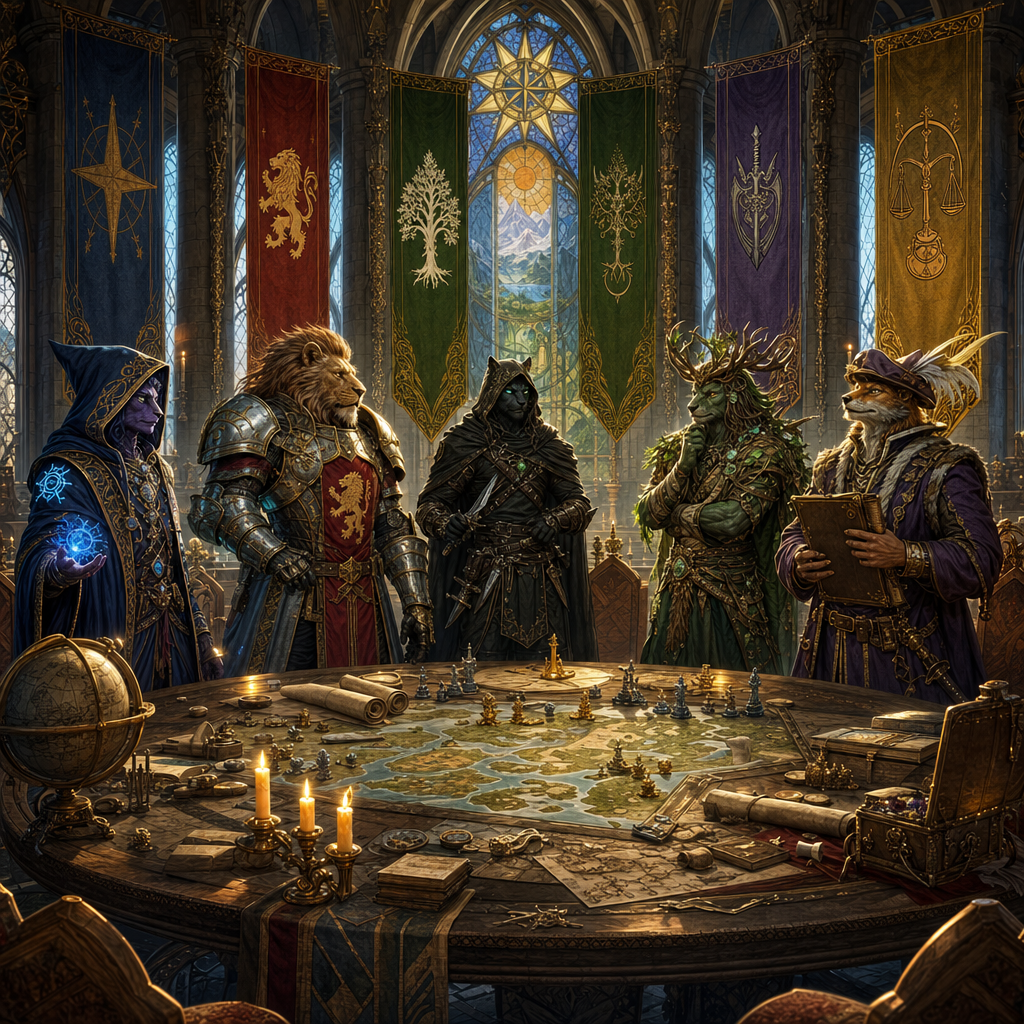
Why Factions Matter More Than You Think
I learned about faction ideas the hard way, sitting alone at my kitchen table at midnight with my third cup of coffee and a campaign that felt flat. I had dungeons. I had monsters. I had a perfectly serviceable plot about a necromancer threatening the realm. What I didn't have was a world that felt lived in.
Then I made a single change: I created three factions with competing interests in the same necromancer problem. Suddenly, the adventure wasn't just about stopping evil—it was about navigating politics, choosing allies, and dealing with consequences. The world came alive because groups of people with their own agendas started moving whether my character was involved or not.
That's the power of good faction ideas. They transform static settings into dynamic worlds.
What Makes a Faction Actually Interesting
Here's what I've learned from running solo campaigns and the occasional group session: factions need the same things characters need. Motivation, personality, flaws, and something to lose.
The Core Elements
- A clear goal: What does this faction want? "Power" is too vague. "Control of the river trade to fund their orphanages" is specific and creates story.
- Internal conflict: Every organization has disagreements. The traditionalists versus the reformers. The idealists versus the pragmatists.
- A face: Players don't interact with abstractions. They need an NPC representative—someone memorable who embodies what the faction stands for.
- Resources and weaknesses: What can they offer? What do they desperately need? These become quest hooks.
My goat Biscuit has more charisma than most faction leaders I've seen in published adventures. Don't let your factions be faceless bureaucracies.
Faction Ideas That Actually Work
Let me share some faction ideas I've used and seen work beautifully in play. These go beyond "generic thieves guild" or "standard church."
The Keeper's Archive
A secret society of librarians and scholars who believe dangerous knowledge should be preserved but hidden. They're not evil—they genuinely want to protect people from information that could destroy civilization. But they also decide what counts as "too dangerous," which makes them both helpful and terrifying.
Story hooks: They hire the party to retrieve a forbidden tome before it falls into the wrong hands. Plot twist: the "wrong hands" might include the party themselves. They maintain hidden libraries in unexpected places—I once put one under a rural schoolhouse, guarded by a very serious elderly woman who was absolutely willing to poison tea if necessary.
The Broken Chains
Former slaves, indentured servants, and escaped prisoners who've built a mutual aid network. They help people disappear, start over, and fight back against exploitation. Some members want justice. Others want revenge. That internal tension writes itself.
Story hooks: They offer the party sanctuary but expect payment in kind—break someone out, steal incriminating documents, or testify against a corrupt noble. They operate through coded messages, safe houses, and a remarkable intelligence network built on people society overlooks.
The Margin Traders
A merchant collective that deals exclusively in magical oddities, experimental potions, and items of questionable legality. Not quite criminals, not quite legitimate—they exist in the profitable gray area and prefer it that way.
Story hooks: They're the only ones who can get that rare component the wizard needs. They also know everyone's business because everyone eventually needs something they can't buy in regular shops. Information brokerage becomes as valuable as their merchandise.
I actually used Creature Forge AI's NPC generator to create the face of this faction in one of my campaigns—a silver-tongued foxfolk merchant named Copper who had my border collie's exact coloring and troublemaking energy. The photo-upload feature let me turn my actual dog into a D&D character, and honestly, it was perfect. He even had the same "I'm innocent, why would you accuse me?" expression.
The Root Wardens
Druids and rangers who've decided that civilization has encroached far enough. They're not attacking cities (yet), but they're actively sabotaging expansion, making forests "unsafe," and reclaiming farmland. They believe they're fighting an existential threat to the natural world. The local baron believes they're terrorists.
Story hooks: Both sides hire the party. The Wardens to investigate why forest creatures are dying mysteriously. The baron to stop "eco-extremists" from destroying his lumber operation. The truth might be that both groups have valid points and there's no clean solution.
The Covenant of the Final Hour
Clerics, paladins, and lay followers preparing for an apocalypse they believe is coming. They stockpile resources, train for battle, and actively work to "save" people whether those people want saving or not. Think doomsday preppers with divine magic and absolute certainty they're right.
story hooks: They're either completely correct and everyone else is in denial, or they're dangerous fanatics creating the crisis they fear, or—most interestingly—a little of both. Maybe their prophecy is real but their interpretation is wrong.
Making Factions Collide
The real magic happens when faction ideas intersect. Here's where stories get complicated in the best way:
- The Keeper's Archive has a book the Broken Chains need to expose a slaver network
- The Margin Traders sold something to the Root Wardens that's causing forest corruption
- The Covenant is recruiting members of the Broken Chains, promising salvation from a world that failed them
Set up three or four factions with overlapping goals and competing methods. Then step back and watch the consequences cascade. In solo play, I literally roll dice to determine which faction acts when I'm not directly involved with them. The world keeps moving. That's what makes it feel real.
Practical Faction Building
When I'm creating a new faction from scratch, I use this simple framework:
The Five Questions
- What do they want? Be specific. Write it as a one-sentence goal.
- Why can't they have it? What's the obstacle? Often it's another faction.
- Who leads them? Create one memorable NPC. Give them a voice, a quirk, a problem.
- Who opposes them internally? Every faction has dissent. Name the opposing viewpoint.
- What do they need from the party? This is your quest hook. Make it something only adventurers can provide.
I keep faction notes in a simple table: goals, resources, current projects, and relationship status with other factions and the party. Update it after every session. When factions change based on player actions, the world feels responsive and alive.
Small Factions Are Often Better
You don't need continent-spanning organizations. Some of my best faction ideas have been local: a neighborhood watch that's becoming a protection racket, a group of war veterans who meet weekly at a tavern and still think of themselves as a unit, or three merchant families who've been feuding for generations over a contract none of them can even find anymore.
Small factions have faces players remember. They create personal stakes. And they're easier to manage when you're juggling multiple groups.
Let Players Create Factions Too
Once your party reaches mid-levels, they might want to start their own faction. Encourage it. A party-created organization changes the campaign dynamic—suddenly they're not just reacting to the world, they're shaping it.
Give them the same treatment you give established factions: goals, obstacles, NPCs they recruit or clash with, resources they need. Maybe they start a monster hunting guild, or a school for street kids, or a network of safe houses for refugees. Let them feel the complications of running something, not just adventuring for someone else.
Bringing Your Factions to Life
The difference between faction ideas on paper and factions that drive stories is specificity. Don't write "the thieves guild steals things." Write "the Copper Fingers specialize in stealing secrets—they're blackmailers and information brokers who occasionally take jewelry as side work when a member needs quick cash."
Don't write "religious organization." Write "the Bearers of the Dawn wake at sunrise every morning to sing the sun up because they genuinely believe if they stop, it won't rise. They're considered eccentric by most, but they also run the best soup kitchen in the city and their elderly members have surprisingly sharp memories about local history."
When you need NPCs to represent these factions—the quartermaster of the Broken Chains, the head librarian of the Keeper's Archive, that one Margin Trader who always knows where to find what you need—tools like Creature Forge AI can help you generate complete characters quickly. The ability to upload a photo and build a fantasy version means you can turn your own pets, friends, or even that one rooster who terrorized you as a kid into memorable faction representatives with full stat blocks and personality.
Factions turn your campaign world from a map with dots on it into a living place where groups of people pursue their own goals, clash over resources and ideology, and create opportunities for the kind of stories players remember years later. Start with one or two faction ideas that excite you. Give them specific wants, memorable faces, and reasons to care what the party does. Then watch your world start moving on its own.