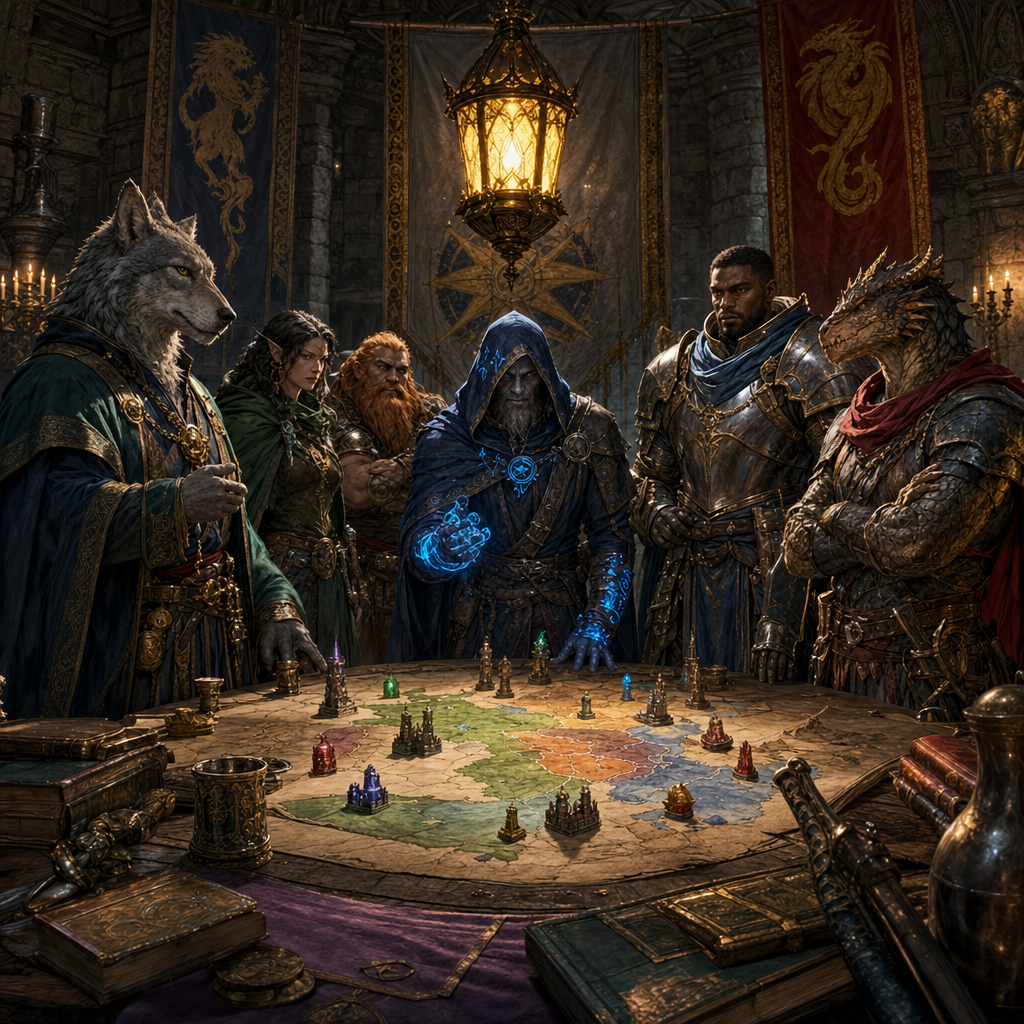
I've spent a lot of late nights at my kitchen table rolling up solo campaigns, and I've learned this the hard way: factions are what make a world feel alive. Not the geography. Not the lore dump about the Sundering of Whatsitcalled. Factions—groups with goals, grudges, and the will to act on both.
Good DnD faction ideas give your players something to care about beyond the next dungeon crawl. They create tension, offer branching storylines, and let characters make meaningful choices. Do you side with the rebels or the crown? The merchants or the monastics? And when done right, factions can generate conflict without you having to script every encounter.
Here's how I build factions that feel real, plus a few starter ideas you can steal or remix for your own table.
What Makes a Faction Work?
A faction isn't just a name and a logo. It's a group of people with a shared goal who are willing to pursue it even when it costs them something. That last part matters. If your faction doesn't have stakes, it's just set dressing.
Here's what every good faction needs:
- A clear goal: What do they want? Power? Safety? Revenge? Knowledge? The goal should be specific enough to drive action.
- A motivation: Why do they want it? This is where personality comes in. Two factions might both want control of a city, but one wants it to restore order and the other wants it to burn the old regime down.
- A flaw or weakness: Perfect factions are boring. Maybe they're corrupt, or desperate, or blind to their own hypocrisy. Flaws create opportunities for your players to exploit or empathize.
- Internal conflict: Not everyone in the faction agrees on methods or priorities. This gives you natural NPCs to role-play and plot hooks that aren't just "faction vs. faction."
- A face: One NPC the players can associate with the group. A leader, an ambassador, a loudmouth. Someone memorable.
When I ran a solo campaign last spring, I had a faction called the Dustbrothers—a gang of halfling smugglers operating out of an old grain silo. Their goal was simple: keep the trade routes open so their families didn't starve during the occupation. Their flaw? They'd started smuggling weapons for both sides of the war, and it was about to blow up in their faces. The "face" was a character I modeled after my old border collie, Sadie—loyal, scrappy, and way too trusting. I even used Creature Forge AI's character generator to upload a photo of her and turn her into a halfling rogue with the same scruffy energy. Gave the whole faction more heart than I expected.
Starter DnD Faction Ideas
If you're staring at a blank page, here are some plug-and-play faction concepts. Tweak the goals, swap the aesthetic, make them yours.
1. The Ember Compact
Type: Druid circle / eco-terrorist cell
Goal: Stop the spread of industrial magic (factories, enchantment mills, etc.) by any means necessary.
Flaw: They're so focused on the "greater good" that they'll sacrifice innocent lives if it slows progress.
Hook: The party's patron hires them to protect a new airship route. The Ember Compact sees it as a scar across sacred land.
2. The Chain Syndicate
Type: Merchant guild with teeth
Goal: Control every major trade route in the region and squeeze out independent sellers.
Flaw: They're paranoid and bureaucratic—endless internal audits, betrayals, and power plays.
Hook: A player wants to open a shop. The Syndicate offers "protection." Declining has consequences.
3. The Ashen Oath
Type: Knightly order
Goal: Hunt down and eliminate all undead, necromancers, and death magic—no exceptions.
Flaw: They've become zealots. They'll execute a grieving widow who tried to resurrect her child.
Hook: One of the PCs dies and is brought back. The Ashen Oath finds out.
4. The Bookbinders
Type: Secret society of archivists and spies
Goal: Collect and preserve all knowledge, especially the dangerous kind governments try to erase.
Flaw: They hoard information. They'll let a city burn if it means protecting a rare manuscript.
Hook: The party finds a coded book. The Bookbinders want it back. So does the king.
5. The Woundless
Type: Cult of body-modders and alchemists
Goal: Achieve physical immortality through experimental augmentation—replacing flesh with clockwork, stone, or living metal.
Flaw: They're starting to lose their humanity (literally). Some members can't remember who they were before.
Hook: A noble's daughter joins the Woundless. Her father wants her "rescued." She doesn't want to leave.
Building Faction Leaders Fast
You don't need a 10-page backstory for every faction lieutenant. You need a voice, a quirk, and a stat block you can pull out when the party inevitably tries to fight them.
This is where tools like Creature Forge AI's NPC generator come in handy. Punch in a concept—"paranoid merchant lord," "zealous paladin with a drinking problem," "halfling smuggler based on my dog"—and it'll give you a full character: personality traits, appearance, motivations, and mechanics. If you've got a photo of someone (or something) that fits the vibe, you can even upload it and the generator builds a character that actually looks like them. I've used it for everything from major villains to random innkeepers, and it saves me hours.
The key is to give each leader one memorable detail. A scar. A verbal tic. A strange pet. My go-to is animals. The head of the Dustbrothers carried a chicken everywhere. Why? Who knows. But my players never forgot him.
How Factions Create Conflict (Without You Doing Extra Work)
Once you've established two or three factions with opposing goals, the campaign starts to run itself. You don't have to plan every encounter—just set up the dominoes and let the players knock them over.
Here's how it works in practice:
- Let factions act offscreen: While the party is dungeon-crawling, the Ember Compact burns down a factory. The Ashen Oath starts a witch hunt. The world keeps moving.
- Make factions approach the players: NPCs should be recruiting, warning, bribing, or threatening the party based on their own agendas. Don't wait for the players to seek them out.
- Force hard choices: The best faction conflicts come when both sides have a point. The druids are extremists, but they're not wrong about the harm industrial magic causes.
- Use betrayal and shifting alliances: A faction the party helped in Act 1 might become their enemy in Act 2. People change. Priorities shift.
I ran a solo game where I'd rolled up a ranger character who got caught between two factions: a logging company (trying to feed a starving town) and a circle of druids (protecting an ancient grove). Both sides made sense. Both sides hated each other. I didn't plan the ending—I just played it out and let the dice decide who my ranger sided with. That's the magic of factions. They create drama without needing a script.
Common Pitfalls (and How to Avoid Them)
Even good faction ideas can fall flat if you're not careful. Here are the mistakes I've made (and seen) most often:
Pitfall 1: Too Many Factions
You don't need a dozen groups. Start with two or three and let them breathe. If players can't remember who's who, you've overcomplicated it.
Pitfall 2: Factions That Don't Interact
If your factions exist in separate bubbles and never collide, they're not creating tension. Make sure their goals overlap or conflict in ways the party will notice.
Pitfall 3: The "Obviously Evil" Faction
Unless you're running a straightforward heroic campaign, avoid factions that are pure evil with no redeeming traits. Give every group a reason to exist, a perspective that makes sense to them, even if the players disagree.
Pitfall 4: Ignoring Player Choice
If the players pick a side, honor it. Let them feel the consequences—good and bad. If they betray a faction, that faction should remember.
Wrapping Up: Make It Personal
The best DnD faction ideas are the ones that connect to your players' characters. If the rogue has a criminal past, put them in contact with a thieves' guild that wants them back. If the cleric's god is fading, introduce a faction trying to erase all worship of minor deities. If the fighter's village was burned down, maybe the arsonists were hired by one of your factions.
Factions aren't just worldbuilding—they're plot engines. And when you anchor them to the people at your table, they become the kind of story beats players talk about years later.
If you're building out faction leaders and need a quick way to generate compelling NPCs with personality and stats, give Creature Forge AI a spin. You can even upload a photo—your grumpy uncle, your cat, that one friend who'd make a perfect villain—and it'll turn them into a fully realized D&D character. I've used it to populate whole factions in less time than it takes to finish a pot of coffee.
Now go build some factions. Make them flawed. Make them passionate. And watch your players care about the world in ways a map never could.