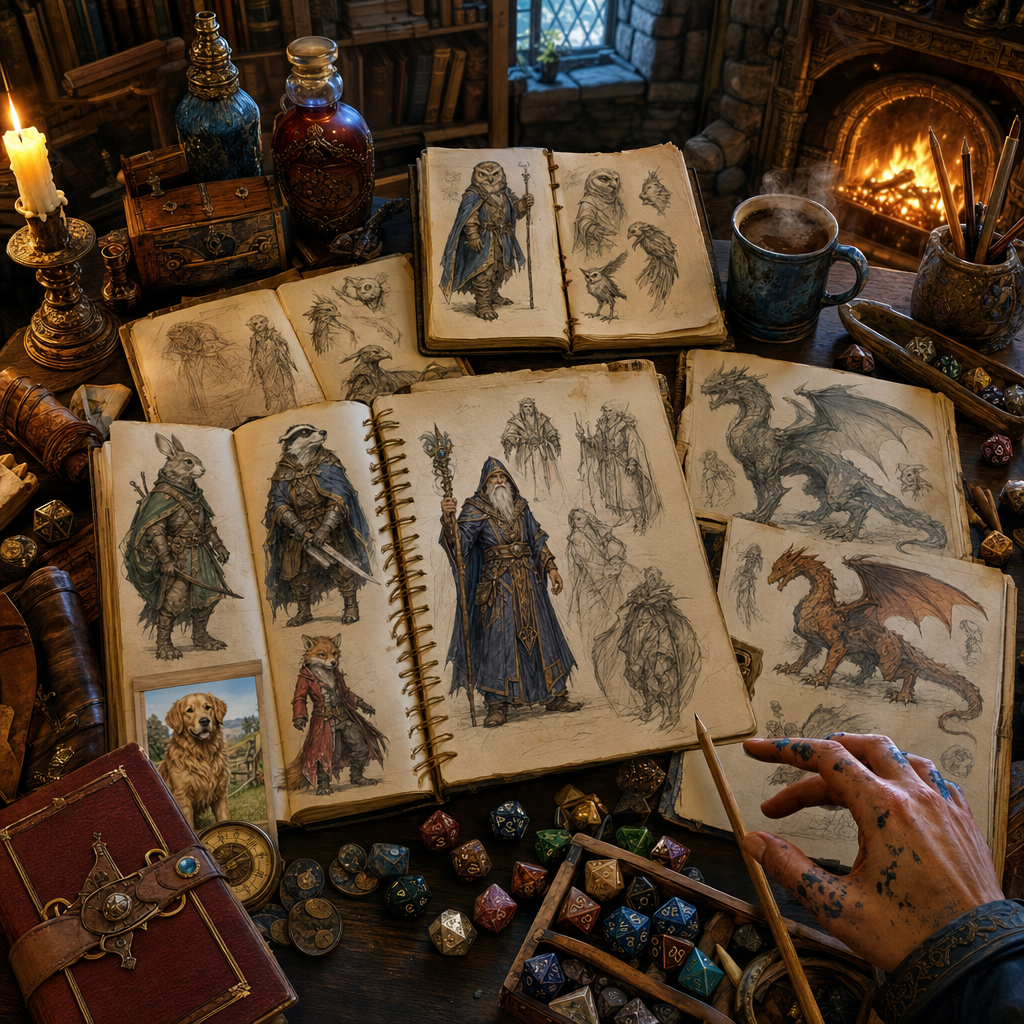
I have a folder on my computer called "Campaign Ideas" that's basically a graveyard. Seventeen half-baked d&d concepts, none of which made it past the "wouldn't it be cool if..." phase. A warlock whose patron is actually a sentient forest. A city built inside a dead god's ribcage. A bard college that teaches necromancy through sea shanties.
Great concepts. Zero follow-through.
The problem wasn't the ideas—it was that I didn't know how to develop them past that initial spark. A cool concept is like kindling. It'll catch fire, but it won't keep burning unless you actually build something around it.
What Makes a D&D Concept Actually Usable
Here's what I learned after running solo campaigns for the better part of three years: the best d&d concepts aren't the most original ones. They're the ones you can execute at the table without sixteen pages of notes.
A usable concept has three things:
- A clear hook — one sentence that makes someone lean forward
- Immediate conflict — built-in tension you don't have to manufacture
- Room to grow — space for players (or you, if you're solo) to add their own fingerprints
That warlock with the forest patron? The hook is solid. But what's the conflict? Why does the forest need a warlock? What does it want? Once I asked those questions, the concept went from "neat idea" to "three-session arc about a logging company accidentally awakening an ancient grove-mind."
Starting With What You Know
The absolute best advice I ever got about developing d&d concepts came from a forum post I can't even find anymore: "Start with something real, then make it weird."
I grew up on a farm. We had this border collie named Biscuit who would herd anything—chickens, goats, occasionally my little sister. Smart as hell, loyal to a fault, and absolutely convinced that everyone needed supervision. One night, during a particularly brain-dead solo session, I thought: what if Biscuit was a ranger?
Not a ranger with a dog companion. An actual dog who became a ranger.
I sketched it out: a canine ranger (anthropomorphic, walking upright with a weathered longbow) who believes she's responsible for keeping the entire party alive. Compulsive. Protective. Suspicious of anything that moves without her permission. She had Biscuit's anxiety and Biscuit's heart. That character ran for eight months of solo play and I still think about her.
Here's the thing: I could describe her personality in my sleep because I knew Biscuit. The concept had roots.
Building Characters From Real Life
This is where concept development gets fun. You don't need to invent everything from scratch. Look around your actual life:
- That coworker who always has a backup plan? That's a wizard with 47 contingency spells.
- Your aunt who collects crystals and talks to plants? Druid. Obvious druid.
- The cat that stares at you like it knows your browser history? Warlock familiar. Definitely judging you.
Real personality traits make concepts feel lived-in. You're not building a character sheet—you're building a person who happens to have a character sheet.
And if you want to get weird with it, tools like Creature Forge AI's character generator let you actually upload a photo—of your dog, your friend, yourself—and turn it into a full fantasy character. I'm not saying you should turn your childhood pet into a barbarian, but I'm also not not saying that. (I did it. No regrets. My goat Biscuit Junior is now a Circle of the Shepherd druid. It's perfect.)
Monster Concepts: Make Them Mean Something
Monsters are where most d&d concepts go to die, because we treat them like stat blocks instead of story elements.
Bad monster concept: "A big scary dragon."
Good monster concept: "A dragon who's losing her memory and can't remember where she buried her hoard. She's terrified, aggressive, and convinced everyone is trying to steal from her."
See the difference? One is a bag of hit points. The other is a situation.
When you're developing monster concepts, ask:
- What does this creature want?
- What's stopping it from getting that?
- Why does it need the party—or why does the party need it?
Even a basic goblin becomes interesting when you know it's trying to kidnap chickens because its tribe's food supply got cursed and poultry is the only thing they can digest now. Suddenly it's not "kill ten goblins," it's "figure out what's wrong and maybe help these desperate little weirdos."
World-Building Concepts Without the Overwhelm
Here's where I see people freeze up: they think they need to build an entire world before session one.
You don't.
Start with one town. Give it three problems. That's your campaign.
The Three-Problem Framework
This is my go-to for developing setting concepts that don't collapse under their own weight:
- A local problem — something immediate and personal (missing livestock, haunted mill, corrupt guard captain)
- A regional threat — something bigger on the horizon (goblin army, strange weather, merchant guild war)
- A weird mystery — something that doesn't make sense yet (why do all the dogs in town bark at the mayor? why does it rain only on Thursdays? what's that humming sound from the old well?)
Layer those three things and you've got a setting that feels alive. Players can tackle the local problem while you figure out how the regional threat and the weird mystery connect. (Spoiler: you don't have to know yet. I never know yet.)
NPC Concepts: Personality Over Stats
NPCs are the easiest d&d concepts to develop because they don't need to be balanced—they just need to be memorable.
Give every NPC:
- One strong personality trait
- One thing they want
- One quirk that makes them stick in your players' heads
That's it. You don't need a backstory novel.
Example: Marta the blacksmith. She's suspicious of anyone who doesn't have calluses. She wants to retire and open a bakery. Her quirk? She hums sea shanties while she works, even though she's never seen the ocean.
Done. That's a whole person. If your players latch onto her, you build more. If they don't, you spent five minutes instead of five hours.
And honestly? If you're stuck, just generate a few NPCs with different personalities and see which one makes you smile. The NPC generator is stupid good for this—punch in a basic concept and it'll give you enough detail to riff on. I've built entire side quests around randomly generated bartenders.
Turning Concepts Into Sessions
Okay, you've got your concept. Now what?
The bridge from "cool idea" to "playable session" is scenes. Break your concept into three to five moments you want to happen:
- The discovery
- The complication
- The choice
- The consequence
- The resolution (or the cliffhanger)
Let's take that memory-loss dragon concept:
- Discovery: Party finds a village burned—but the dragon didn't take anything, just trashed the place looking for something
- Complication: They track the dragon and realize she's old, confused, begging them to help her remember
- Choice: Help her find her hoard, kill her while she's weak, or try to trap/relocate her
- Consequence: Her hoard is in a sacred temple. The locals will riot if they go in. The dragon is getting more desperate.
- Resolution: However they solve it, they learn the hoard contains an artifact that's been eating her memories—and now it knows they exist.
See? Concept became structure. Structure became session. You can improvise everything in between.
When Concepts Fail (And How to Save Them)
Sometimes an idea just doesn't work. The players aren't interested. The plot thread goes nowhere. The NPC you spent an hour developing gets ignored for the random street vendor you made up on the spot.
This is fine.
Here's the secret: recyclable concepts. That dragon? Also works as a lich, a sphinx, or a cursed king. That suspicious blacksmith? Transplant her to the next town. That forest-patron warlock? Reuse the patron for a different character.
Nothing is wasted if you keep the good parts.
The Concept Development Checklist
Before you bring any d&d concept to the table, ask yourself:
- Can I explain this in one sentence?
- Does it create an immediate question or problem?
- Can I describe the personality/motivation without looking at notes?
- Is there room for players to surprise me?
- Do I actually want to run this, or does it just sound cool?
If you answered yes to at least three of those, you're good. Run it.
Your Next Step
Look, I still have that "Campaign Ideas" folder. It's still full of half-concepts. The difference now is that I know which ones are worth developing—and I know how to turn a scribbled note into something I can actually play.
Start small. Pick one concept. Build three scenes around it. See what happens.
And if you need a shortcut—if you want to see what a character, monster, or NPC could look like before you commit to building them out—try Creature Forge AI. Upload a photo, describe a vibe, let it surprise you. Sometimes the best concepts are the ones you didn't know you were looking for.
Your table's waiting. Go build something weird.