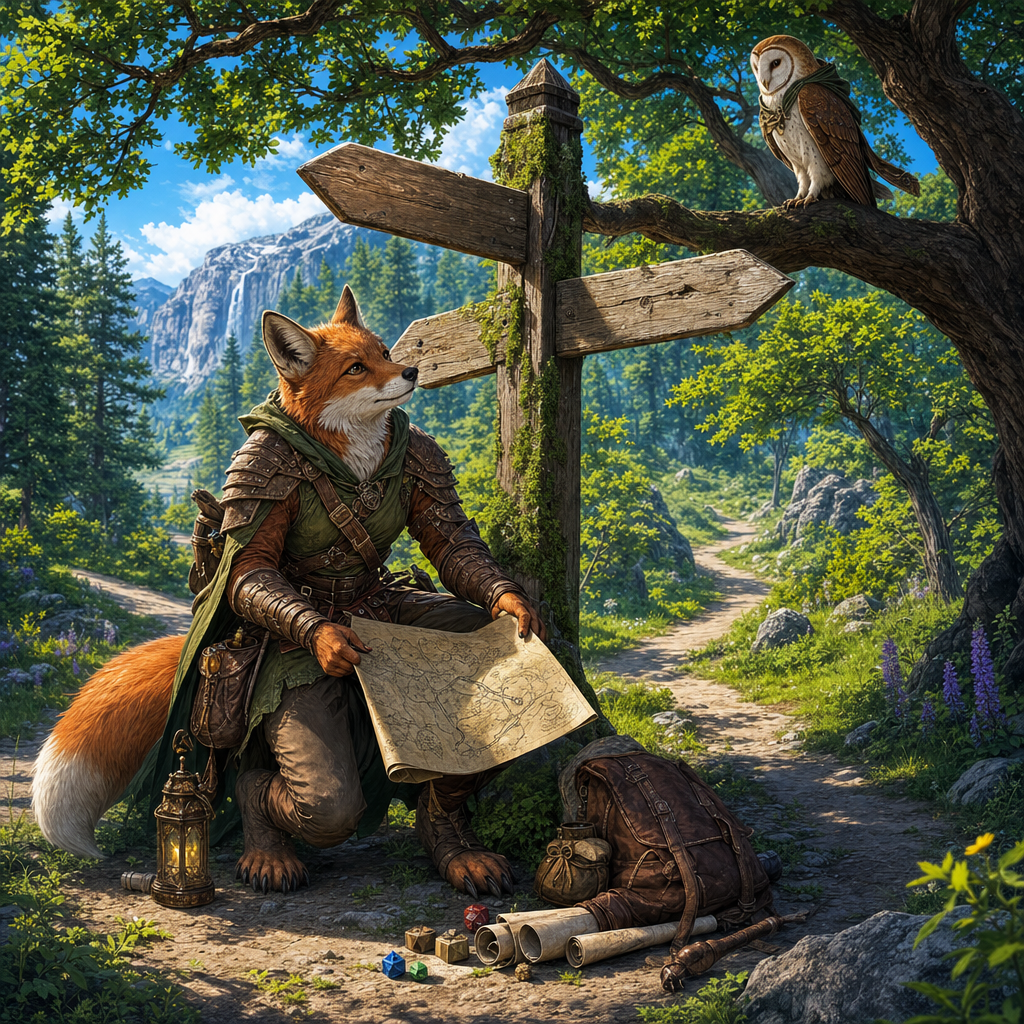
Why Your First Campaign Should Be Simple (and Why That's Enough)
When I started playing D&D solo—late nights at the kitchen table, one lamp, too much coffee—I made the mistake every beginner makes. I built a world. Continents, pantheons, trade routes, three kinds of elvish dialects. I spent weeks on a campaign that collapsed in session two because I had no idea how to actually run a game.
Here's what I learned: the best D&D campaign ideas for beginners aren't the most elaborate. They're the ones that get you playing fast, give you room to improvise, and don't fall apart when your players do something weird. And they will do something weird.
If you're a new Dungeon Master—or a new player trying to pitch a campaign to your equally-new friends—you need hooks that are strong enough to pull everyone in but flexible enough to survive contact with actual humans rolling dice. That's what this guide is: campaign frameworks that work, even when you're figuring it out as you go.
The "Everyone Knows Everyone" Village Campaign
Start small. Literally. Drop your party in a single village where everyone knows everyone, and something is wrong.
Why This Works for Beginners
- Limited scope: You only need to prep one location. A tavern, a general store, a handful of homes. You're not juggling kingdoms.
- Built-in investment: If the blacksmith is someone's uncle and the missing shepherd is someone's childhood friend, players care immediately.
- Easy to expand: When you're ready, the mystery leads to the forest. Then the old ruins. Then the thing beneath the ruins. But you don't have to know that yet.
Sample Hook
The village wells have run dry, except for one—and anyone who drinks from it has been sleepwalking into the woods at night. Three people haven't come back. The village elder hires the party (local kids, travelling sellswords, whoever) to figure out what's happening before someone else disappears.
You can solve this with a corrupted water spirit, a hag's curse, or a forgotten temple. You decide session-to-session based on what your players latch onto.
The "Caravan Guard" Campaign
The party is hired to protect a merchant caravan traveling from Point A to Point B. It's a brilliant campaign idea for beginners because the structure does half your work.
Why This Works
- Built-in pacing: Each day is a new encounter. Bandits. A broken wagon wheel. A strange traveler with a warning. A festival in a roadside town.
- Flexible difficulty: Encounters scale easily. Goblins today, a moral dilemma tomorrow, a dragon flying overhead (but not fighting) the day after.
- Natural endpoint: When the caravan reaches its destination, you've got a complete arc. If everyone's having fun, the merchant hires them again for the return trip—through a different route.
Sample Hook
A merchant named Coral is transporting a mysterious sealed crate to the city of Fallhaven. She's paying well but won't say what's inside. Bandits want it. A rival merchant wants it. Halfway through the journey, something inside the crate starts scratching.
You can reveal it's a rare beast, a cursed artifact, or a person in witness protection. Let your players' paranoia and theories guide you.
The "Dungeon of the Week" Campaign
Some of the best D&D campaign ideas for beginners embrace the episodic. Your party are dungeon delvers, treasure hunters, or members of an adventurer's guild. Every session is a new job.
Why This Works
- No complex plot required: You're not tracking a story across twelve sessions. Each dungeon is self-contained.
- Learn by doing: Every session teaches you something new about pacing, encounters, and what your players enjoy.
- Easy to connect later: Once you've run five standalone dungeons, you realize three of them were connected all along. Surprise! The lich you fought in dungeon two was the one hiring your party in dungeon five.
Sample Hook
The party works for the Delver's Guild, a loose organization that posts contracts on a board in the guildhall. Session one: clear rats from a nobleman's cellar. Session two: retrieve a stolen heirloom from a kobold warren. Session three: investigate why previous adventurers never came back from the Mourning Crypts.
Each mission adds a piece to a bigger mystery you can improvise as you go.
The "Creature Companion" Campaign
Here's one I stumbled into by accident. I was running a solo game and decided my character—a ranger with more heart than sense—rescued a wolf cub from a trap. That cub became the emotional anchor for twenty sessions. When creatures matter, stories stick.
Give your party a creature to protect, escort, or help. Maybe it's a baby griffon that imprinted on the fighter. Maybe it's a sentient awakened shrub that the druid adopted. Maybe it's an NPC's beloved pet that got cursed and needs fixing.
Why This Works
- Instant emotional hook: Players will burn down villages to protect something small and vulnerable.
- Built-in story engine: The creature needs food. Medicine. Someone's hunting it. It's the key to an ancient prophecy. It evolves or grows as the campaign progresses.
- Easy to visualize: If you want to make it even more personal, tools like Creature Forge AI let you upload a photo of a real pet and turn it into a fully statted D&D character. My border collie Scout is now a Lupine scout with a fear of thunderstorms and advantage on perception checks. Best NPC I've ever run.
Sample Hook
A farmer's prized goat—possibly magical, possibly just extremely lucky—has been stolen by bandits who think it's a sacred beast worth a fortune. The farmer can't pay much, but the goat is the only thing keeping his farm alive through a drought. The party recovers the goat. The goat refuses to leave their side. The goat is, somehow, always right about danger.
The "Murder Mystery" One-Shot (That Becomes a Campaign)
Start with a single-session murder mystery. Someone important is dead. Everyone's a suspect. The party has one night to solve it.
If your group loves it, the same noble's family hires them for another job. Then another. Suddenly you're running a campaign about a detective agency in a city of intrigue, and you never had to plan past next session.
Why This Works
- Low commitment: You're pitching one session. If it flops, no harm. If it's magic, you've got a campaign.
- Teaches improv: Players will interrogate NPCs you barely planned. You'll learn to think on your feet faster than any prep guide can teach you.
- Scalable complexity: Session one is a simple poisoning. Session ten involves a thieves' guild, a corrupt magistrate, and a devil in human skin.
Sample Hook
Lord Merrick is dead at his own feast. Poisoned wine. Locked doors. Eight guests, all with motive. The city guard is incompetent. The party—guests themselves, or hired entertainment—are the only ones who can solve it before dawn, or everyone gets arrested.
What Makes These Campaign Ideas Beginner-Friendly?
Every framework here shares three things:
- Clear starting point: You know exactly where session one begins. No twenty-minute lore dump required.
- Room to improvise: When your players zig instead of zag, the campaign bends instead of breaking.
- Built-in hooks for expansion: If your one-shot becomes a campaign, the structure supports it. If your campaign needs to wrap up early, it can.
You don't need a perfect world. You need a strong situation, interesting characters, and a willingness to let your players surprise you. The rest builds itself, session by session, dice roll by dice roll.
Tools That Help When You're Starting Out
Here's something I wish I'd known earlier: you don't have to build every creature, NPC, and stat block from scratch. When I finally stopped trying to homebrew everything and started using tools that did the heavy lifting, my prep time dropped from hours to minutes.
If you need a band of goblins, a mysterious forest spirit, or a guardian beast for that creature companion campaign, something like Creature Forge AI generates fully statted monsters in seconds. If you need a merchant, a suspicious guard captain, or a villain's right-hand schemer, the NPC generator does the same for characters.
And if you want to turn your actual dog into a playable Tabaxi rogue or your grumpy cat into a sorcerer's familiar with a personality? Upload a photo. The tool builds a character that actually looks like them, complete with stats and traits. It's absurd. It's delightful. It works.
Your First Campaign Doesn't Have to Be Your Best Campaign
My first campaign was a mess. My players derailed the plot in session one by befriending the villain. I panicked. I improvised a new villain on the spot—a resentful blacksmith who felt overlooked. It became the best arc of the whole campaign, and I didn't plan a single session of it.
That's the secret every beginner needs to hear: your campaign will go sideways. It's supposed to. The goal isn't a flawless story. It's a story you all build together, surprise by surprise, laugh by laugh, critical fail by critical fail.
Start simple. Play big. The rest will follow.
Ready to Build Your First Campaign?
Pick one of these frameworks. Prep your first session—just the first session. Write down three NPCs, one location, and one problem. Then sit down with your friends, roll some dice, and see what happens.
If you need creatures, NPCs, or characters to fill out your world—especially if you want to turn a real pet or person into a fantasy adventurer—try Creature Forge AI. It won't run the game for you, but it'll give you the tools to stop prepping and start playing.
Your first campaign is waiting. Go make something weird and wonderful.