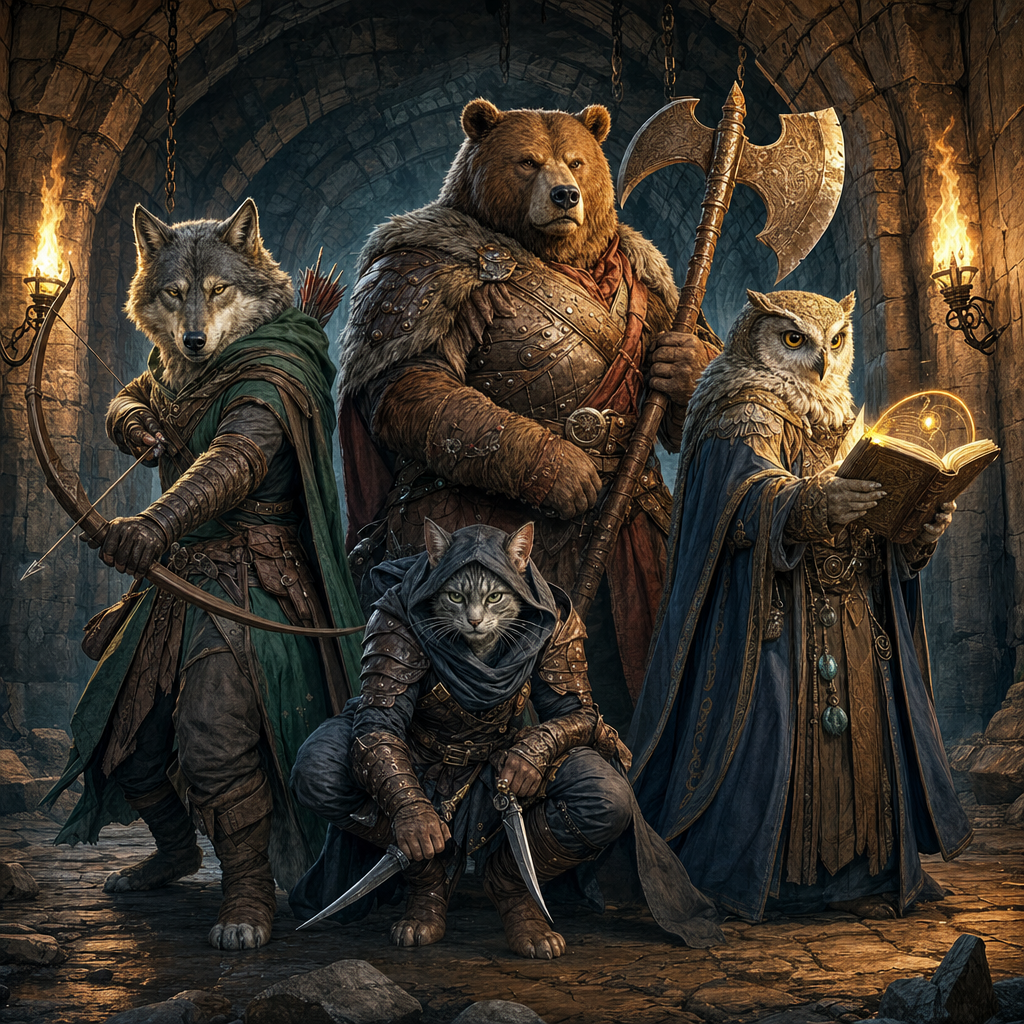
I grew up surrounded by animals—dogs that herded sheep, cats that ruled the barn, a goat named Biscuit who had more personality than half the people I knew. So when I discovered DnD animal races, something clicked. These weren't just fantasy tropes. They were a way to bring the creatures I'd lived alongside into the stories I was telling at my kitchen table during those late-night solo sessions.
Animal races in D&D offer something unique: instant visual identity, built-in personality hooks, and a connection to the natural world that grounds even the most epic fantasy. Whether you're drawn to the classic Tabaxi rogue or want to homebrew a border collie paladin (yes, I've done it), understanding how these races work opens up a whole new dimension of character creation.
What Are DnD Animal Races?
In D&D terms, animal races are playable ancestries that blend humanoid traits with animal characteristics. They're not literal animals—they're anthropomorphic beings with animal features, culture, and often a deep connection to nature or specific environments. Think upright posture, hands that can wield weapons, and the ability to speak Common, but with fur, feathers, scales, or other bestial traits.
The most common official animal races include:
- Tabaxi: Cat-like wanderers with climbing speed and feline agility
- Aarakocra: Bird-folk with flight and keen eyesight
- Lizardfolk: Reptilian survivalists with natural armor and bite attacks
- Tortle: Turtle-people with high AC and a calm, measured approach to life
- Kenku: Crow-like mimics who can't speak originally but copy sounds perfectly
- Harengon: Rabbit-folk with incredible jumping ability and lucky escapes
Each brings mechanical benefits and rich roleplay potential. But here's where it gets interesting: you're not limited to what's in the official books.
Choosing the Right Animal Race for Your Character
The best animal race for your character depends on three things: mechanics, story, and personal connection.
Start With Story
What animal resonates with the character concept in your head? A loyal protector might be a wolf-like Lupine. A cunning trickster could be a fox-inspired Vulpin. A steadfast tank might channel bear energy. Don't let optimal builds override what feels right. I've learned more about character through suboptimal but thematically perfect choices than I ever did min-maxing.
Consider the Mechanical Fit
Once you have your concept, look at what the race offers:
- Does it have natural weapons that complement your class?
- Are there movement bonuses (climbing, swimming, flight) that open tactical options?
- Do the ability score increases align with your build, or are you using Tasha's rules to reassign them?
- What unique abilities does it bring—like the Tabaxi's Feline Agility or the Harengon's Rabbit Hop?
The goal isn't perfection. It's synergy between who your character is and what they can do.
Mine Your Own Life
Here's something I stumbled into during a particularly long solo campaign: I was stuck on a ranger concept until I looked out the window and saw my border collie, Maggie, herding chickens with this intense, focused energy. Suddenly I knew exactly who this character was—a canine-inspired tracker with Pack Tactics (homebrewed), high Intelligence, and an obsessive need to keep the party together. She became one of my favorite characters, and it started with a real animal I knew.
That's when I discovered Creature Forge AI's character generator. You can actually upload a photo of your pet and generate a full D&D character sheet—complete with stats, a backstory, and art that looks like your actual animal. I uploaded Maggie's photo just to see what would happen, and the result was uncanny: a Border Collie Scout with a shepherd background, pack-oriented abilities, and even a personality quirk about constantly counting party members. It nailed her.
Homebrewing Your Own Animal Races
If the official options don't cover the animal you have in mind, homebrewing is easier than you think. Here's a simple framework:
Core Traits Framework
- Ability Score Increase: +2 to one stat, +1 to another (or use Tasha's flexible rules)
- Age: Lifespan that fits your world
- Alignment: Common tendencies, not restrictions
- Size: Small or Medium usually
- Speed: 30 feet standard, adjust if the animal is notably fast or slow
- Special Movement: Climb, swim, or burrow speed if it fits the animal
- Natural Weapons: Claws, bite, or horns—usually 1d4 or 1d6 damage
- Unique Ability: One signature trait (keen smell, pack tactics, defensive curl)
- Languages: Common plus one relevant to their culture
Keep it simple. Balanced homebrew doesn't mean complexity—it means one cool thing, not five mediocre things.
Example: Caprine (Goat-Folk)
Because I can't not make a goat race after years with Biscuit:
- Ability Score Increase: +2 Constitution, +1 Wisdom
- Size: Medium
- Speed: 30 feet, climb speed 20 feet
- Sure-Footed: Advantage on saves against being knocked prone
- Headbutt: Unarmed strike deals 1d6 bludgeoning, and you can use a bonus action to shove after hitting
- Mountain Born: Acclimated to high altitude and difficult terrain
That's a complete race. It's balanced against official options, reflects goat behavior, and gives clear mechanical identity.
Roleplaying Animal Races Beyond the Surface
Here's where animal races get mishandled: players treat them as humans with fur. The ears are decorative. The tail is scenery. But the richest characters lean into how being that animal changes perspective.
Sensory Differences
A wolf-like character might describe rooms by scent first. A bird-folk watches exits from above. A bear-person talks about hunger with alarming frequency. These aren't gimmicks—they're how that body experiences the world.
Cultural Touches
What does a society of cat-folk value? Probably independence, curiosity, territorial respect. Lizardfolk? Practicality, survival, emotional restraint. Let the animal nature inform the culture without making it a stereotype.
The Little Physical Quirks
My Tabaxi knocked things off tables. Not on purpose—just testing if they'd fall. My Aarakocra couldn't sit normally in chairs. These moments made them feel real in ways stat blocks never could.
Using Animal Races in Your Campaign World
If you're a DM, animal races are world-building gold. They ask questions like:
- How do different races interact in multi-species cities?
- Are there prey-predator tensions between, say, rabbit-folk and wolf-folk?
- Do animal races have their own nations, or are they integrated into human societies?
- What gods or natural forces do they revere?
Don't treat animal races as exotic foreigners in an otherwise human world. Give them history, architecture, cuisine, art. A Tabaxi city might have vertical streets and rope bridges. Lizardfolk settlements could be amphibious, half-submerged. Let the animal nature shape everything.
Turning Real Pets Into Fantasy Characters
This is where the magic really happens. You know your pets better than any random NPC in a sourcebook. You know their personalities, their quirks, the way they move through space. Why not bring that into your game?
I've done this with half my farm animals. Biscuit the goat became a chaotic neutral druid with a chip on his shoulder. My old barn cat, Duchess, turned into a rogue with the Criminal contact feature and a habit of "acquiring" shinies. These weren't just characters—they were my characters, informed by years of living alongside the real animals.
The photo-upload feature I mentioned earlier makes this absurdly easy. You're not starting from scratch with stat blocks and backstory. You're uploading a photo and getting a character that looks and acts like your actual pet, translated into D&D mechanics. It's like having a personal character artist who also knows 5e inside-out.
Common Pitfalls to Avoid
A few things I've learned the hard way:
- Don't make them joke characters. Animal races can be funny, but if that's all they are, they get old fast.
- Avoid racist tropes. Animal races aren't a safe space for stereotypes you wouldn't apply to human cultures. Treat them with the same respect.
- Balance homebrew carefully. Flight is notoriously hard to balance at low levels. Natural weapons shouldn't outpace class features. When in doubt, compare to official races.
- Don't force it. If an animal race doesn't fit the campaign setting or tone, it's okay to save it for another game.
Where to Start
If you're new to animal races, pick one official option and play it for a one-shot. Get a feel for how the mechanics and roleplay intersect. Then, if you're feeling adventurous, homebrew something personal—an animal you love, a pet you've lost, a creature that fascinates you.
Or skip the guesswork entirely and try Creature Forge AI. Upload a photo of your dog, your cat, your childhood hamster. See what the generator builds. You might be surprised how much personality comes through—and how quickly a throwaway idea becomes your next long-term character.
Animal races aren't just a mechanical choice. They're a way to bring something you love—something real—into the stories you're telling. And in solo play, late at night with a cup of coffee and a notebook, that connection matters more than any optimized build ever could.