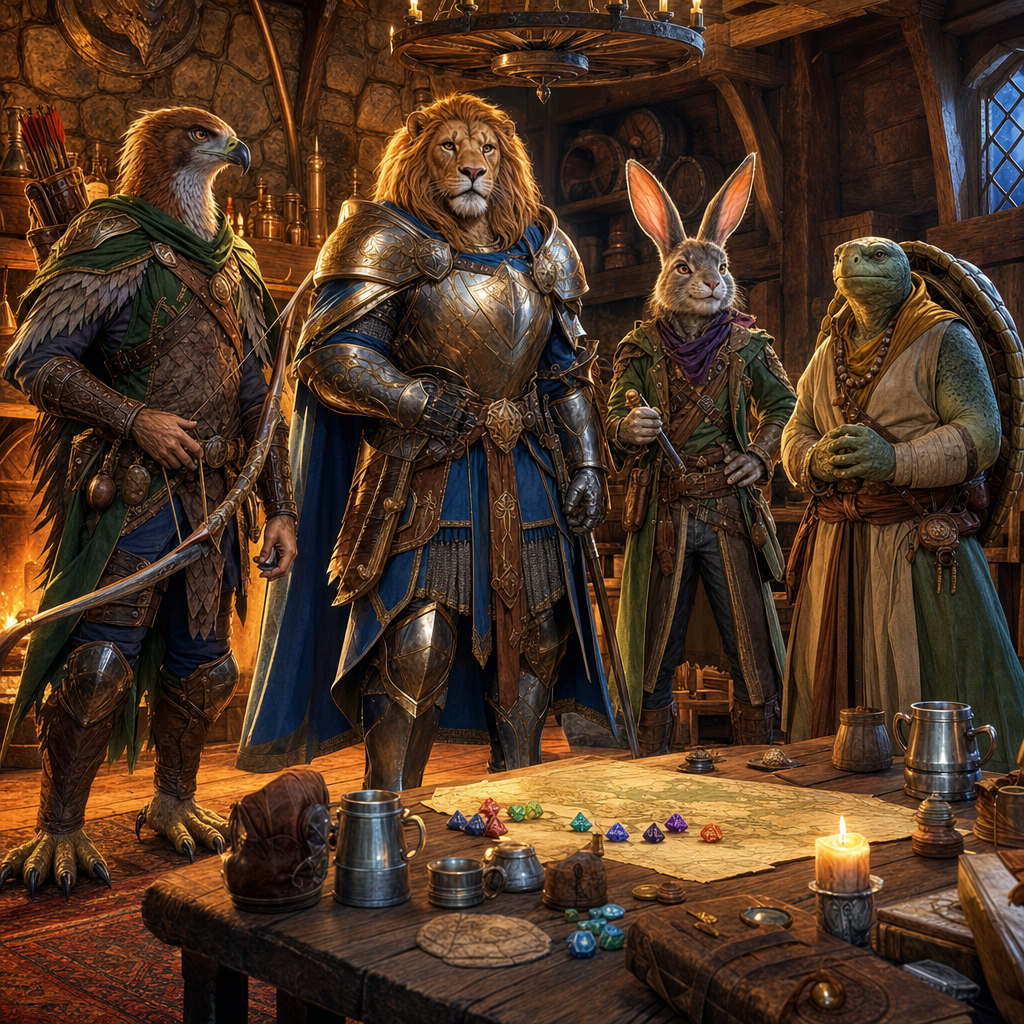
Why Play an Animal Race in D&D?
I'll be honest—the first time I saw someone play a Tabaxi rogue, I thought it was just for laughs. A literal cat person sneaking around, knocking things off tables for no reason. But then I watched that player bring genuine depth to the character: curiosity that wasn't just comic relief, a wanderlust tied to feline independence, physical grace that made every description of movement feel different.
That's when I got it. DND all animal races aren't gimmicks. They're invitations to see the game world through non-human senses, to embody instincts and physicality that humans don't have. And if you grew up around animals like I did—spending afternoons with goats who'd headbutt you for attention and horses who'd spook at their own shadows—you already know that animals have personalities as complex as any person's.
This guide covers every official animal race in fifth edition, plus practical advice for homebrewing your own when the rules don't quite have what you need.
Official DND Animal Races
Aarakocra (Bird People)
These eagle-headed, feather-winged people hail from the Elemental Plane of Air. Their defining trait is flight—50 feet per round—which makes them exceptional scouts and gives them tactical advantages most races can't touch. The tradeoff? They can't wear medium or heavy armor while flying, and they're fragile (no ability score bonuses to Constitution in most versions).
Best for: Rangers, druids, monks who want mobility over durability. Players who think three-dimensionally.
Flavor note: Aarakocra see the world from above. They're claustrophobic in dungeons, reverent of open sky, and often struggle with the concept of property boundaries ("why can't I just fly over the wall?").
Tabaxi (Cat People)
Tabaxi are my personal favorite for solo campaigns—that Feline Agility trait (double your speed for one turn) makes chase scenes and tactical repositioning incredibly fun to narrate. They get Dexterity and Charisma bonuses, climbing speed, and proficiency in Perception and Stealth.
Best for: Rogues, bards, monks. Anyone who wants to be quick, curious, and a little bit selfish.
Flavor note: Tabaxi are driven by obsessive curiosity about specific topics. One month it's ancient poetry, the next it's the mating habits of swamp beetles. Lean into that obsessive quality—it's not randomness, it's intensity focused on whatever catches their attention.
Tortle (Turtle People)
Tortles are walking tanks with a natural AC of 17—no armor required. They can retreat into their shells for +4 AC (but you're prone and your speed is 0). They're Strength and Wisdom focused, with decent hit points and a patient, thoughtful culture.
Best for: Clerics, paladins, druids. Characters who value defense and longevity.
Flavor note: Tortles are wanderers by tradition, spending their long lives exploring before returning home to lay eggs and share stories. Play up that sense of timelessness—they've got decades; they can wait.
Lizardfolk (Reptile People)
Lizardfolk are often misunderstood as "evil" because they're pragmatic to the point of alien. They see other creatures as potential food, allies, or threats—no sentimentality. Mechanically, they get natural armor (13 + Dex modifier), a bite attack, Hold Breath, and the amazing Hungry Jaws ability (bite attack that heals you).
Best for: Druids, rangers, barbarians. Players comfortable with moral ambiguity.
Flavor note: Lizardfolk don't understand mammalian emotions. Grief, romance, honor—these are foreign concepts. They're loyal to their clutch, but in a cold, calculated way. It's a fascinating roleplay challenge.
Kenku (Crow People)
Kenku are cursed. They've lost their wings, their creativity, and their voices—they can only mimic sounds they've heard. Mechanically, this is represented by Expert Forgery and Mimicry abilities. They get Dexterity and Wisdom, plus proficiency in two skills of your choice.
Best for: Rogues, rangers, warlocks. Players who love constraints and creative problem-solving.
Flavor note: The no-speech-only-mimicry rule is controversial. Some tables ignore it, some embrace it. If you play it straight, you'll be doing voice impressions and sound effects all night—exhausting but memorable.
Harengon (Rabbit People)
These hare-folk come from the Feywild and are newer to the game (introduced in The Wild Beyond the Witchlight). They add proficiency bonus to initiative rolls, have Rabbit Hop (bonus action jump without provoking opportunity attacks), and get proficiency in Perception.
Best for: Any class that values going first and staying mobile. Rogues, fighters, even wizards.
Flavor note: Harengon are twitchy, alert, always scanning for danger. They're Fey-touched, so mix wariness with whimsy—they take threats seriously but celebrate survival with wild parties.
Owlin (Owl People)
Another recent addition, Owlin have flight (like Aarakocra) but with fewer restrictions—they can wear any armor. They also get darkvision and proficiency in Stealth, making them natural night scouts and ambush predators.
Best for: Rangers, rogues, warlocks. Characters who operate in darkness.
Flavor note: Owls are silent hunters with neck-swiveling vision. Play up the uncanny stillness and sudden head-turns. They're patient, methodical, and deeply unsettling to people who aren't used to them.
Unofficial and Homebrew Animal Races
Here's where it gets personal. Last year I was running a solo campaign and wanted to play a border collie as a ranger—loyal, tireless, obsessed with herding the party into tactical formations. The problem? There's no official "dog person" race in D&D.
So I homebrewed one. Used the Creature Forge AI character generator, uploaded a photo of my dog Maggie (black and white, one ear up, one ear down), and it generated a full lupine ranger build—stats, abilities, even suggested pack tactics and a herding instinct trait. The artwork looked exactly like her, just standing upright with a bow. I've never felt more attached to a character.
That's the beauty of animal races: if it doesn't exist officially, you can make it. Here are the most common homebrew beastfolk:
- Lupines/Wolffolk: Pack tactics, keen smell, often Strength or Wisdom based. Think teamwork and loyalty.
- Foxfolk/Kitsune: Charisma and Intelligence, illusion magic, trickster flavor. Fey-adjacent.
- Bearfolk: Strength and Constitution, powerful build, hibernation or rage mechanics. Natural tanks.
- Mousefolk: Small size, Dexterity, stealth and survival bonuses. Brave despite being tiny.
- Raccoonfolk: Dexterity and Intelligence, natural thieves, proficiency with tinker's tools. Absolute chaos gremlins.
- Elephant/Loxodon: Actually official (from Guildmaster's Guide to Ravnica), but worth mentioning—Wisdom and Constitution, natural armor, trunk for tool use, and Powerful Build.
How to Choose the Right Animal Race for Your Character
Start with the animal, not the mechanics. What creature resonates with you? What behaviors, instincts, or symbolic meanings do you want to explore?
If you're playing a cat person, don't just take the Dexterity bonus and call it done. Think about why cats move the way they do—the stalk-and-pounce hunting style, the obsessive grooming, the way they claim territory by rubbing against things. If you're playing a bird person, consider how flight changes your relationship with gravity, weather, and enclosed spaces.
Then match mechanics to concept. A bear shouldn't be a Dexterity-based rogue (usually). A mouse probably shouldn't be your Strength-based barbarian (though that's hilarious, so maybe do it anyway).
Questions to Ask Yourself
- What role does this animal play in nature? (Predator, prey, scavenger, social pack member, solitary hunter?)
- What senses define them? (Smell, sight, hearing, echolocation?)
- How do they communicate? (Vocalizations, body language, scent marking?)
- What are their survival instincts? (Fight, flight, freeze, play dead?)
- How long do they live, and how does that affect their worldview?
Roleplaying Animal Races Without Falling Into Stereotypes
The biggest mistake I see with animal races is playing them as one-note joke characters. The Tabaxi who only cares about yarn. The Kenku who's just a parrot. The Lizardfolk who eats everything.
Real animals—and real animal people—are complex. My goat Biscuit is stubborn, sure, but she's also anxious during thunderstorms, protective of the younger goats, and has figured out how to unlatch three different types of gates. If I played a goat-folk character, I'd lean into that cleverness and those contradictions, not just "lol she headbutts things."
Give your beastfolk character:
- Contradictions: A timid wolf. A gregarious turtle. A clumsy cat.
- Cultural depth: What's their society like? Do they have coming-of-age rituals? Taboos? Art?
- Personal history: Were they raised among their own kind or by other races? How does that shape their identity?
- Goals beyond instinct: Yes, cats are curious, but what is this particular cat curious about, and why does it matter to them?
Making Your Own: Tools and Tips
If you want to homebrew an animal race and need a starting point, the Creature Forge AI character builder is genuinely useful—you can upload a photo of your actual pet or a reference image and it'll generate a full character sheet with race traits, suggested class synergies, and art that looks like the creature you're envisioning. It handles the stat-crunching so you can focus on personality and story.
If you're building from scratch without tools, use these guidelines:
- Ability Score Increases: +2 to one stat, +1 to another (or three +1s). Base it on the animal's natural strengths.
- Speed: 30 feet is standard. Slower for heavy creatures (25), faster for runners (35-40).
- Special Movement: Climbing, swimming, or burrowing speed if it fits the animal.
- Senses: Darkvision (60 feet) is common. Keen smell or hearing can be represented with advantage on Perception checks.
- Natural Weapons: Claws, bite, or horns—usually 1d4 or 1d6 plus Strength modifier.
- Unique Trait: One ability that captures the essence of the animal (web-spinning, echolocation, camouflage, etc.).
Playtest it. If it feels overpowered or underpowered, adjust. The goal is "interesting and flavorful," not "game-breaking."
Final Thoughts: Let Your Character Breathe
The best animal race characters I've seen—either at tables or in my own solo games—are the ones where the player lets the animal nature inform the character without defining them. Your Aarakocra isn't just "the bird guy." They're a scout with a fear of being caged, a love of storms, and a complicated relationship with their earthbound companions who'll never understand the sky the way they do.
Your Tabaxi isn't just "the cat burglar." They're an obsessive researcher who got kicked out of three libraries, who grooms compulsively when nervous, who purrs when they're happy even though it embarrasses them.
These details—the specific, the personal, the lived-in—are what make a character memorable.
So whether you're playing an official race from the Player's Handbook or homebrewing a capybara cleric (yes, do it), start with what you love about the animal. Build from there. And don't be afraid to bring your real-world experiences—your pets, your farm animals, the wildlife you've watched—into your fantasy.
If you need a hand bringing that vision to life, try Creature Forge AI. Upload a photo, describe your concept, and see what happens. You might be surprised how close you can get to the character you've been imagining.
Now go give your inner border collie a sword and let them herd some goblins.