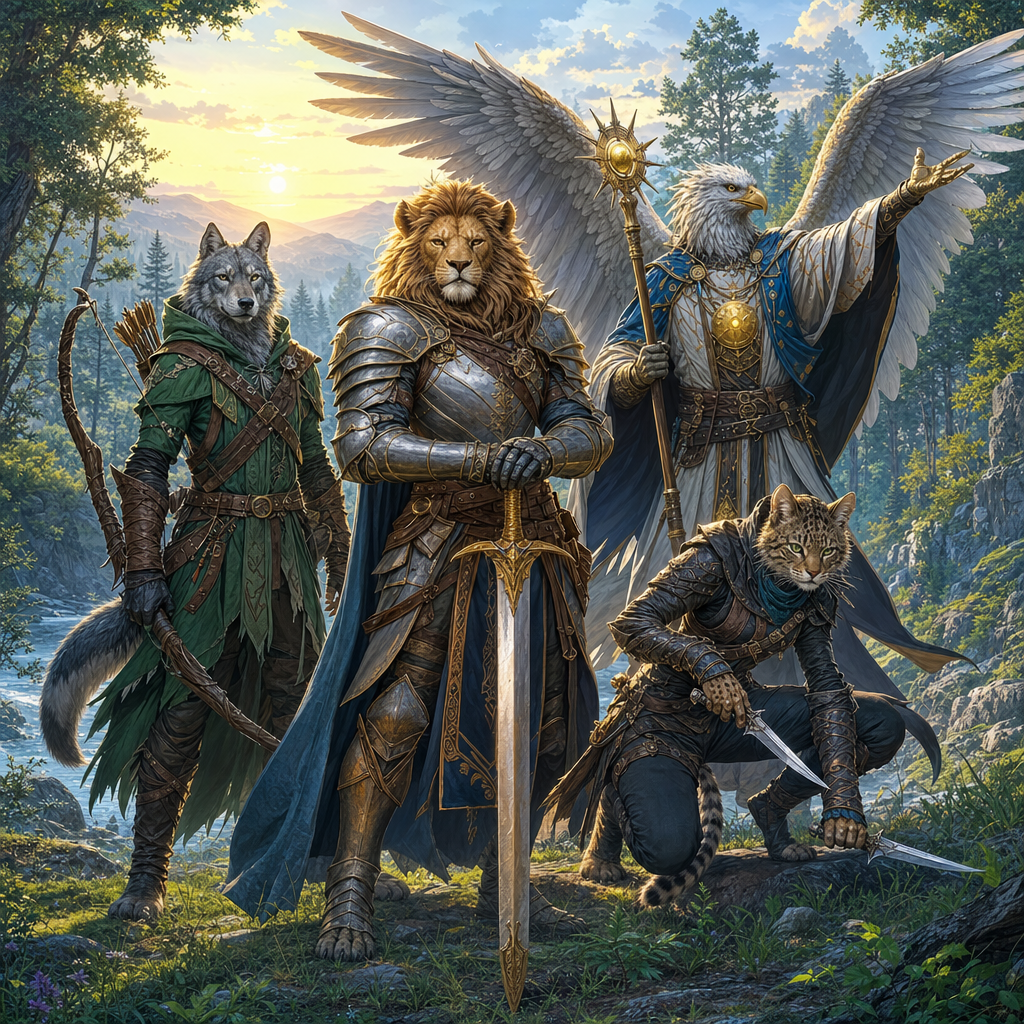
Why DnD 5e Animal Races Matter More Than You Think
I'll be honest: the first time I played a tabaxi, I thought it was just going to be a gimmick. My solo campaign needed a new character after my human fighter met an unfortunate end involving a gelatinous cube and poor spatial awareness. I rolled up a tabaxi ranger named Whiskers—inspired by my barn cat who'd been "helping" me game by sitting on my character sheet—and something clicked.
DnD 5e animal races aren't just reskinned humans with tails. When you lean into their lore, instincts, and cultural backgrounds, they become some of the most memorable characters you'll ever play. Whether you're drawn to the official options in published books or you're eyeing homebrew creations, understanding what makes animal races work will change how you approach character building entirely.
Official Animal Races in D&D 5e
Fifth Edition offers more beast-like player options than any previous version of the game. Here's what's officially available:
Tabaxi: The Wandering Cat-Folk
These feline humanoids from Volo's Guide to Monsters are built for speed and curiosity. With their Feline Agility feature letting them double their movement speed, tabaxi make exceptional scouts, rogues, and monks. But the real gold is in their personality—obsessive curiosity drives them to collect stories, experiences, and treasures. Play a tabaxi if you want a character with built-in motivation to stick their nose into every plot hook.
Leonin: The Lion-Hearted Warriors
Introduced in Mythic Odysseys of Theros, leonin are proud, community-focused warriors with leonine features. Their Daunting Roar ability can frighten enemies, making them natural paladins and fighters. Unlike the solitary tabaxi, leonin think in terms of prides and honor. They're perfect if you want to play strength and nobility without falling into generic "lawful good knight" territory.
Aarakocra: Bird-Folk of the Sky
These avian humanoids can fly at first level, which makes them controversial at some tables but undeniably cool. Aarakocra view the world from above—literally and philosophically. They make incredible rangers and clerics, especially if you play up their alien perspective on ground-dweller problems.
Loxodon: Elephant-Like Wisdom Keepers
From Guildmasters' Guide to Ravnica, loxodon are patient, thoughtful, and surprisingly dexterous despite their size. Their trunk gives them an extra appendage for manipulating objects, and their natural armor means they're tough without heavy equipment. They excel as clerics, druids, and monks who value serenity over aggression.
Tortle: The Wandering Shell-Bearers
Tortles combine natural armor (AC 17 from their shell) with a philosophy of simple living and personal journeys. They're slower than most races but incredibly survivable. I've seen tortle monks absolutely dominate at low levels thanks to that built-in defense.
Lizardfolk: Pragmatic Reptilian Survivors
Often misunderstood as "evil," lizardfolk are actually just radically pragmatic. They don't sentimentalize—dead enemies are potential food, and survival trumps social niceties. Playing one well means thinking like a predator: efficient, practical, and utterly focused on what works. They make fascinating druids and rangers.
Homebrew and Third-Party Animal Races
The official list barely scratches the surface. The D&D community has created animal races for virtually every creature you can imagine:
- Vulpin (Fox-Folk): Clever and charming, perfect for bards and sorcerers who rely on social manipulation
- Lupine (Wolf-Folk): Pack-focused warriors with keen senses and loyalty mechanics
- Corvum (Crow-Folk): Intelligence-based ravens with a knack for collecting secrets
- Minotaur: Bull-headed warriors (technically official in Ravnica and Theros) with charging abilities
- Rabbitfolk (Harengon): Lucky, quick hoppers from The Wild Beyond the Witchlight
When using homebrew, just clear it with your DM first. The best homebrew animal races have cultural depth beyond "it's like humans but with fur"—they should have unique worldviews shaped by their animal nature.
Building Compelling Animal Race Characters
Here's what I've learned from playing and running games with animal races: the mechanics matter less than the roleplay if you want characters people remember.
Let Biology Inform Personality
A tabaxi's curiosity isn't just a trait—it's compulsion. A leonin's pride isn't arrogance—it's cultural identity. When you base character quirks on actual animal behavior, you get believable personalities. My tabaxi ranger couldn't resist investigating sounds in the dungeon, even when it was tactically stupid. That's not bad roleplay—that's a cat being a cat.
Cultural Background Creates Depth
Where did your character grow up? Was your leonin raised in a traditional pride or exiled young? Did your aarakocra grow up among ground-dwellers or in an aerial community? These questions matter more for animal races because their cultures are often radically different from human norms.
Play the Fish-Out-of-Water Moments
Some of the best character moments come from cultural misunderstandings. A loxodon trying to understand why humans lie about their feelings. A lizardfolk confused why the party won't eat the bandits they just killed. These aren't joke characters—they're opportunities to explore what "normal" really means.
Turning Real Animals Into D&D Characters
Last spring, I decided to memorialize my old border collie, Scout, who'd been my constant companion through a decade of late-night gaming sessions. I wanted to create a character that captured her personality—loyal, clever, obsessed with herding the party into formations.
That's when I discovered you could upload an actual photo to Creature Forge AI's character generator and get back a fully-stated D&D character that actually looks like your pet. I uploaded Scout's photo, specified I wanted a lupine ranger, and got back this incredible character sheet complete with abilities themed around her real-life quirks—a herding ability, pack tactics, even a "protective stance" that reflected how she'd always position herself between me and strangers.
It sounds gimmicky until you try it. Playing a character based on a real animal you know intimately gives you instant depth. You already know their personality, their fears, their weird habits. You're not inventing a character—you're translating one.
Mechanical Considerations for Animal Races
Beyond flavor, here's what actually matters at the table:
Ability Score Increases
Most animal races have ability score bonuses that push them toward certain classes. Tabaxi get +2 Dexterity and +1 Charisma—perfect for rogues, bards, and rangers. Leonin get +2 Constitution and +1 Strength—ideal for frontline fighters. Don't fight these too hard unless you're using Tasha's flexible ability scores.
Natural Weapons and Armor
Several animal races come with natural weapons (claws, beaks, horns) or armor (shells, thick hides). These are more useful at low levels than high levels, but they never become useless. A tortle's AC 17 means you can dump Dexterity entirely and focus on other stats.
Unique Movement
Flying (aarakocra), climbing (tabaxi), or swimming speeds can break certain encounters or make them trivially easy. Talk with your DM about how they'll handle this. A good DM will challenge you in ways that make your mobility matter rather than just negating it.
Common Pitfalls to Avoid
After watching players tackle animal races for years, here are the mistakes I see repeatedly:
- Playing them as humans in fursuits: If your tabaxi acts exactly like a human except for saying "meow" occasionally, you're missing the point
- Going full meme mode: Yes, tabaxi are cats. No, that doesn't mean your character is just internet cat videos at the table
- Ignoring party dynamics: A leonin who insists on leading every discussion or a lizardfolk who eats every corpse gets old fast—balance character authenticity with group fun
- Forgetting the world's reaction: In most D&D settings, walking into a human town as a seven-foot-tall elephant person should cause reactions—work with your DM on this
Resources for Animal Race Players
If you're serious about playing animal races well, here's what helps:
- Read the race's lore section, not just the mechanics—it's usually half a page that explains their psychology
- Watch nature documentaries about the real animal—understanding actual wolf pack dynamics makes lupine characters richer
- Browse r/UnearthedArcana for homebrew options, but vet them for balance
- Use character generators to quickly prototype concepts and see how different builds feel
Why This All Matters
Here's the thing about DnD 5e animal races that nobody talks about: they're permission to play personalities that would seem weird on human characters. A human character who's obsessively curious and can't stay on task seems flaky. A tabaxi with the same traits is just being true to their nature. A human who thinks purely in terms of survival pragmatism seems like a sociopath. A lizardfolk with identical behavior is culturally authentic.
Animal races let us explore different ways of thinking, different value systems, different approaches to problems—all while adventuring with friends and rolling dice. That's not a small thing. Some of my most memorable characters have been beastfolk, and some of my players' best roleplay has come from leaning into animal instincts and alien cultures.
My current solo campaign features a vulpin (fox-folk) warlock named Russet who's basically my childhood farm dog Copper translated into fantasy—loyal to a fault, clever about getting into places he shouldn't, and absolutely convinced that every problem can be solved by digging. Would I have thought of that character concept without animal races? Probably not. Does he make every session more interesting? Absolutely.
Getting Started With Your Own Beastfolk Character
If you're ready to build an animal race character that feels real and lived-in, start with these questions: What animal speaks to you? What aspect of their real-world behavior could drive interesting character choices? What would their culture value? And if you want to get really personal—is there a real pet or animal companion whose personality deserves to live on in your campaign?
The tools are there. The lore is rich. And if you want to see what your actual dog would look like as a paladin or your barn cat as a rogue, Creature Forge AI can turn that photo into a full character sheet faster than you can say "initiative roll."
Animal races aren't just alternate character options—they're invitations to think differently about what it means to be a hero, an outcast, a friend, or a survivor in a fantasy world. Give them a shot. Your table will be richer for it, and you might discover that playing a wolf-folk ranger teaches you something about loyalty that your human fighter never could.