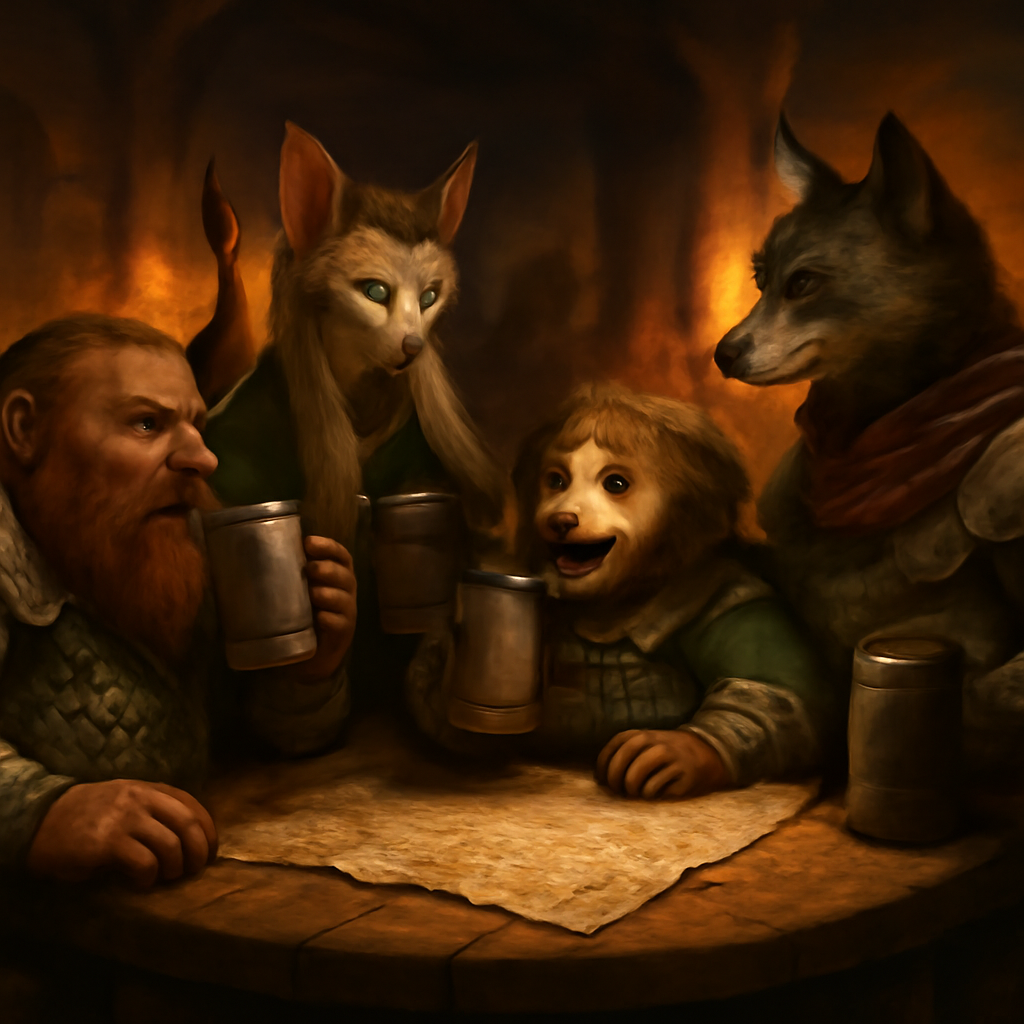
Why Your First Race Choice Matters (But Not As Much As You Think)
When I rolled my first solo character on a Tuesday night three years ago—coffee going cold, my border collie snoring at my feet—I spent forty minutes paralyzed by the Player's Handbook. Tieflings, dragonborn, half-orcs, genasi… the options felt overwhelming. I wanted to play, not audit a fantasy genetics course.
Here's what I wish someone had told me then: the best D&D races for beginners aren't necessarily the "coolest" or most exotic. They're the ones with straightforward mechanics, clear identity, and abilities that actually matter at the table. They let you focus on storytelling, character development, and learning the game—not on managing a dozen conditional modifiers.
After hundreds of hours of solo play and more character sheets than I care to count, I've learned which races work brilliantly for new players. Let's break them down.
What Makes a Race "Beginner-Friendly"?
Before we dive into specific recommendations, let's establish criteria. A good beginner race should offer:
- Simple, always-relevant bonuses — passive ability score increases you don't have to remember to activate
- Few conditional abilities — powers that work consistently, not just "when the moon is full and you're standing in dim light"
- Clear narrative identity — you know who this character is without reading three sourcebooks
- Mechanical forgiveness — features that help you survive those inevitable newbie mistakes
The Top Five Best D&D Races for Beginners
1. Human (Variant)
Humans are the vanilla ice cream of D&D races, and I mean that as the highest compliment. Vanilla is classic for a reason.
The Variant Human gives you a +1 to two ability scores of your choice, one skill proficiency, and—here's the kicker—a feat at first level. That feat lets you customize your character's capabilities right out of the gate without needing to understand complex racial traits. Want to be lucky? Take Lucky. Want to hit harder? Take Great Weapon Master (eventually). Want to never lose concentration on a spell? War Caster.
Humans also have zero weird biology to track. No darkvision range limits, no sunlight sensitivity, no "you can breathe underwater but only for an hour." You're just… a person. Trying to adventure. Maybe wondering why you left the farm.
Speaking of which: I once uploaded a photo of my grumpy barn cat Murphy to Creature Forge AI's character generator, and it created this perfect Tabaxi rogue with Murphy's exact attitude—whiskers, scowl, and all. But when I was truly starting out? I played humans. They let me learn the game without adding layers of complexity.
2. Dwarf (Hill or Mountain)
Dwarves are beginner-friendly tanks. You get:
- +2 Constitution (more hit points—you will appreciate this when a goblin crits you)
- Darkvision (60 feet of "I can see in the dark" utility)
- Resistance to poison damage and advantage on saves against poison (poison is everywhere in low-level adventures)
- Proficiency with common weapons and tools
Hill dwarves get +1 Wisdom and an extra hit point per level. Mountain dwarves get +2 Strength and light/medium armor proficiency. Both are excellent. Both are hard to kill. Both give you room to make tactical errors while you're learning.
Dwarves also have clear personality hooks: stubborn, loyal, obsessed with craft and clan. You don't need a backstory seminar. You know who this character is.
3. Halfling (Lightfoot)
Halflings are small, cheerful, and mechanically brilliant for beginners because of one feature: Lucky.
When you roll a natural 1 on an attack roll, ability check, or saving throw, you can reroll the die and must use the new roll. This is a safety net for new players who will absolutely roll 1s at the worst possible moments. (I rolled three nat 1s in a single combat encounter during my second session. My halfling bard survived. A half-orc probably wouldn't have.)
You also get +2 Dexterity and advantage on saves against being frightened. Lightfoot halflings add +1 Charisma and the ability to hide behind larger creatures—perfect for rogues, bards, or anyone who doesn't want to be in the front line.
Narratively, halflings are accessible. They're hobbits. Everyone understands hobbits. You like comfort, second breakfast, and staying out of trouble (but you're here anyway because of Reasons). Simple. Effective.
4. Elf (High or Wood)
Elves give you a taste of the magical and unusual without overwhelming complexity.
All elves share these traits:
- +2 Dexterity (great for almost any class)
- Darkvision (60 feet)
- Advantage on saves against being charmed
- Immunity to magical sleep
- Trance instead of sleep (only need 4 hours of rest—useful in solo play when you're managing watch schedules)
- Perception proficiency
High elves get +1 Intelligence, one wizard cantrip, and proficiency with longswords and bows. Wood elves get +1 Wisdom, faster movement speed, and the ability to hide in light natural phenomena like rain or falling leaves.
Both are strong. Both have abilities you'll use regularly without needing to reference the rulebook every turn. Wood elves edge ahead for raw simplicity, but high elves give you a little magic to experiment with.
5. Dragonborn
Dragonborn almost didn't make this list—they're slightly more complex than the others—but they earned their spot because they're cool and new players want to feel cool.
You get +2 Strength, +1 Charisma, and a breath weapon you can use once per rest. The breath weapon scales with your level (so it stays relevant), and it's simple: pick your dragon ancestry (fire, cold, lightning, etc.), then breathe that damage type in a cone or line.
The catch: you'll need to remember when you've used your breath weapon and what damage type you chose. But if you can handle that, dragonborn deliver the fantasy of being a dragon-person without burying you in conditional modifiers.
You also get resistance to your chosen damage type. If you're a gold dragonborn, fire can't hurt you as badly. Straightforward. Thematic. Fun to describe at the table (or in your solo journal).
Honorable Mentions
Half-Elf
Half-elves are mechanically fantastic (+2 Charisma, +1 to two other scores of your choice, multiple skill proficiencies) but narratively a little vague. "I'm half one thing and half another" works great for experienced players building nuanced characters. For beginners, it can feel like homework. Still, if you're drawn to a face character (bard, sorcerer, warlock, paladin), half-elves are nearly perfect.
Goliath
Big, strong, and simple. Goliaths get +2 Strength, +1 Constitution, and a once-per-rest ability to reduce damage taken. They're basically dwarves who decided to get taller. If you want to smash things and not die, goliath works—but they're less versatile than the top five.
Races to Avoid As a Beginner
Some races are genuinely complex or situational. I'd skip these until you've got a few sessions under your belt:
- Kenku — can't speak normally, only mimic sounds (this is a fascinating roleplaying challenge but brutal for new players)
- Yuan-Ti Pureblood — mechanically powerful but narratively dense; you're a snake person with spell resistance and innate spellcasting
- Aarakocra — flight at first level is strong but can break early adventures; also, your DM might ban them
- Genasi (any subtype) — four different versions with different abilities; cool but homework-heavy
Matching Race to Class (Quick Guide)
If you've already chosen your class and need a complementary race:
- Fighter, Barbarian, Paladin: Dwarf (mountain), Dragonborn, Human
- Rogue, Ranger, Monk: Elf (wood), Halfling (lightfoot), Human
- Wizard, Sorcerer: Elf (high), Human, Half-Elf
- Cleric, Druid: Dwarf (hill), Elf (wood), Human
- Bard, Warlock: Half-Elf, Halfling, Human
Notice how often "Human" appears? There's a reason.
A Note on Narrative Versus Mechanics
Here's the truth I learned after my fifth or sixth character: the "best" race is the one that excites you narratively. If you're genuinely drawn to tieflings because you love the horns-and-tail aesthetic and the outcast storyline, play a tiefling. You'll figure out the mechanics because you care about the character.
But if you're feeling overwhelmed and just want to start playing? Stick with this list. These races are training wheels that don't feel like training wheels. They're legitimately strong, flavorful, and forgiving.
I keep a notebook of every character I've ever rolled—names, races, classes, the works. About sixty percent are humans, dwarves, or halflings. Not because the exotic options aren't fun, but because sometimes simple is fun. My favorite character ever was a hill dwarf cleric named Magda who had absolutely no patience for nonsense. She was mechanically straightforward and narratively unforgettable. That's the sweet spot.
Build Your Character the Easy Way
If you're ready to create your first character, you don't need to do it alone with just a handbook and hope. Creature Forge AI makes character creation fast and visual—you can even upload a photo of yourself, a friend, or a pet and turn them into a fully realized D&D character. I've used it to immortalize my chickens as a squad of halfling rangers. (Henrietta has surprisingly good Dexterity.)
The tool handles the mechanical heavy lifting—stats, abilities, gear—while you focus on story and personality. It's perfect for beginners who want to skip the spreadsheet phase and get to the adventure.
Final Thoughts: Pick Simple, Play Bold
The best D&D races for beginners are the ones that let you be a hero without needing an advanced degree in game mechanics. Humans, dwarves, halflings, elves, and dragonborn all deliver strong, clear identities with abilities that matter from level one to level twenty.
Choose one. Name them. Give them a reason to leave home (or the barn, or the mountain, or the cozy halfling burrow). Then roll initiative.
You'll figure out the rest as you go. That's the best part.