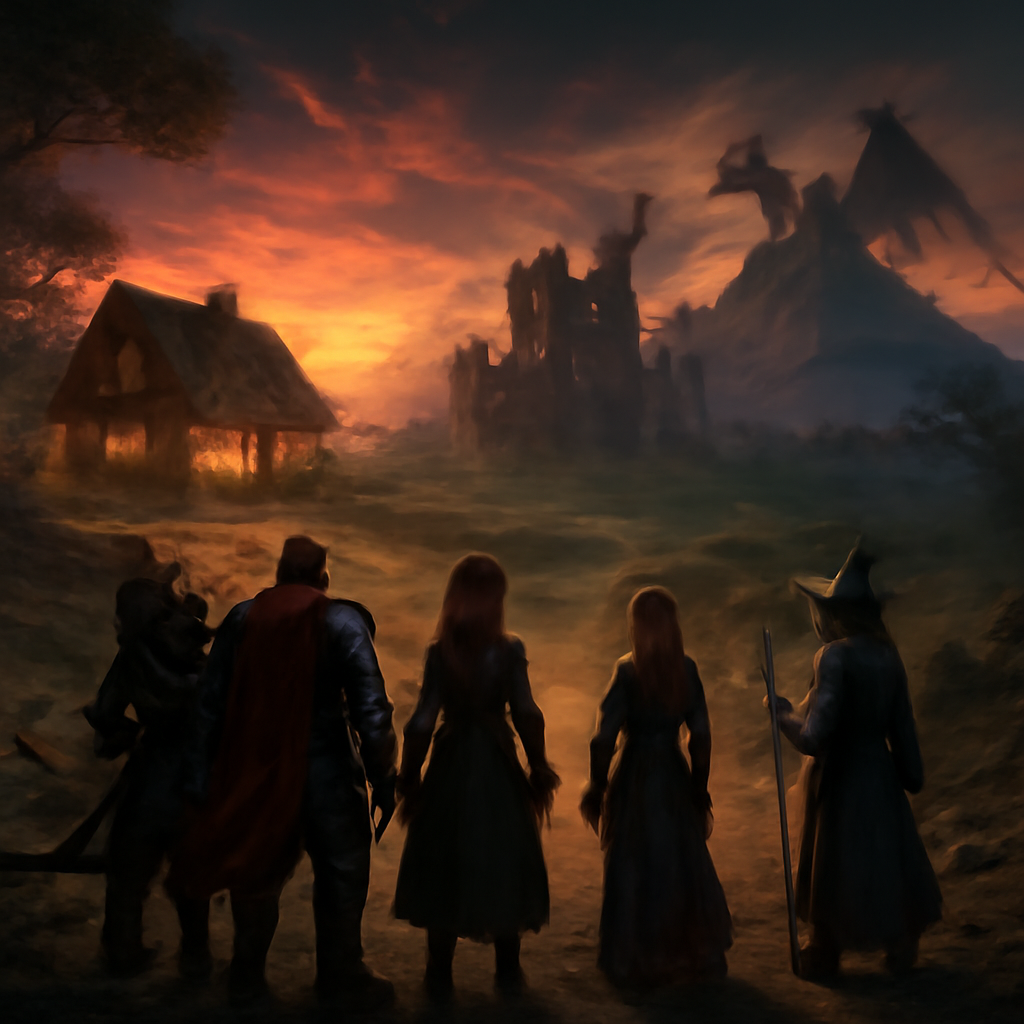
Why One-Shots Hit Different
I ran my first D&D one shot on a Tuesday night when my regular campaign fell through. Three players, two hours, and a half-baked idea about a missing wedding cake. By the time we wrapped at midnight, we'd accidentally created a noir mystery involving a jealous gnome baker, a love triangle, and my border collie Murphy reimagined as a Tabaxi ranger with a suspicious obsession with butter. It was chaos. It was perfect. And it taught me something: the best D&D one shot ideas aren't the ones with the most complex plots—they're the ones that give you a complete story in the time you actually have.
One-shots are beautiful because they're self-contained. No dangling plot threads. No "we'll pick this up in three weeks." You start, you adventure, you end. Players leave satisfied. It's like the perfect short story instead of committing to a whole novel series when you've got a busy week ahead.
The Heist: High Stakes, Low Prep
Here's the structure that never fails me: the party needs to steal something valuable from somewhere dangerous, and they have limited time to plan. That's it. That's the whole concept.
The Setup: A mysterious patron (I usually make them slightly untrustworthy) hires the party to steal an artifact, a document, or a person from a heavily guarded location. Maybe it's a noble's manor during a masquerade ball. Maybe it's a dragon's hoard while the dragon is out hunting. Maybe it's breaking someone OUT of jail instead of into somewhere.
Why this works: Players get to be clever. They scout, they plan, they improvise when everything goes sideways—and it always goes sideways. You can run the whole thing in three acts: Planning (20 minutes), The Heist (60-90 minutes), and The Escape (30 minutes).
Pro tip: Create three different entry points and let players choose their approach. The front door (social), the back window (stealth), or the underground tunnel (combat). Prep light complications for each route, then let player choices determine which obstacles matter.
Complications That Complicate Good
- A rival thief crew is attempting the same heist simultaneously
- The artifact is cursed and starts affecting whoever's carrying it
- The patron lied about what they're actually stealing
- An innocent guard who's just trying to do their job really well
The Murder Mystery: Everyone's a Suspect
Lock your players in a mansion, a train, or a remote monastery with a fresh corpse and a handful of NPCs who all have secrets. This is my go-to when I have newer players because it teaches investigation, roleplay, and consequence all at once.
The Formula: Someone important is dead. The authorities can't arrive until morning (snowstorm, magical barrier, sea voyage—pick your poison). The killer is definitely one of the five NPCs present. Create each NPC with: a secret they're hiding, a motive for murder, and an alibi that's almost-but-not-quite airtight.
The beautiful thing about murder mysteries is you can decide who the actual killer is AFTER you see which NPC your players latch onto. Yes, this is cheating. No, I don't care. The story that emerges from player investigation is better than the one you pre-plan.
NPCs That Work Every Time
- The grieving spouse (red herring—too obvious)
- The business partner who benefits from the death
- The servant who knows everything but says little
- The family member who's hiding a relationship to the victim
- The outsider who arrived just before the murder (this is often my actual killer)
I learned this structure running solo sessions late at night—you, a notebook, some dice, and a dog who judges your plot twists. My old hound Biscuit had more common sense than half the detectives I've created, and she once knocked over my dice tower right when I was about to reveal a clue, which honestly improved the pacing.
The Arena: Straightforward and Satisfying
Sometimes players just want to hit things with swords, and that's valid. An arena one-shot delivers pure tactical combat with built-in stakes and a clear win condition.
Three-Round Structure:
- Round One: Warm-up fight against something easy—goblins, animated armor, a very confident chicken (okay, maybe not that last one)
- Round Two: The challenge fight—another adventuring party, a puzzle-combat hybrid, enemies with interesting mechanics
- Round Three: The showstopper—a monster way above their level, but give them environmental advantages (ballistas, traps, magical hazards they can trigger)
Between rounds, let them shop at vendor stalls, get healed by clerics (for a price), or gather information about their next opponent. This gives you natural breaks and lets players catch their breath.
The secret sauce: make the arena organizer memorable. They should be announcing fights with dramatic flair, taking bets, and reacting to player creativity. When my players used Mold Earth to create a pit trap during round two, my announcer (a retired halfling barbarian named Crash) completely lost his mind with excitement. Suddenly the crowd was chanting. Stakes elevated.
The Escort Mission (But Make It Good)
Yes, escort missions get a bad reputation. But flip the script: what if the person they're escorting is MORE capable than the party, but cursed/injured/bound by oath not to fight?
Escort a powerful wizard whose magic is temporarily sealed. Protect a reformed villain traveling to stand trial who COULD defend themselves but has sworn not to use violence. Guard a prince who's secretly far more competent than he appears but is playing weak for political reasons.
The journey should have three distinct encounters: a combat, a social challenge, and an environmental hazard. The key is making the VIP interactive—they comment, they have opinions, they make the party's job harder with their personality while simultaneously making the STORY more interesting.
The Time Loop: Groundhog Day at the Table
The party wakes up in a tavern. They have one day to stop a catastrophe—a dragon attack, an assassination, a ritual—but every time they fail (or succeed wrong), the day resets. This is phenomenal because players learn from each loop, and you can reuse the same NPCs and locations with slight variations.
Loop Structure:
- Loop 1-2: Players figure out something's wrong and gather information
- Loop 3-4: They attempt solutions that fail in interesting ways
- Loop 5: Armed with everything they've learned, they execute the perfect plan (or a gloriously imperfect one that somehow works)
The trick is each loop should be shorter than the last because players skip what they already know. Loop one might take 45 minutes. Loop five might take 15 because they're speedrunning to the important parts.
The Wholesome One: Not Every Adventure Needs Violence
Here's my dark horse pick for best D&D one shot ideas: no combat at all. The party is hired to run a festival, investigate why crops are failing (it's not monsters, it's a water rights dispute), or reunite a lost pet with its owner across a city where they don't speak the language.
Last month I ran a session where the party had to convince a stubborn goat to come down from a cliff before a storm hit. That goat had more personality than some dragons I've run. They tried food (failed), intimidation (goat laughed at them), and finally an Animal Handling check where the ranger just... talked to it about feeling stuck and scared. It was ridiculous and heartfelt and nobody rolled initiative once.
These sessions work because they're LOW stakes but HIGH heart. Perfect for introducing new players or cleansing the palate after a brutal campaign.
Quick Tips for Any One-Shot
Start in Media Res
Don't waste time on "you meet in a tavern." Start with the tavern on fire, the artifact already stolen, the dragon LANDING in front of them. You can flash back to explain how they got here after the hook is set.
Pre-Generated Characters Save Lives
Offer pre-gens with built-in connections to each other and the plot. Or if your players are bringing their own characters, create them ahead using a generator that speeds up the process. I've been using Creature Forge AI's character builder lately—you can even upload photos of pets or people and it'll create a fantasy version that actually looks like them. Turned my childhood dog into a Lupine paladin last week and I'm still not over how perfect it was.
Have a Clear End Condition
Players should know what "winning" looks like from the start. Steal the crown. Solve the murder. Survive until dawn. Defeat the champion. Clear goals mean clear satisfaction when they succeed.
Build in Multiple Paths to Success
If there's only ONE way to solve your mystery or heist, that's not a one-shot—that's a railroad with prettier scenery. Give them options. Reward creativity. Let them surprise you.
When You Need NPCs Fast
The biggest time-sink in prep is creating memorable NPCs with personality and stats. You need them, but you don't need to spend three hours on each one. Quick generators help—I keep NPC creation tools bookmarked for when I need a shopkeeper, guard captain, or rival adventurer on the fly. The photo upload feature means I can base characters on actual people or animals, which gives them instant personality in my head.
Make It Yours
The best D&D one shot ideas aren't the ones you find in a book—they're the ones you steal from three different sources and Frankenstein together with your own weird touches. Take the heist structure, add the murder mystery's investigation, set it in an arena during a time loop. Sure, why not? It's your table.
One-shots are permission to experiment. They're where you test wild ideas without committing to twenty sessions. They're where you discover that your players will spend forty-five minutes negotiating with a goat and love every second.
Ready to build your next one-shot? Creature Forge AI can help you populate it with monsters, NPCs, and characters faster than you can say "roll for initiative"—including that feature where you upload a photo and watch your real-life pet become an adventurer. Because honestly? Your cat probably has more charisma than most PCs anyway.
Now go forth. Run something weird. End before midnight. Leave them wanting more.