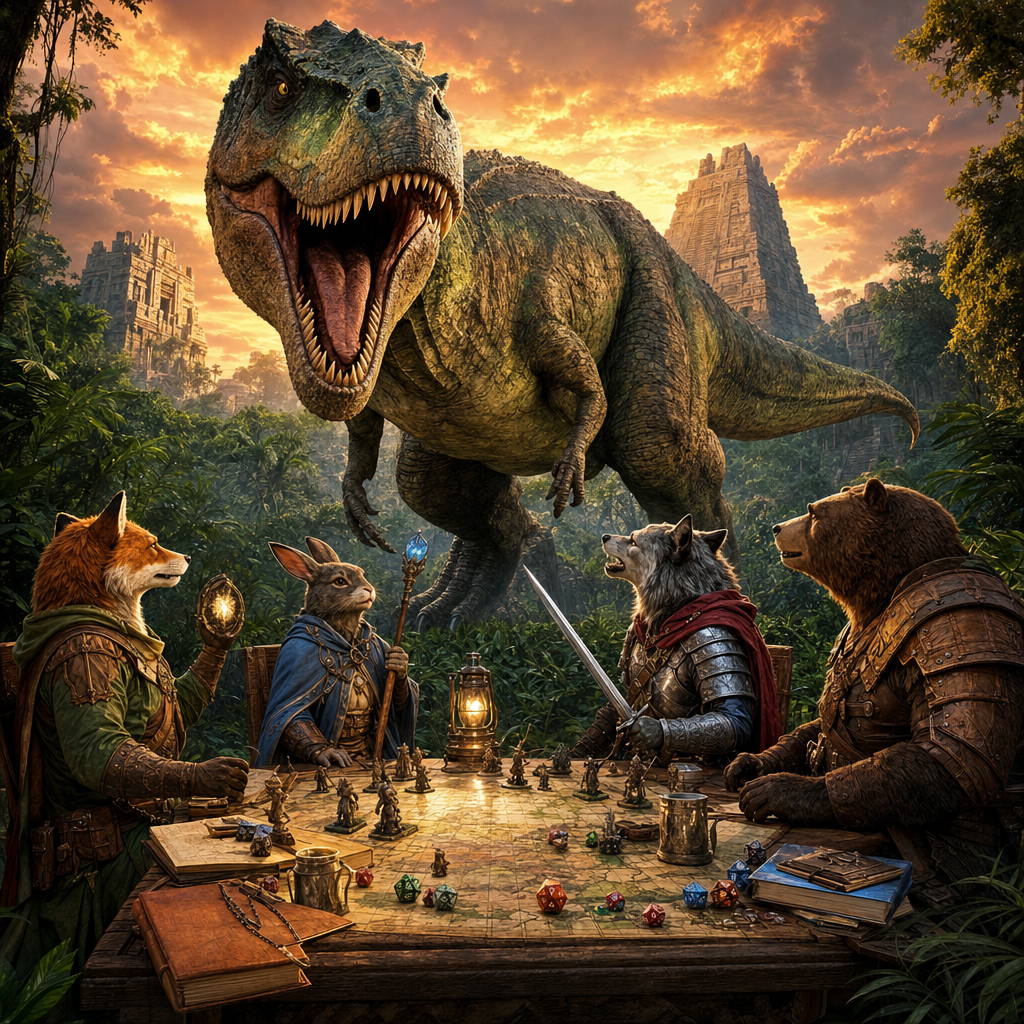
I'll be honest: the first time I threw dinosaurs at my solo ranger character, I expected a straightforward combat. What I got was three sessions of paranoid jungle survival, failed Perception checks, and a Velociraptor ambush that still haunts me. Turns out the best dinosaurs for a D&D encounter aren't just the biggest ones—they're the ones that change how your players think, move, and plan.
Dinosaurs offer something most monsters don't: primal recognition. Everyone knows what a T-Rex does. That instinctive fear makes them perfect for encounters that feel dangerous even before you roll initiative. But picking the right dinosaur for the right moment? That takes some thought.
Why Dinosaurs Work So Well in D&D
Dinosaurs occupy a weird sweet spot in tabletop encounters. They're not magical. They're not evil. They're just hungry, territorial, or protecting their young—which makes them believable threats. You don't need a villain's monologue or a complex motivation. A dinosaur sees the party, decides they look like food or a threat, and acts accordingly.
That simplicity is powerful. It lets you focus on terrain, tactics, and tension instead of exposition. Plus, dinosaurs fit almost anywhere: jungles, islands, lost valleys, wildlands touched by primal magic, even the Underdark if you want to get weird with it.
The Best Dinosaurs for a D&D Encounter (By Situation)
Here's the thing: not every dinosaur serves the same purpose. A Stegosaurus creates a completely different encounter than a pack of Deinonychus. Let's break it down by what you actually want to accomplish at the table.
For Pack Tactics and Paranoia: Velociraptor (CR ¼) or Deinonychus (CR 1)
If you want your players constantly checking over their shoulders, go with pack hunters. Velociraptors are the scrappy entry-level option—CR ¼ means you can throw a whole pack at low-level parties without ending the campaign. They get Pack Tactics, so they're rolling with advantage as long as they swarm together, and their 30-foot speed means they will chase down stragglers.
Deinonychus are the scarier cousins. CR 1, bigger claws (2d6+3 slashing with Pounce), and the same Pack Tactics advantage. I used these in a jungle hex crawl and my ranger burned through all her arrows trying to keep them at range. They circled. They waited. They attacked from three sides at once. It was beautiful.
Encounter tip: Use dense jungle or rocky terrain with lots of hiding spots. Have the pack make Stealth checks. Let players hear rustling in the undergrowth before they see teeth. The fear is in the anticipation.
For "Oh No" Moments: Allosaurus (CR 2)
The Allosaurus is your mid-tier apex predator. CR 2 makes it a legitimate threat to parties around levels 3–5, but not an instant TPK. It's got a solid Bite attack (2d10+4 piercing) and Pounce, which knocks targets prone and lets it claw them as a bonus action if they fail a Strength save.
What I love about the Allosaurus is the "oh no" moment when players realize they've wandered into its territory. It's big enough to be scary but not so overwhelming that retreat feels impossible. You can build an entire encounter around tracking it, setting traps, or luring it away from something the party needs.
Encounter tip: Have it show up mid-combat with something else. The party's fighting lizardfolk, getting confident, then this thing crashes through the trees because it heard the noise and wants in on the action.
For Absolute Chaos: Tyrannosaurus Rex (CR 8)
Look, if you're putting a T-Rex in an encounter, you're not subtle. You're saying, "This is a big deal." CR 8 means this is a serious challenge for a party of four 8th-level characters—or an unforgettable "run for your lives" moment for lower levels.
The T-Rex's Bite is horrifying (4d12+7 piercing plus grapple), and it can swallow creatures whole if they're Medium or smaller. I watched my solo barbarian get swallowed, spend two rounds cutting his way out from the inside, and emerge covered in acid burns and dinosaur bile. He still talks about it.
The best T-Rex encounters aren't always about fighting it. Sometimes it's about escaping it. Or distracting it. Or realizing mid-fight that the villain you're chasing just woke it up on purpose.
Encounter tip: Give it a reason to be there. Maybe it's guarding a nest. Maybe it's been magically controlled and breaks free mid-scene. Let the environment tell the story—toppled trees, massive footprints, half-eaten megafauna.
For Environmental Hazards: Ankylosaurus (CR 3) or Triceratops (CR 5)
Not every dinosaur encounter needs to be a predator. Ankylosaurus is basically a walking tank—AC 15, 68 hit points, and a tail attack (4d6+4 bludgeoning) that can wreck your day. It's not hunting the party. It's just in the way. Or the party startled it. Or some bandits are using it as a living siege weapon.
Triceratops is the next step up: CR 5, with a Trampling Charge that deals 5d6 bludgeoning and can knock creatures prone. Imagine the party trying to cross a valley and suddenly there's a herd of Triceratops stampeding because something spooked them. Now it's not about fighting—it's about not getting trampled.
Encounter tip: Use these for dynamic environments. Collapsing bridges, narrow canyons, fragile rope bridges over ravines. The dinosaur isn't the villain—it's the obstacle. And obstacles can be redirected, avoided, or (if your party's creative) weaponized.
For Aquatic Ambushes: Plesiosaurus (CR 2)
Water encounters are tricky, but a Plesiosaurus makes them memorable. CR 2, decent hit points, and a solid Bite attack (3d6+4 piercing). It's not going to one-shot anyone, but it will drag a PC underwater if they're not careful, and suddenly your wizard's trying to hold their breath while casting.
I used one in a river crossing encounter once. The party thought they were safe on a raft until something bumped it from below. Cue panicked Perception checks, someone falling in, and the ranger trying to shoot into murky water. It wasn't deadly—it was tense, which is sometimes better.
Encounter tip: Combine it with environmental pressure—rapids, a ticking clock, limited visibility. The Plesiosaurus doesn't need to kill anyone; it just needs to make the party's lives difficult.
Making Dinosaur Encounters Actually Memorable
Here's the secret: the best dinosaur encounters aren't about stat blocks—they're about behavior. Dinosaurs aren't mindless monsters. They're animals. They flee when injured. They protect their young. They get distracted by easier prey.
Some tips I've picked up from solo play and way too many nature documentaries:
- Give them a reason to be there. Nesting ground. Watering hole. Migration route. Territory dispute with another predator. Context makes the encounter feel real.
- Use the environment. Dinosaurs interact with their surroundings. They knock over trees. They leave tracks. They make noise. Let the party hear the encounter before they see it.
- Let the party be clever. If your ranger wants to use Animal Handling to calm a spooked herbivore, let them try. If the rogue wants to set a trap using bait, reward creativity. Dinosaurs aren't tactical geniuses—they can be outsmarted.
- Vary the threat level. Not every dinosaur needs to be hostile. Maybe the party encounters a docile Brachiosaurus and has to figure out how to get past it without startling it. Low stakes, high tension.
Turning Real Creatures Into D&D Characters
This is where things get fun. I grew up on a farm, and I've always thought my animals would make incredible D&D characters. My border collie Scout? Definitely a ranger with Pack Tactics. My goat Biscuit? Barbarian. No question.
If you've ever looked at your pet and thought, "They'd be amazing in a campaign," you're not alone. One of the coolest things about Creature Forge AI is you can actually upload a photo of a real pet or person and it'll generate a full fantasy character that looks like them—stats, backstory, artwork, the whole thing. I tried it with a photo of Scout and got a lupine ranger with her exact coloring and that intense stare she gets when she's working. It was unsettling in the best way.
You can do the same thing with dinosaurs, honestly. Need a unique Velociraptor with a scar and a grudge? Generate it. Want a T-Rex as a druid's wild shape form? Done. It's the kind of tool that makes worldbuilding feel less like homework and more like play.
Final Thoughts: Pick the Dinosaur That Tells the Story
The best dinosaurs for a D&D encounter aren't necessarily the strongest or the scariest—they're the ones that fit the moment. A pack of Velociraptors teaches players to watch their backs. An Allosaurus raises the stakes. A T-Rex becomes a legendary story your group tells for years.
Think about what you want the encounter to do. Build tension? Test teamwork? Force a retreat? Create a memorable "oh crap" moment? Let that guide your choice, then layer in terrain, behavior, and context to make it feel alive.
And if you're stuck for inspiration—or you just want to see what a dinosaur-inspired character looks like with full stats and art—try out Creature Forge AI's monster generator. Upload a photo, tweak the details, and let the tool surprise you. Sometimes the best encounters come from the ideas you didn't plan.
Now go make your players afraid of the jungle. They'll thank you later.