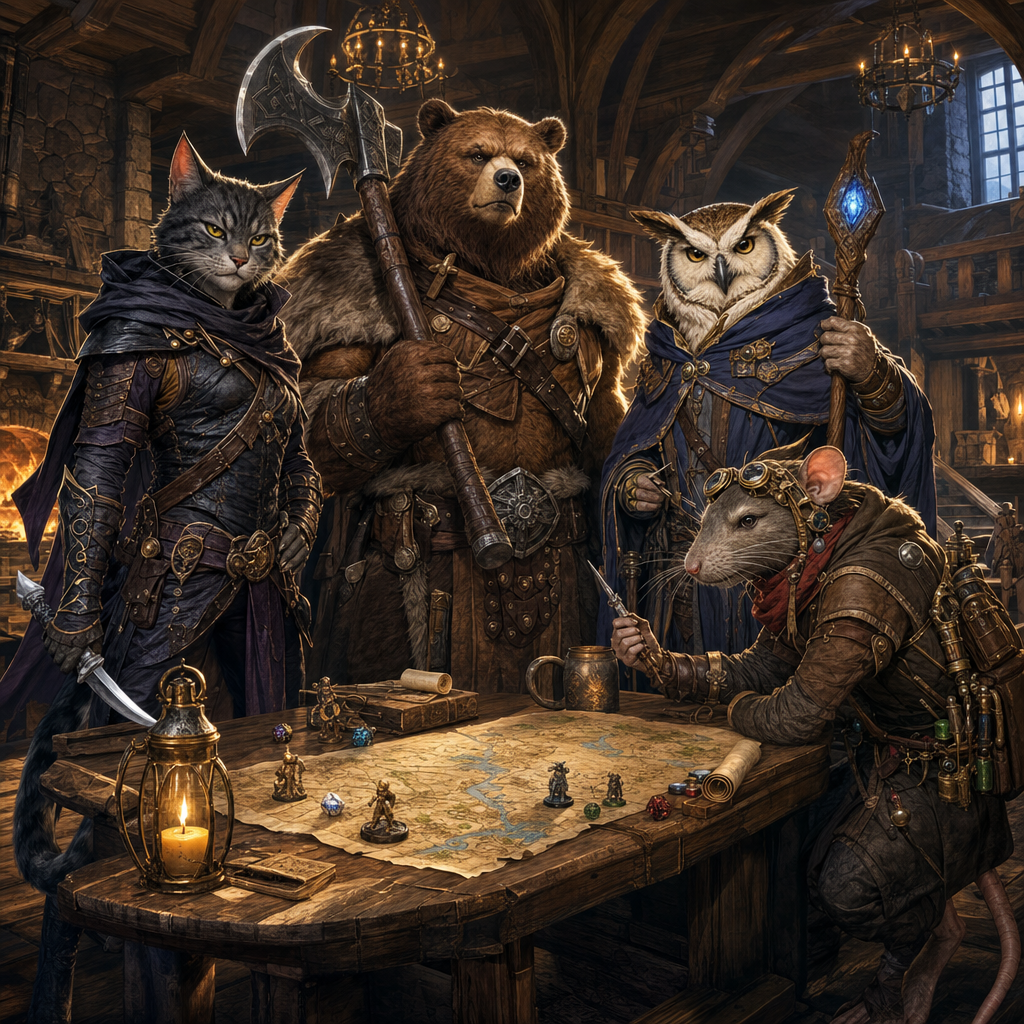
I've always been surrounded by animals. Growing up on a farm meant waking up to roosters, feeding goats before breakfast, and dodging the barn cat who thought she owned the place. So when I discovered that D&D had animal races—actual playable beastfolk—it felt like coming home. The first time I rolled up a Tabaxi ranger based on our barn cat Pepper, complete with her attitude problem and uncanny ability to appear exactly where she wasn't wanted, I knew I'd found something special.
Animal races in DnD open up a world of creative possibilities. Whether you're drawn to the sleek cunning of catfolk, the fierce loyalty of lupine Shifters, or the aerial grace of Aarakocra, these races offer more than just mechanical benefits—they bring personality, flavor, and a different perspective to your campaigns.
What Are Animal Races in D&D?
In D&D terms, "animal races" typically refers to the various beastfolk or animalistic humanoid races available as player character options. These aren't literal animals—they're bipedal, sapient beings with animal features, capable of wielding weapons, casting spells, and engaging in all the activities adventurers do.
The distinction matters: these races have hands, speak languages, and integrate into society (even if that integration is sometimes awkward). They're not your ranger's animal companion or a druid's wild shape—they're fully realized people who happen to have fur, feathers, or scales.
Popular Animal Races in 5th Edition
Tabaxi: The Feline Wanderers
Tabaxi are catfolk driven by curiosity and wanderlust. They get Feline Agility (a burst of speed once per combat) and climb speeds that make them natural scouts and skirmishers. Perfect for rogues, monks, or rangers who want to dart in and out of danger.
Personality-wise, Tabaxi are collectors of stories and experiences. They're restless, inquisitive, and often surprisingly social despite the cat stereotypes. I played a Tabaxi bard once who couldn't resist investigating every locked door—it drove the party wizard crazy, but it also saved us from three separate ambushes.
Kenku: The Corvid Mimics
Kenku are crow-like beings cursed to speak only through mimicry—they can't create new sounds, only repeat what they've heard. This quirk makes them challenging but incredibly rewarding to roleplay. They gain proficiency in two skills and can mimic sounds and voices with perfect accuracy.
The speech limitation isn't just a gimmick. It forces creative problem-solving and leads to genuinely funny moments. A Kenku rogue in one of my solo campaigns communicated entirely through snippets of overheard tavern conversations—"Another round!" meant yes, "The King's justice!" meant danger.
Aarakocra: The Bird People
Aarakocra are avian humanoids with a 50-foot fly speed at first level—powerful, but potentially campaign-breaking. Many DMs restrict them for this reason. They're excellent as rangers, druids, or clerics, bringing an aerial perspective to exploration and combat.
Their society values freedom and isolationism, making them natural outsiders in ground-based campaigns. That fish-out-of-water element creates rich roleplaying opportunities.
Shifter: The Lycanthropic Heritage
Shifters are humanoids with lycanthropic ancestry—not quite werewolves, but carrying that beast within. They can "shift" as a bonus action, gaining temporary hit points and additional abilities based on their subrace (Beasthide, Longtooth, Swiftstride, or Wildhunt).
Mechanically solid for barbarians, fighters, and rangers. Thematically, they offer internal conflict—the struggle between civilization and the wild calling.
Tortle: The Turtle Folk
Tortles are exactly what they sound like: turtle people. They get a natural AC of 17 (no armor needed) and can withdraw into their shells for defense. Slow movement speed, but that defensive capability makes them fantastic for strength-based clerics or druids.
Roleplaying-wise, Tortles are often portrayed as wise, patient, and deeply connected to nature. Think less "teenage ninja" and more "wandering monk seeking enlightenment."
Lesser-Known Animal Races Worth Exploring
Beyond the popular options, there are some deep cuts that deserve attention:
- Loxodon: Elephant people from Ravnica with natural armor and a trunk they can use for manipulation. Incredible for clerics and paladins.
- Hadozee: Gliding simian folk from Spelljammer who can glide between elevated positions—perfect for swashbuckling campaigns.
- Harengon: Rabbit-like folk introduced in The Wild Beyond the Witchlight, with proficiency bonus to initiative and the ability to escape grapples as a bonus action.
- Owlin: Owl-like beings with flight speed and darkvision, offering a more balanced alternative to Aarakocra.
Creating Custom Animal Races Based on Real Pets
Here's where things get personal. My border collie, Scout, has more personality than most NPCs I've written. She's intelligent, obsessive about herding (even when there's nothing to herd), and has this intense stare that could intimidate a dragon. Naturally, I wanted to play her in a campaign.
The beauty of modern tools is that you don't have to homebrew everything from scratch anymore. Creature Forge AI's character generator lets you upload an actual photo of your pet and generates a D&D character that captures their look and essence. I uploaded a picture of Scout, selected "canine" traits, and got back a Shifter ranger with pack tactics abilities and an obsessive focus on protecting her party members—perfect.
If you're homebrewing manually, start with these steps:
- Identify core traits: What makes this animal special? Speed? Strength? Senses? Special abilities like climbing or swimming?
- Find a similar official race: Use it as a baseline. Want to play a fox? Start with Tabaxi and adjust.
- Balance abilities: Keep it roughly equivalent to existing races. Flight is powerful; low-light vision is common. Don't stack too many strong features.
- Add personality hooks: What cultural or behavioral traits define this race? These matter more than mechanics for memorable characters.
Roleplaying Animal Races Effectively
The mechanical benefits are easy—the roleplaying is where these races shine or fall flat. Here are some principles I've learned:
Lean Into Animal Behaviors (But Don't Overdo It)
Your Tabaxi can be curious and sometimes aloof without constantly licking her paws. Your Kenku can collect shiny objects without being a kleptomania caricature. Find one or two signature behaviors and use them sparingly for flavor.
Consider the Society
How does the world treat beastfolk? Are they common or exotic? Trusted or feared? This context shapes your character's worldview and interactions. A Kenku in a city where they're common merchants has a very different experience than one in a human kingdom where they're seen as cursed thieves.
Respect the Table
Some players find animal races immersion-breaking. Some DMs restrict them for setting reasons. Have the conversation before bringing a penguin paladin to a gritty low-fantasy campaign. Flexibility beats stubbornness every time.
Multiclassing and Build Considerations
Animal races often have mechanical synergies that make certain multiclass combinations particularly effective:
- Tabaxi Rogue/Monk: Stack movement abilities for ridiculous mobility. Feline Agility plus Monk speed equals hit-and-run perfection.
- Aarakocra Ranger/Rogue: Aerial sniping with sharpshooter. Controversial but devastatingly effective.
- Shifter Barbarian/Fighter: The shifting ability's temporary HP stacks beautifully with Rage damage reduction.
- Kenku Bard/Rogue: Expertise in Deception plus perfect mimicry creates incredible infiltration opportunities.
Why Animal Races Matter for Solo Play
I do a lot of solo adventuring—late nights, a notebook, some dice, and a cup of coffee. Animal races are fantastic for solo campaigns because they bring built-in personality and decision-making frameworks. When I'm not sure what my character would do, I think: "What would Scout do?" or "How would Pepper react?" Those animal instincts provide guidance that pure mechanics can't.
Plus, there's something deeply satisfying about building a character based on a creature you know intimately. Every quirk, every behavioral tic—it's all grounded in observation rather than generic fantasy tropes.
Bringing Your Own Animals to Life
If you've got a pet with main-character energy—and let's be honest, most of them think they already are the main character—consider bringing them into your next campaign. Whether you use official beastfolk races as templates, homebrew something custom, or use tools designed specifically for this purpose, the result is a character with built-in depth and personality.
I've played versions of my grumpy goat Biscuit (reflavored Minotaur), the barn owl who nested in our hay loft (Owlin druid), and of course Scout and Pepper. Each one brought something unexpected to the table—literally, in Biscuit's case, who once ate the DM's character sheet. The digital version was better behaved.
Animal races in DnD aren't just about mechanics or novelty. They're about bringing a different perspective to your adventures, exploring what it means to be caught between the wild and civilization, and sometimes—just sometimes—immortalizing the pets who've shaped our lives in the worlds we create.
Ready to turn your favorite animal into an adventurer? Try Creature Forge AI and see what kind of hero emerges. You might be surprised how well that grumpy barn cat translates to a cunning rogue, or how your loyal dog becomes the paladin your party desperately needs. The creatures we love deserve their own quests, after all.