Why Animal Races Work in D&D
I grew up on a farm where animals outnumbered people about twenty to one. Dogs, cats, goats, chickens, a couple of horses, and one rooster who thought he ran the place. When I finally got into D&D years later — solo campaigns, late nights with coffee and dice — it didn't take long before I started wondering: what if my border collie Maggie could be a ranger? Not as a familiar or a beast companion, but as the actual character?
That's the appeal of an animal race in D&D. Not shapeshifted druids. Not pets. Fully playable characters who happen to be dogs, cats, ravens, or whatever creature captures your imagination. It sounds goofy until you try it — then it becomes one of the most memorable campaigns you'll ever run.
The Basics: What Is an Animal Race?
In D&D terms, a "race" is the species or ancestry your character belongs to — elf, dwarf, tiefling, and so on. An animal race takes that framework and applies it to creatures from the natural world. You're not playing a human who likes dogs. You're playing a sapient canine with class levels, opposable thumbs (or paws that work like them), and a backstory.
This isn't official content in the Player's Handbook, so it lives in homebrew territory. But the 5e ruleset is flexible enough to support it beautifully if you build the mechanics right.
The Two Approaches
- Anthropomorphic beastfolk: Your animal stands upright, wears armor, wields weapons, and speaks Common. Think Tabaxi (cat people) or Aarakocra (bird people), but extended to dogs, rabbits, goats, raccoons — anything.
- Awakened animals: Your animal retains its natural form but gains intelligence, speech, and class abilities. Harder to justify mechanically (how does a housecat wear plate mail?), but fantastic for the right table.
Most homebrew animal races lean toward the first option. It's easier to balance and doesn't break immersion when your fox bard pulls out a lute.
Building an Animal Race: Core Mechanics
If you want your animal race to feel like it belongs in D&D — not like a joke character — you need solid mechanics. Here's the framework I use:
Ability Score Increases
Every race grants ASI bonuses. Tie them to the animal's nature:
- Canines: +2 Constitution (loyal, enduring), +1 Wisdom (alert, perceptive)
- Felines: +2 Dexterity (agile, graceful), +1 Charisma (independent, confident)
- Equines: +2 Strength (powerful), +1 Constitution (hardy)
- Corvids (ravens, crows): +2 Intelligence (clever problem-solvers), +1 Dexterity
Speed and Movement
Don't just default to 30 feet. Animal races should reflect real-world movement:
- Horses: 40 ft. walking speed
- Cats/Dogs: 35 ft. walking speed, advantage on Acrobatics checks
- Birds: 25 ft. walking, 50 ft. flying (with restrictions — maybe no heavy armor)
- Rabbits: 30 ft., but can Dash as a bonus action once per short rest
Natural Weapons and Senses
This is where animal races shine. Give them claws, beaks, or hooves as natural weapons (1d4 or 1d6 slashing/piercing). Grant darkvision if the animal is nocturnal. Canines get advantage on Perception checks involving smell. Birds get advantage on sight-based Perception.
Unique Traits
One signature ability makes the race memorable:
- Canine Loyalty: Once per long rest, when an ally within 10 feet drops to 0 HP, you can move up to your speed toward them and grant them advantage on their next death save.
- Feline Grace: You take no damage from falls of 20 feet or less, and you have advantage on saves against being knocked prone.
- Corvid Cunning: You can mimic sounds you've heard, and you have proficiency in one tool of your choice (reflecting their real-world tool use).
My First Animal Race Character: Maggie the Ranger
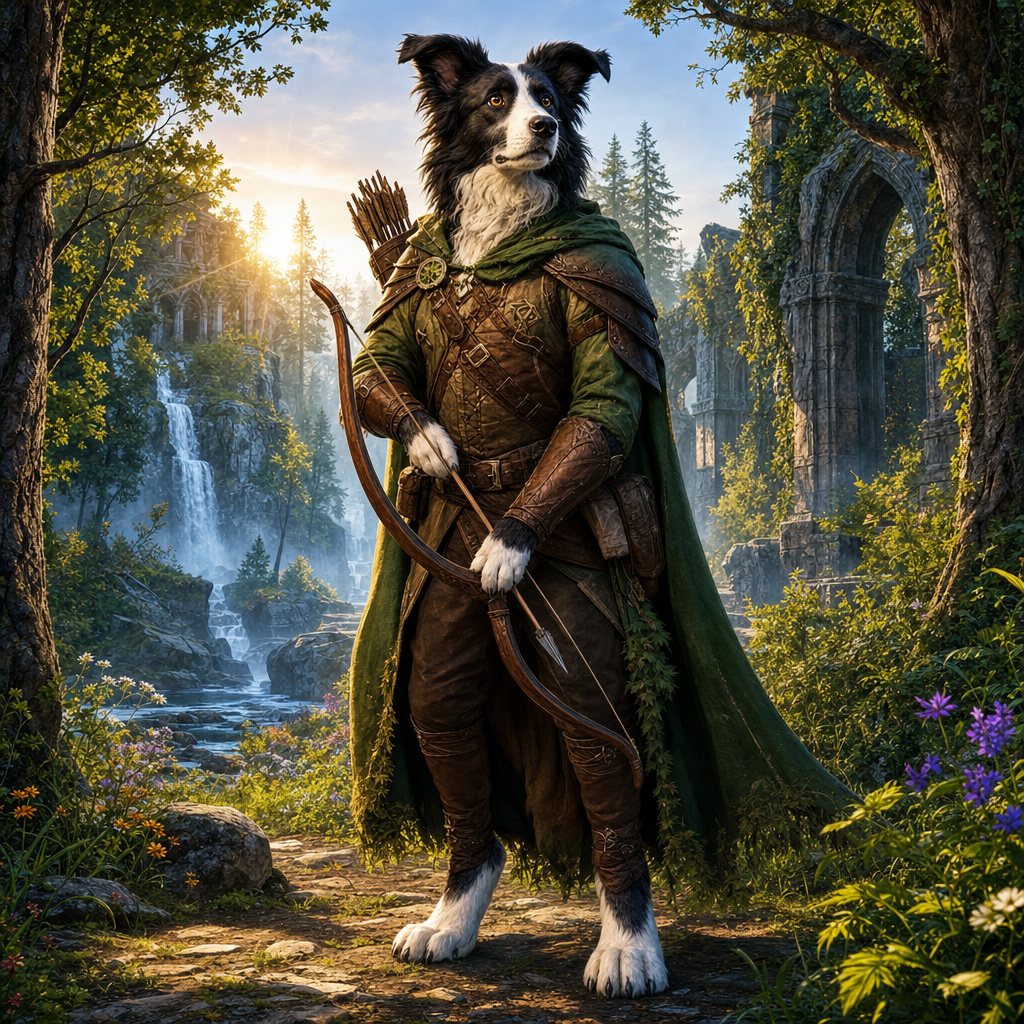
The first time I built an animal race character, I uploaded a photo of my dog Maggie to Creature Forge AI's character generator. I wasn't expecting much — just curious if it could actually capture her. It generated a border collie ranger with her exact coloring: black and white fur, alert brown eyes, even the little white blaze on her muzzle. The stat block gave her +2 Constitution and +1 Wisdom, proficiency in Survival and Perception, and a trait called "Herding Instinct" that let her use a bonus action to reposition an ally within 10 feet.
I ran her through a solo campaign — a lone ranger tracking goblins through the highlands. It shouldn't have worked as well as it did. But every time she rolled Perception to catch a scent on the wind, or used Herding Instinct to pull a wounded NPC out of melee range, it felt right. She wasn't a gimmick. She was Maggie, doing what Maggie does best, just with a longbow and leather armor.
Balancing Animal Races at Your Table
The biggest pitfall with homebrew animal races is making them too strong. Flight at 1st level breaks early-game encounters. Ridiculous speed trivializes dungeon crawls. Here's how to keep things fair:
Compare to Existing Races
Use official races as a benchmark. Your custom canine race shouldn't be stronger than a Variant Human or a Wood Elf. If your traits feel overpowered, add a restriction:
- Flight: Only usable without medium or heavy armor
- High speed: Can't use while wearing heavy armor
- Natural weapons: Don't scale past 1d6 — they're a fallback, not a replacement for real weapons
Session Zero Conversations
Talk to your DM or your players. Some tables embrace the whimsy of a party that's half dogs and half cats. Others want a more serious tone. Make sure everyone's on the same page before you bring your goat paladin to the table.
Tools for Building Animal Race Characters
If you're homebrewing from scratch, you'll need stat blocks, racial traits, and art that sells the concept. I lean on Creature Forge AI for this — especially the photo upload feature. You can snap a picture of your actual pet, feed it into the generator, and get back a full D&D character sheet with traits, backstory, and an illustration that actually looks like them. It's absurdly fun, and it saves hours of homebrewing.
For players who want a more hands-on approach, the Monster Mashup tool is worth exploring. It's a free random generator that fuses real animals into hybrid creature concepts — no AI, just dice-style rolling. If you're stuck on what kind of animal race to build, mash together a "horse" and a "raven" and see what concept emerges. Sometimes the best ideas come from happy accidents.
Campaign Ideas for Animal Race Parties
Once you've built your animal race, where do you take them? Here are a few hooks:
The All-Pet Party
Every player brings an animal race based on their real pet. You're a band of awakened animals trying to find your way home after being separated from your humans during a planar event. It's equal parts heartfelt and hilarious.
The Wildlands Rebellion
Animals have gained sapience and formed their own civilization in the deep forest. Your party is the first generation to venture into human cities, seeking trade, alliances, or answers about the magic that changed you.
The Druid's Last Wish
A dying archdruid used their final spell to awaken a group of animals and give them a quest: stop the force that's poisoning the land. You're farmers, hunters, and companions who suddenly have agency — and the weight of the world on your shoulders.
Common Questions
Can animal races multiclass?
Absolutely. There's no reason a raven can't be a wizard, or a dog can't be a barbarian. In fact, unexpected class choices make animal race characters even more memorable.
Do they speak Common?
In most homebrew settings, yes — animal races are sapient and can communicate like any other player character. You can add a "Beast Speech" trait that lets them talk to non-awakened animals of their type, which is both mechanically useful and thematically satisfying.
What if my DM says no?
Respect the table's tone. If your DM wants a gritty, low-magic campaign, a talking corgi might not fit. But if they're open to homebrew, offer to work with them on balance. Most DMs appreciate a player who brings ideas and flexibility.
Why This Matters
D&D is at its best when it lets you tell stories that matter to you. For me, that's often the animals I grew up with — creatures with distinct personalities, quirks, and a kind of loyalty you don't find anywhere else. Turning them into playable characters isn't just a mechanical exercise. It's a way to honor them, to imagine them as heroes, to let them live in a world where their courage actually changes things.
Your cat who sits on your keyboard? That's a rogue with expertise in Stealth. Your dog who howls at every passing car? That's a bard with Vicious Mockery. The goat who once headbutted a fence down? That's a barbarian with a grudge.
If you've ever looked at your pet and thought, "You'd be unstoppable in a fantasy world," this is your permission to make it happen. Build the stat block. Roll the dice. Let your animal race character surprise you.
And if you need a head start, try Creature Forge AI. Upload a photo. See your pet as a hero. It's worth it just to see their face rendered in fantasy armor, standing upright, ready for adventure. Because if D&D is about anything, it's about taking the things we love and imagining them larger, braver, and absolutely legendary.