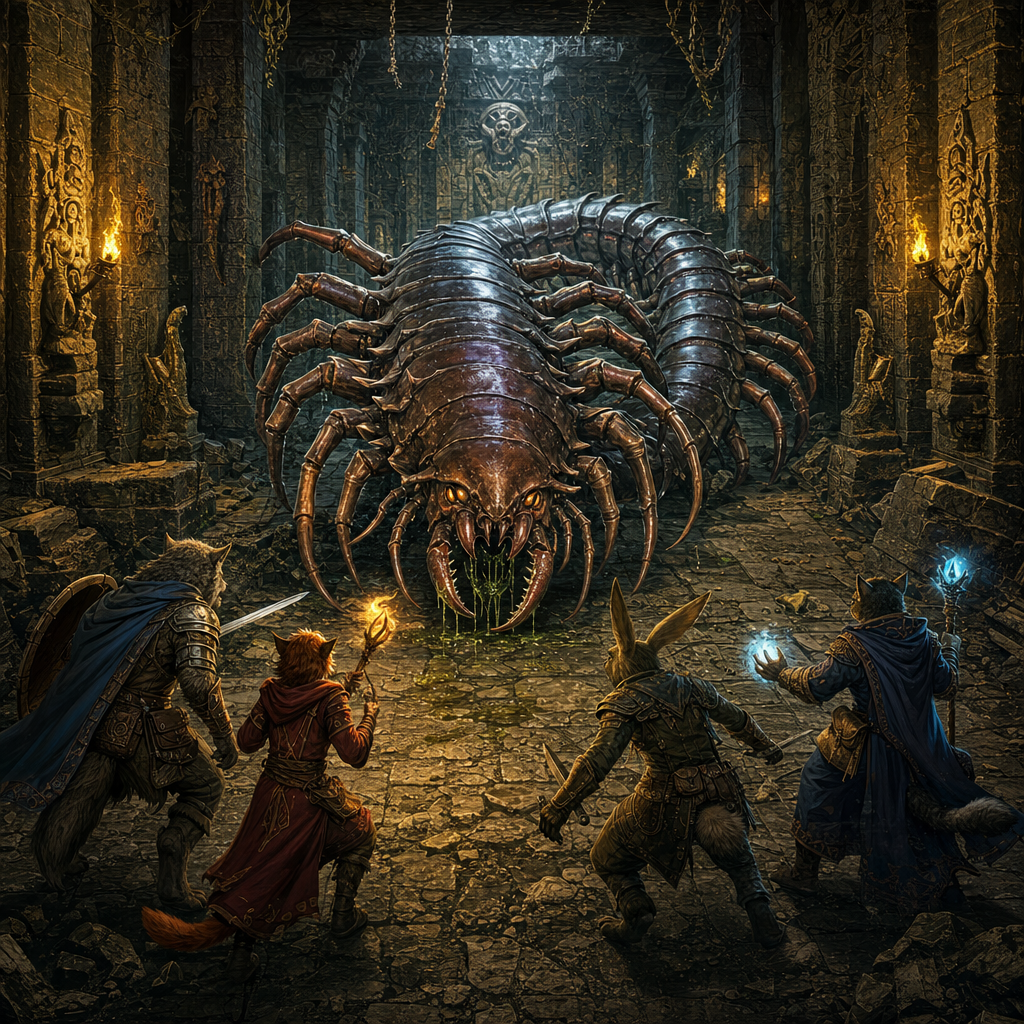
I learned to respect insects young. Not the Disney kind—the real ones. The kind that built nests in our barn rafters and turned a peaceful afternoon into a sprinting evacuation when you got too close. Hornets don't negotiate. They don't monologue. They just swarm, and suddenly you're reconsidering every life choice that brought you near their territory.
The 5e giant insect works the same way in D&D, except now they're horse-sized and your character can't just run inside and slam the door. These creatures occupy a weird space in the Monster Manual—not quite iconic enough to headline adventures, but absolutely capable of turning a routine forest trek into a desperate scramble for survival.
What Makes Giant Insects Different
Giant insects aren't dragons. They're not calculating. They don't hoard gold or hold grudges. What makes them terrifying is their wrongness—that uncanny valley where something familiar becomes monstrous when you scale it up.
A regular ant on your kitchen counter? Annoying. A giant ant with mandibles that can shear through leather armor? That's the stuff of nightmares.
In 5e, giant insects typically share these traits:
- Simple but deadly: Low Intelligence, straightforward tactics, but enough HP and damage output to threaten low-to-mid level parties
- Environmental storytelling: Their presence explains things—why is this forest abandoned? Why won't locals travel this road?
- Swarm potential: Even when the stat block is singular, insects feel wrong alone. The threat of more creates tension
- Alien biology: Poison, webs, paralysis—these creatures don't fight fair because they're not built like mammals
Core 5e Giant Insect Stat Blocks
The Monster Manual gives us several baseline giant insects, each with distinct tactical applications.
Giant Centipede (CR 1/4)
The classic low-level terror. 4 HP, but that bite carries poison (3d6 damage, DC 11 CON save). They're ambush predators—think tight tunnels, dark corners, surprise attacks that can drop a wizard before anyone realizes combat started.
I ran a solo campaign where my ranger was tracking a missing child through cave systems. Three giant centipedes, lurking on the ceiling. That first surprise round? Absolute panic. The poison turned a simple rescue into a race against time as I burned through healing potions.
Giant Spider (CR 1)
Web-walking, web-shooting ambush hunters with a bite that can paralyze (DC 11 CON save). At 26 HP with 14 AC, they're tougher than centipedes and tactically flexible. They don't rush in—they trap, bite, retreat into darkness.
Giant Wasp (CR 1/2)
Flying speed 50 feet. Sting attack with poison damage. These are pursuit predators. Unlike spiders that set traps, wasps chase. They turn forest encounters into running battles where the terrain matters more than the creature's stat block.
Giant Scorpion (CR 3)
Now we're talking mid-level threats. 52 HP, 15 AC, multiattack (two claws, one sting). The sting delivers 4d10 poison damage on a failed DC 12 CON save. These are dungeon bosses for levels 3-5, especially in desert or underground settings.
Running Giant Insects That Feel Real
Here's what I've learned from both barnyard hornets and tabletop centipedes: insects don't behave like wolves or goblins. They're not pack hunters with social structures. They're programmed responses to stimuli.
Trigger-Based Behavior
Insects react. Someone steps on webbing? Spider investigates. Party camps near a giant ant colony entrance? Ants emerge at dusk, following pheromone trails toward food smells. Bright torch light in a cave? Centipedes retreat to darkness.
This isn't tactical genius—it's instinct. And somehow that makes it scarier. You can't intimidate a giant wasp. You can't reason with mandibles.
Sound Design
Describe the noise. Chittering. The scrape of chitin on stone. The wet sound of mandibles working. I keep a folder of cricket and cicada recordings that I play at low volume during giant insect encounters. It's amazing how much tension comes from that background drone.
Environmental Clues
Giant insects leave evidence:
- Webbing (thick as rope, sticky, everywhere)
- Shed exoskeletons (hollow, brittle, unsettling)
- Drag marks where prey was hauled away
- That smell—earthy, sharp, wrong
- Silence (no birds, no small mammals, nothing)
Let players know something's wrong before initiative. The best giant insect encounters start with dread, not surprise.
Creative Applications Beyond Random Encounters
Where giant insects really shine is when you use them as more than combat obstacles.
Living Dungeon Hazards
Ancient ruins overrun by giant ants. The ants aren't the villains—they're just there, repurposed the space, built their colony in what used to be a wizard's tower. Now navigating the dungeon means understanding their territory, avoiding queens' chambers, timing patrols.
Forced Choices
The village needs medicine from cave moss, but giant spiders nest there. Do you fight through? Sneak past? Negotiate with the druid who maybe could calm them? Insects create scenarios where combat isn't automatically the best option.
Ecological Storytelling
What made them giant? Magical pollution? Ancient druidic experiments gone wrong? A dying god's influence? The 5e giant insect becomes a clue, evidence of something larger wrong with the world.
Scaling Difficulty: When Giants Aren't Giant Enough
Standard giant insects work for levels 1-5, but what about higher-tier play?
Elite Variants
Add templates:
- Dire: Double HP, increase damage dice by one step, add +2 to attack and damage
- Blighted: Necrotic damage instead of poison, undead immunities, created by necromantic corruption
- Fey-Touched: Spell-like abilities (invisibility 1/day, suggestion at will), alien intelligence
Legendary Insects
Give the queen legendary actions. Summon swarms as a lair action. Suddenly that giant ant colony becomes a set-piece encounter worthy of level 10 parties.
Tools for Building Your Own
Sometimes the Monster Manual insects don't quite fit your vision. Maybe you need a giant stag beetle with defensive charges, or a massive dragonfly with aerial superiority.
This is where I shamelessly plug what I actually use: I'll grab a photo—sometimes my old farm Polaroids, sometimes just an interesting bug from online—and run it through Creature Forge AI's monster generator. Upload a picture of a beetle, get a stat block and art that actually captures that specific creature's vibe. It's faster than homebrewing from scratch and gives you something visually consistent.
The real magic is how it handles scaling. Need that beetle at CR 2? CR 5? CR 8? Adjust one slider and the stats recalculate, keeping the core identity intact.
Giant Insects in Different Settings
Urban Encounters
Sewers. Always sewers. But also: granaries infested with giant weevils, dockside warehouses where giant roaches have nested in imported cargo, noble gardens gone wrong when someone's exotic collection escaped.
Desert Campaigns
Giant scorpions, giant ants building mound-cities visible from miles away, buried beetle larvae waiting in sand to ambush travelers. The desert is alive with chitin.
Underdark Expeditions
This is where giant insects thrive. Darkvision, tremorsense, adapted to tight spaces. The Underdark isn't ruled by drow—it's ruled by things with too many legs that were here first.
Common Mistakes to Avoid
Don't make giant insects smart. Intelligence 1 means they're sophisticated hunting machines, not tacticians. They don't retreat strategically—they retreat instinctively when hurt.
Don't make every encounter a fight. Sometimes the giant spiders let you pass because you're not prey-sized. Sometimes the giant ants ignore you entirely because you're not threatening the queen.
Don't forget terrain. Insects are terrain. Webs as difficult terrain, centipedes emerging from walls, wasps attacking from three dimensions. If your giant insect fight feels like fighting bandits with different stat blocks, you're doing it wrong.
Final Thoughts from the Solo Table
The 5e giant insect will never be as iconic as a beholder or as tragic as a lich. But used right—with attention to their alien nature, their environmental impact, their pure instinctive drive—they create moments of genuine horror and tension that more "intelligent" monsters can't match.
There's something primal about facing down a creature that doesn't hate you, doesn't want your gold, isn't part of some conspiracy. It just is, and you're in its space, and now those mandibles are moving your direction.
That childhood terror of the hornet's nest? That's what you want at your table. That's what giant insects can give you.
Whether you're running pre-written stat blocks or building your own chittering nightmares, make them insect first, giant second. Let them be alien. Let them be wrong. Let them scuttle and scrape and make your players remember why humans invented fire and big sticks in the first place.
And if you need help bringing your specific vision to life—whether that's a unique variant or just perfect art to show your players—Creature Forge AI has your back. Because sometimes the monster in your head deserves to exist on the page exactly as you imagined it.
Now if you'll excuse me, I have a solo session waiting. Giant cave crickets. It's going to be a long night.